

RV solar power has become an increasingly popular option for campers who want more freedom from electrical hookups. Whether you enjoy weekend trips, extended road travel, or boondocking in remote locations, a properly designed solar and battery system can help you operate essential RV equipment without relying entirely on campground power or a generator.
- What Is an RV Solar Power System?
- How Does RV Solar Power Work?
- The Main Components of an RV Solar System
- 1. Solar Panels
- 2. Solar Charge Controller
- 3. RV House Batteries
- 4. Inverter
- 5. Wiring and Protection Equipment
- How Much Solar Power Does an RV Need?
- Understanding Battery Capacity
- How Many Solar Panels Are Needed?
- Can RV Solar Power Run an Air Conditioner?
- Solar Power Does Not Eliminate the Need for Other Charging Sources
- Common RV Solar Mistakes to Avoid
- Buying panels before calculating energy needs
- Ignoring battery capacity
- Choosing an inverter that is too small
- Forgetting inverter losses
- Installing undersized wiring
- Overlooking roof shade
- Mixing incompatible batteries
- Assuming solar works the same in every season
- Is RV Solar Power Worth It?
- Questions to Ask Before Buying an RV Solar System
- Final Thoughts
However, installing solar panels on an RV is not as simple as placing a few panels on the roof. Solar panels, batteries, charge controllers, inverters, wiring, and other components must work together as one system.
This guide explains how RV solar power works, what the main components do, how to estimate your energy needs, and what to consider before investing in a system.
What Is an RV Solar Power System?
An RV solar power system uses photovoltaic panels to convert sunlight into electrical energy. That energy is then regulated and stored in batteries so it can be used when needed.
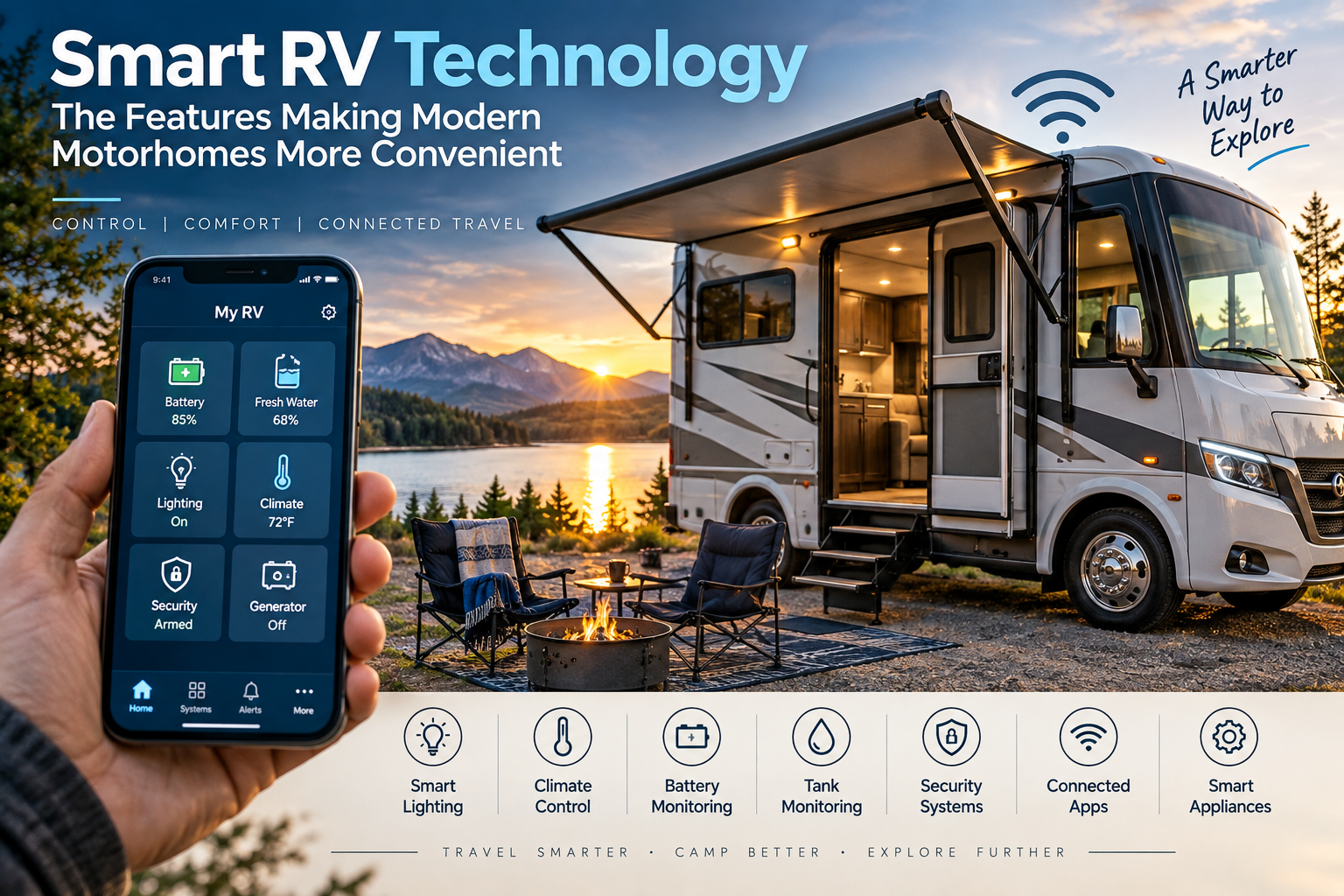
A typical RV solar setup includes:
- Solar panels
- A solar charge controller
- One or more house batteries
- An inverter, if you want to operate compatible AC appliances
- Cables, fuses, disconnects, and other protection equipment
- A monitoring system or battery monitor
The basic process is:
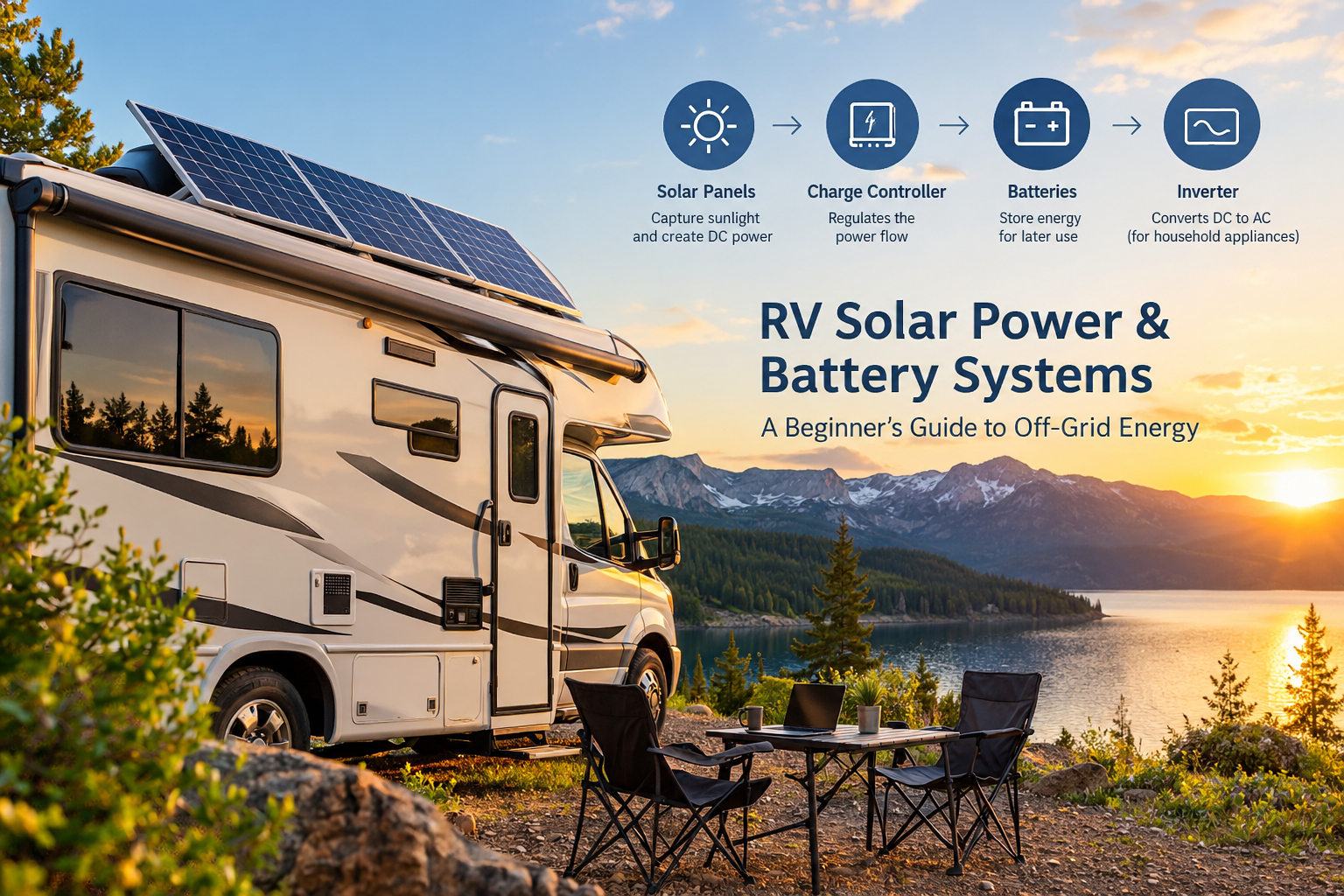
Solar panels collect energy → the charge controller regulates it → the batteries store it → the RV uses the stored energy.
Solar panels do not usually power every RV appliance directly. Instead, they help recharge the battery bank, while the batteries supply power to the RV’s electrical loads. <Cite refs={[“turn0search6″,”turn0search7”]} />
How Does RV Solar Power Work?
Most RVs use a combination of 12-volt DC electricity and 120-volt AC electricity.
12-volt DC power
The RV’s battery bank generally supplies DC power to equipment such as:
- Interior lights
- Water pumps
- Vent fans
- USB charging ports
- Certain refrigerators
- Control boards
- Electric steps
- Some slide-out and leveling systems
These devices can often operate directly from the battery system, depending on the RV’s design.
120-volt AC power
AC power is used by many household-style appliances, including:
- Standard wall outlets
- Televisions
- Microwaves
- Coffee makers
- Induction cooktops
- Hair dryers
- Some air-conditioning systems
To operate AC appliances from batteries, an RV generally needs an inverter. An inverter converts the battery’s DC electricity into AC electricity that compatible appliances can use.
An inverter does not create additional energy. It only changes the form of the electricity, and the conversion process also consumes some power.
The Main Components of an RV Solar System
1. Solar Panels
Solar panels collect sunlight and convert it into DC electricity.
RV solar panels are commonly available in two broad forms:
Rigid solar panels
Rigid panels are usually mounted above the RV roof using brackets or other mounting hardware.
Potential advantages include:
- Stronger physical construction
- Better airflow beneath the panel
- Long-term durability
- Good suitability for permanent installations
However, rigid panels can add height and may require more involved mounting work.
Flexible solar panels
Flexible panels are thinner and lighter than many rigid alternatives. They can be useful where roof weight, clearance, or curved surfaces are important considerations.
Potential disadvantages may include:
- Greater sensitivity to installation conditions
- More difficulty replacing or repairing individual panels
- Potentially shorter service life in some applications
- Reduced airflow when mounted directly against a roof surface
The best option depends on the RV roof, available space, weight limits, budget, and whether the system is intended to be permanent or portable.
2. Solar Charge Controller
The solar charge controller sits between the solar panels and the battery bank. Its job is to regulate the electricity coming from the panels and deliver it to the batteries in a suitable manner.
Two common types are:
PWM charge controllers
PWM stands for pulse-width modulation.
PWM controllers are generally simpler and less expensive. They may be suitable for smaller or basic systems where the panel and battery voltages are closely matched.
MPPT charge controllers
MPPT stands for maximum power point tracking.
MPPT controllers can extract energy from solar panels more efficiently under many operating conditions. They are often preferred for larger systems, higher-capacity installations, or setups where panel voltage differs significantly from battery voltage.
An MPPT controller can be more expensive than a basic PWM controller, but the additional cost may be justified when available roof space is limited or energy production is important.
3. RV House Batteries
The battery bank stores energy collected from the solar panels and other charging sources.
Common battery choices include:
- Flooded lead-acid batteries
- AGM batteries
- Lithium iron phosphate batteries, often called LiFePO4
Flooded lead-acid batteries
Flooded batteries are a traditional option and are often less expensive at the time of purchase.
However, they may require:
- Regular maintenance
- Appropriate ventilation
- Careful charging
- Protection against excessive discharge
AGM batteries
AGM stands for absorbed glass mat.
AGM batteries are sealed and generally require less routine maintenance than flooded batteries. They can be a practical upgrade for some RV owners, although they still have limitations regarding usable capacity, weight, charging, and discharge depth.
Lithium batteries
Lithium iron phosphate batteries are increasingly common in modern RV electrical systems.
Potential advantages include:
- Lower weight for comparable usable capacity
- Greater usable energy in many applications
- More consistent voltage during discharge
- High cycle-life potential when properly used
- Faster charging under suitable conditions
They can also cost more initially and may require compatible charging equipment, battery-management systems, and attention to temperature limitations.
The cheapest battery is not always the least expensive option over the entire period of ownership. Buyers should consider usable capacity, expected service life, installation requirements, and replacement costs.
4. Inverter
An inverter converts battery power from DC into AC power.
There are two main categories worth understanding:
- Modified sine-wave inverters
- Pure sine-wave inverters
A pure sine-wave inverter generally provides AC power that is more closely comparable to conventional utility power and is often the safer choice for sensitive electronics and certain appliances.
The inverter must be sized according to:
- The appliances you want to operate
- Their running wattage
- Their starting or surge requirements
- How long you expect to use them
- The battery bank’s ability to supply the necessary current
A large inverter does not automatically mean the RV has enough battery capacity to run large appliances for long periods.
5. Wiring and Protection Equipment
A safe solar installation requires more than panels and batteries.
Important components may include:
- Properly sized cables
- DC-rated fuses
- Circuit breakers
- Disconnect switches
- Busbars
- Cable lugs
- Roof cable-entry hardware
- Battery isolation equipment
- Appropriate grounding and bonding arrangements
Incorrect cable sizing can create voltage drop, heat, and energy losses. Inadequate protection can increase the risk of equipment damage or electrical fires.
RV electrical systems may contain both low-voltage DC circuits and potentially dangerous AC circuits. Installation or modification work should be performed by a qualified professional when the owner is not experienced with RV electrical systems. <Cite refs={[“turn0search1″,”turn0search9”]} />
How Much Solar Power Does an RV Need?
There is no single solar-system size that works for every RV. The correct setup depends on how much electricity you use and how long you want to remain away from hookups.
Start by estimating your daily energy consumption.
The basic formula is:
Energy used = Power × Time
For example, if a device uses 60 watts and operates for three hours:
60 watts × 3 hours = 180 watt-hours
Watt-hours, written as Wh, measure energy consumption.
Here is a simplified example:
| Device | Estimated power use | Daily use | Daily energy |
|---|---|---|---|
| Laptop charger | 60 W | 3 hours | 180 Wh |
| Refrigerator | — | — | 500 Wh |
| LED lighting | 10 W | 4 hours | 40 Wh |
| Total | 720 Wh |
This is only an illustrative example. Actual refrigerator consumption, inverter losses, weather, user behavior, and appliance efficiency can change the result.
A system using approximately 720 watt-hours per day would need to produce at least that much usable energy on an average day to replace its consumption. In practice, additional capacity is often necessary because solar production changes with weather, shade, panel orientation, season, and system losses. <Cite ref=”turn0search1″ />
Understanding Battery Capacity
RV batteries are often described in amp-hours, or Ah.
To estimate energy capacity, you can use:
Watt-hours = Volts × Amp-hours
For example:
12 volts × 100 Ah = 1,200 watt-hours
That figure represents nominal energy capacity, not necessarily the amount of energy that can be used in normal operation.
The usable amount depends on factors such as:
- Battery chemistry
- Recommended depth of discharge
- Temperature
- Battery age
- Discharge rate
- System efficiency
- Battery-management settings
Lead-acid batteries are commonly operated with a more limited usable depth of discharge than lithium batteries. The exact limits should be based on the battery manufacturer’s specifications rather than a universal assumption.
Example: Three days of energy storage
Suppose an RV uses approximately 720 Wh per day.
For three days:
720 Wh × 3 = 2,160 Wh
At a nominal 12-volt system voltage:
2,160 Wh ÷ 12 V = 180 Ah
This is a simplified calculation. The final battery-bank size must also account for usable capacity, inverter losses, temperature, reserve capacity, and the battery manufacturer’s recommendations.
How Many Solar Panels Are Needed?
Solar-panel output is usually listed in watts. A 200-watt panel does not produce 200 watts continuously throughout the day. Its actual output depends on sunlight and operating conditions.
Important factors include:
- Peak sunlight hours
- Cloud cover
- Shade
- Panel temperature
- Dirt and debris
- Roof orientation
- Panel tilt
- Wiring losses
- Charge-controller efficiency
- Seasonal changes
A rough starting point is:
Required solar watts = Daily energy consumption ÷ Effective peak-sun hours
For example, if an RV needs 720 Wh per day and receives an estimated five effective peak-sun hours:
720 Wh ÷ 5 hours = 144 watts
That result is only a theoretical minimum under the assumptions used. A real RV system would usually need additional capacity to compensate for imperfect conditions and to recharge the battery bank efficiently.
For an RV that spends several days in one location, a larger solar array may be necessary because the system must both operate daily loads and replenish energy used from the batteries. <Cite ref=”turn0search1″ />
Can RV Solar Power Run an Air Conditioner?
This is one of the most common questions among RV owners.
The answer is: sometimes, but it depends heavily on the system.
Air conditioners generally require much more power than lights, fans, phones, or small electronics. Operating an air conditioner from batteries may require:
- A large battery bank
- A suitably sized inverter
- Sufficient solar capacity
- Proper wiring and protection
- Careful energy management
- Suitable battery discharge capability
Even when an inverter can start an air conditioner, the batteries may not be able to operate it for very long.
Solar panels also produce energy only when sufficient sunlight is available. Running an air conditioner during hot weather may coincide with strong sunlight, but shade, clouds, roof space, battery capacity, and appliance demand can still limit performance.
For many RV owners, solar power is more practical for essential DC loads and moderate AC loads, while shore power or a generator remains useful for high-demand appliances.
Solar Power Does Not Eliminate the Need for Other Charging Sources
A well-designed RV electrical system may use several charging sources, including:
- Solar panels
- Shore power
- The vehicle alternator
- A generator
- A dedicated battery charger
- An inverter/charger
Solar is valuable because it can replenish batteries without a campground electrical connection. However, shore power and other charging sources can provide useful backup, particularly during extended cloudy weather or when high-power appliances are needed.
An inverter/charger may combine several functions, including converting battery DC power into AC power, charging batteries from shore power, and switching between available power sources. <Cite refs={[“turn0search0″,”turn0search5”]} />
Common RV Solar Mistakes to Avoid
Buying panels before calculating energy needs
More panel wattage does not automatically solve every power problem. The battery bank, charge controller, inverter, wiring, and daily usage must all be considered together.
Ignoring battery capacity
A large solar array cannot store unlimited energy. If the battery bank is too small, excess solar production may not be useful once the batteries are full.
Choosing an inverter that is too small
An inverter must handle both the normal operating load and, where applicable, the starting surge of appliances.
Forgetting inverter losses
When DC battery power is converted into AC electricity, some energy is lost. High-power AC appliances can therefore consume considerably more battery energy than their outlet wattage alone may suggest.
Installing undersized wiring
Long cable runs and high currents make proper cable sizing especially important. Poorly sized wiring can cause voltage drop and excessive heat.
Overlooking roof shade
A small amount of shade can affect solar production, depending on the panel design and how the panels are wired.
Mixing incompatible batteries
Batteries should not be combined casually. Differences in chemistry, age, capacity, voltage, charging requirements, and condition can create performance and safety problems.
Assuming solar works the same in every season
Solar production varies by location, weather, season, and travel style. A system that performs well during a sunny summer trip may produce much less energy during cloudy winter conditions.
Is RV Solar Power Worth It?
RV solar power can be a worthwhile investment if you regularly:
- Camp without electrical hookups
- Boondock on public land or remote sites
- Want to reduce generator use
- Need to maintain batteries during storage
- Travel to places with limited campground infrastructure
- Prefer quieter and more independent camping
It may be less valuable if you almost always stay at full-hookup campgrounds and rarely use battery power.
The best system is not necessarily the largest or most expensive one. It is the system that matches your actual energy needs, travel habits, roof space, budget, and willingness to manage electricity use.
Questions to Ask Before Buying an RV Solar System
Before purchasing equipment, consider the following:
- How much electricity does my RV use each day?
- Which appliances must operate when I am off-grid?
- How many days do I want to camp without hookups?
- Do I need to run AC appliances from an inverter?
- How much roof space is available?
- Will roof-mounted panels experience shade?
- What battery chemistry best suits my budget and usage?
- Can the existing RV wiring support the planned system?
- Will the system work with my converter, alternator charger, and shore-power setup?
- Do I need professional installation?
- Is there enough payload capacity for the additional equipment?
- What monitoring system will help me track energy use and battery condition?
Final Thoughts
An RV solar system can improve travel flexibility, reduce generator dependence, and make off-grid camping more comfortable. But solar panels are only one part of the equation.
A reliable setup depends on the relationship between:
- Energy consumption
- Solar production
- Battery storage
- Charging equipment
- Inverter capacity
- Wiring and protection
- Weather and travel conditions
Before buying a kit, calculate your daily energy needs and decide which appliances you genuinely need to operate away from hookups. Then select the solar array, battery bank, charge controller, inverter, and protection equipment as one coordinated system.
For complex installations, professional advice is worthwhile. A properly sized and safely installed system can provide years of useful service, while an oversized or poorly matched system may add cost without delivering the independence you expected.