
Modern recreational vehicles are becoming more than simple homes on wheels. Many newer RVs now include smart technology designed to make travel more comfortable, improve energy management, simplify maintenance, and give owners better control over important systems.
- What Is Smart RV Technology?
- 1. Central RV Control Panels
- 2. Smartphone-Controlled RV Systems
- 3. Smart Lighting
- 4. Smart Climate Control
- 5. Smart Battery and Energy Monitoring
- 6. Smart Water and Tank Monitoring
- 7. Smart Security and Access Systems
- 8. Smart Appliances
- 9. Connected Safety and Monitoring Features
- 10. RV Connectivity and Cloud-Based Systems
- Advantages of Smart RV Technology
- Greater convenience
- Better energy awareness
- Easier troubleshooting
- Improved comfort
- More informed maintenance
- Better access to information
- Potential Disadvantages
- Higher purchase price
- More complexity
- Dependence on connectivity
- Subscription costs
- Software problems
- Privacy concerns
- Difficult repairs
- What Buyers Should Look for
- How to Avoid Paying for Unnecessary Features
- Final Thoughts
From smartphone-controlled lighting to real-time battery monitoring, smart RV technology can reduce everyday inconvenience and help owners understand what is happening inside their vehicles. However, not every connected feature is essential, and some systems may add cost, complexity, or maintenance requirements.
This guide explains the most useful smart RV technologies, how they work, and what buyers should consider before choosing a connected motorhome or travel trailer.
What Is Smart RV Technology?
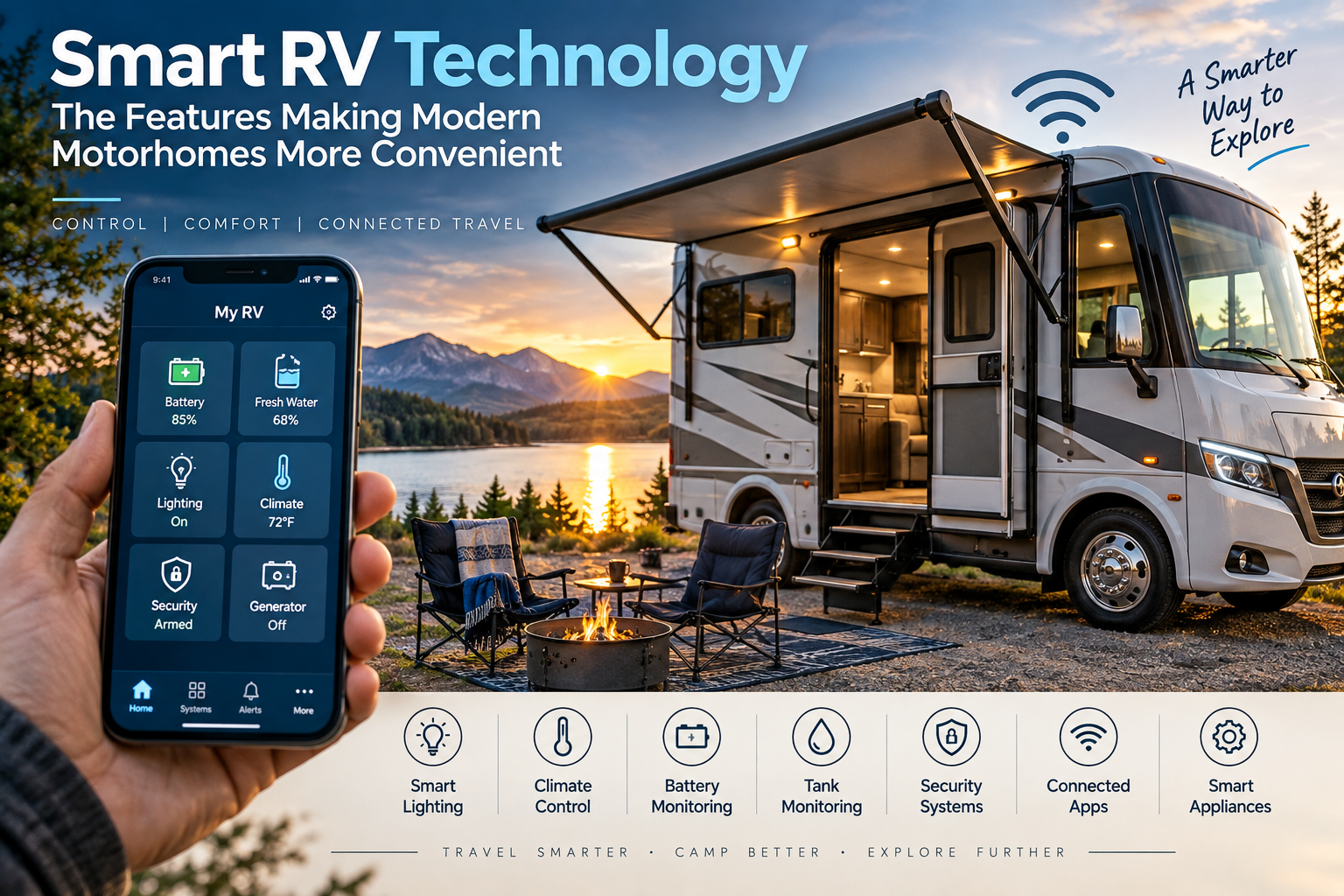
Smart RV technology refers to connected electrical, safety, comfort, and monitoring systems that allow owners to control or check RV functions more easily.
Depending on the RV and manufacturer, smart features may be operated through:
- A central touchscreen
- A smartphone app
- A remote-control device
- A digital dashboard
- Voice commands
- Automated sensors
- A connected internet system
A smart RV system may allow an owner to monitor battery levels, adjust the interior temperature, check holding-tank levels, control lighting, or receive alerts about potential problems.
The exact features vary significantly between RV brands, models, trim levels, and aftermarket systems.
1. Central RV Control Panels
One of the most common smart RV features is a centralized control panel.
Traditional RVs may use separate switches and gauges for:
- Interior lighting
- Water pumps
- Tank heaters
- Water heaters
- Slide-outs
- Awnings
- Generator functions
- Battery monitoring
- Climate control
A central control panel brings some of these functions together in one location.
Potential benefits
A central control panel can:
- Reduce the number of separate switches
- Make important information easier to view
- Simplify operation for new RV owners
- Display battery and tank information
- Provide access to multiple systems from one screen
Some systems also allow remote control through a mobile application.
What to check
Before buying an RV with a central control panel, find out:
- Which systems are actually connected
- Whether the panel works without internet access
- Whether manual controls are still available
- What happens if the screen fails
- Whether software updates are required
- Whether replacement parts are readily available
A smart control panel should make the RV easier to operate, not become the only way to use essential functions.
2. Smartphone-Controlled RV Systems
Some RVs use mobile apps to let owners control or monitor systems remotely.
Depending on the setup, an app may provide access to:
- Interior and exterior lights
- Heating and air conditioning
- Battery status
- Freshwater levels
- Gray- and black-water tank levels
- Slide-outs
- Awnings
- Generator information
- Security alerts
- Location information
For example, an owner may be able to check the battery condition before arriving at a stored RV or turn on climate control before entering the vehicle.
Important limitations
Smartphone control depends on the system’s communication method.
Some features work through a short-range connection, such as Bluetooth, while others require cellular service or an internet connection. If the RV is parked in an area with weak coverage, remote access may be limited or unavailable.
Owners should also understand whether the app requires:
- A subscription
- A cellular data plan
- A separate communication module
- A compatible smartphone
- Regular software updates
A system that works well at a campground may not provide the same functionality in a remote location.
3. Smart Lighting
Smart lighting systems allow users to control lights more conveniently and, in some cases, automate them.
Possible features include:
- Dimmable LED lighting
- App-based controls
- Motion-activated lights
- Exterior lighting zones
- Timers
- Bedside controls
- Automatic entry lighting
- Adjustable color temperature
LED lighting already uses relatively little energy compared with older lighting technologies. Smart controls can improve convenience and may help reduce unnecessary energy use, although the energy savings depend on how the system is used.
Useful lighting features for RV owners
Some practical examples include:
- Automatically turning on entry lights at night
- Dimming lights during evening hours
- Controlling exterior lights from inside the RV
- Using motion sensors in storage areas
- Switching off several lighting zones at once
For boondockers, efficient lighting combined with good battery monitoring can help manage daily energy consumption.
4. Smart Climate Control
Temperature management is particularly important in an RV because the interior can heat up or cool down quickly.
Smart climate-control systems may allow owners to:
- Set a target temperature
- Control heating and cooling remotely
- Monitor interior temperature
- Adjust fan settings
- Schedule temperature changes
- Receive high- or low-temperature alerts
Some systems can also monitor more than one temperature zone.
Why climate control matters
Temperature control is not only about comfort. It can also help protect:
- Pets
- Sensitive electronics
- Food
- Plumbing
- Batteries
- Interior materials
However, remote climate control should never be treated as a guarantee of safety. Internet interruptions, power loss, equipment failure, extreme weather, or a tripped circuit can prevent a system from operating.
Owners should have backup plans when temperature-sensitive people, animals, or equipment are involved.
5. Smart Battery and Energy Monitoring
Energy monitoring is one of the most useful smart technologies for RV owners, especially those who camp without electrical hookups.
A monitoring system may display:
- Battery voltage
- Battery state of charge
- Charging current
- Discharge current
- Solar input
- Power consumption
- Estimated remaining capacity
- Shore-power status
- Inverter activity
Basic voltage readings can provide useful information, but voltage alone may not accurately show the remaining capacity of every battery type under every operating condition.
A more advanced battery monitor may measure energy moving into and out of the battery bank to provide a more useful estimate of state of charge.
Why energy monitoring is valuable
Without reliable monitoring, owners may not know how quickly they are using electricity.
A smart energy monitor can help answer questions such as:
- How much power is the refrigerator using?
- Is the solar system producing enough energy?
- How much battery capacity remains?
- Which appliance is consuming the most electricity?
- Is the inverter drawing power when no AC appliance is operating?
- Is the battery charging correctly?
This information can help owners reduce unnecessary generator use and avoid unexpected battery depletion.
6. Smart Water and Tank Monitoring
RV owners often rely on tank gauges to estimate the levels of:
- Freshwater
- Gray water
- Black water
- Propane
- Wastewater
Traditional tank sensors can sometimes provide inaccurate readings because of residue, buildup, sensor placement, or the shape of the tank.
Some newer monitoring systems use alternative sensing methods or more advanced measurement technology to improve the accuracy of tank-level information.
Benefits of smart tank monitoring
A more informative system may:
- Display tank levels digitally
- Provide alerts when a tank is nearly full
- Help prevent wastewater overflow
- Show freshwater availability
- Support better planning during boondocking
- Reduce the need for manual checking
However, no tank-monitoring system should be assumed to be perfectly accurate. Owners should understand how the system measures levels and learn how to recognize unusual readings.
7. Smart Security and Access Systems
Connected security features are becoming more common in recreational vehicles.
Possible systems include:
- Keyless entry
- Digital door locks
- Smartphone-based access
- Motion sensors
- Door and window alerts
- Interior cameras
- Exterior cameras
- GPS tracking
- Alarm notifications
These features may improve convenience and provide additional information when the RV is unattended.
Security considerations
Smart security systems also create new responsibilities.
Owners should review:
- Password security
- App permissions
- Software updates
- Data collection policies
- Camera placement
- Cellular requirements
- Backup access methods
- What happens if the battery is disconnected
A digital lock should have a reliable backup method, such as a physical key or another manufacturer-approved access option.
Owners should also avoid placing cameras where they could violate the privacy of passengers, guests, or neighboring campers.
8. Smart Appliances
Some RV appliances now include digital controls, remote monitoring, or energy-management features.
Examples may include:
- Refrigerators
- Ovens
- Microwaves
- Induction cooktops
- Water heaters
- Washing machines
- Coffee makers
- Air-conditioning systems
Smart appliances may offer:
- Remote status checks
- Temperature monitoring
- Timers
- Fault alerts
- Energy-use information
- Automatic shutoff features
However, smart functionality does not necessarily mean an appliance uses less energy. Efficiency depends on the appliance design, operating conditions, insulation, temperature settings, and user behavior.
When comparing appliances, buyers should evaluate actual power consumption and reliability rather than choosing a product only because it has app connectivity.
9. Connected Safety and Monitoring Features
Smart RV systems may also support safety-related monitoring.
Depending on the vehicle, these systems can include:
- Smoke alarms
- Carbon-monoxide detectors
- Propane-leak detectors
- Tire-pressure monitoring
- Water-leak sensors
- Temperature alerts
- Battery fault warnings
- Door-open notifications
- Fire or heat alerts
These technologies can provide useful warnings, but they should supplement—not replace—regular inspections and basic safety practices.
Owners should regularly check:
- Detector batteries
- Sensor operation
- Fire extinguishers
- Tire condition
- Electrical connections
- Propane equipment
- Emergency exits
- Battery terminals
- Water lines and fittings
A connected alert is useful only if the sensor works, the system has power, and the owner receives and understands the notification.
10. RV Connectivity and Cloud-Based Systems
Many smart RV features depend on some form of connectivity.
Common communication methods include:
- Bluetooth
- Wi-Fi
- Cellular networks
- Local wireless networks
- Manufacturer-specific communication systems
Some systems work locally, while others send information through cloud-based services.
Cloud connectivity can make remote monitoring possible, but it also introduces potential limitations.
Questions to ask
Before purchasing a connected RV system, find out:
- Does it work without cellular service?
- Is a monthly subscription required?
- Does the system use a manufacturer-specific app?
- Can the system be transferred to a second owner?
- How often does the software receive updates?
- Is the system compatible with Android and iOS?
- What happens if the manufacturer stops supporting the app?
- Can the RV still be operated manually?
Long-term software support is an important consideration when purchasing expensive connected equipment.
Advantages of Smart RV Technology
Smart systems can offer several practical benefits.
Greater convenience
Owners may control several systems from one panel or mobile device.
Better energy awareness
Battery and solar monitoring can help users understand their electricity consumption.
Easier troubleshooting
Error messages and system alerts may help identify problems before they become more serious.
Improved comfort
Remote climate control, automated lighting, and smart appliances can make the RV easier to use.
More informed maintenance
Water, battery, temperature, and equipment alerts may help owners notice unusual conditions earlier.
Better access to information
Digital dashboards can bring important information together instead of requiring owners to inspect several separate gauges.
Potential Disadvantages
Smart RV technology is not without drawbacks.
Higher purchase price
Connected systems may increase the initial cost of an RV or require additional aftermarket equipment.
More complexity
More electronic components can mean more potential points of failure.
Dependence on connectivity
Some features may not work properly without cellular or internet service.
Subscription costs
Certain systems may require ongoing payments for cellular access, cloud storage, or advanced features.
Software problems
Apps may experience bugs, compatibility issues, or update-related problems.
Privacy concerns
Connected systems may collect information about location, usage, or device activity.
Difficult repairs
A specialized control module may be harder or more expensive to replace than a conventional switch or gauge.
What Buyers Should Look for
Before purchasing an RV with smart technology, consider the following checklist:
- Which smart features are included as standard equipment?
- Which features require an optional package?
- Can the systems be operated manually?
- Does the system work without internet access?
- Is a cellular subscription required?
- Are software updates provided?
- Is the mobile app reliable and regularly maintained?
- Can the system be repaired by an RV technician?
- Are replacement components available?
- Does the system work with the RV’s existing electrical setup?
- Can the owner transfer the system to a new account?
- What happens if the central screen or control module fails?
- Are important alerts delivered reliably?
- What information does the app collect?
- Is the technology genuinely useful for your travel style?
How to Avoid Paying for Unnecessary Features
Not every RV owner needs every connected feature.
For example:
- A full-time remote worker may value reliable connectivity and energy monitoring.
- A boondocker may prioritize solar, battery, and tank monitoring.
- A family traveler may prefer climate control and security alerts.
- A weekend camper who stays at full-hookup sites may not need extensive remote controls.
- An owner who prefers simple systems may value manual switches and easy repairs more than app-based features.
The best technology is the technology that solves a real problem.
Before paying for a premium technology package, identify the features you will actually use and compare them with simpler alternatives.
Final Thoughts
Smart RV technology can make recreational vehicles more convenient, comfortable, and easier to monitor. Central control panels, smartphone apps, energy monitors, smart lighting, climate systems, tank sensors, and connected safety devices can all provide useful benefits when properly designed and maintained.
However, smart technology should not be judged only by how many features it offers. Buyers should also consider reliability, repairability, connectivity requirements, privacy, subscription costs, and manual backup options.
A well-designed smart RV system should help owners make better decisions and manage their vehicle more easily. It should not make basic RV functions unnecessarily difficult or leave the owner completely dependent on an app.
The most valuable smart RV technology is not always the most advanced. It is the technology that provides meaningful benefits, works reliably, and remains practical throughout the RV’s ownership life.