

Walk into a newer RV today and you may find much more than a refrigerator, air conditioner and television.
- What Makes an RV “Smart”?
- Why does that matter?
- Why this matters to an owner
- Lighting
- Climate
- Slides and Awnings
- Electrical Systems
- Appliances
- RV network
- Wi-Fi
- Cellular internet
- Satellite internet
- 1. What systems are actually connected?
- 2. What can I control from the main display?
- 3. Does it require internet?
- 4. What happens if the app stops working?
- 5. Can the system be serviced easily?
- 6. Can the system be upgraded?
- 7. Can I see the energy information?
Modern RVs increasingly use connected control systems, sensors, mobile apps and automated energy management to monitor and control different parts of the vehicle.
But what actually makes an RV “smart”?
And more importantly, does smart technology make an RV better, or does it simply add more features that can eventually need troubleshooting?
The answer depends on how the systems are designed and how well they work together.
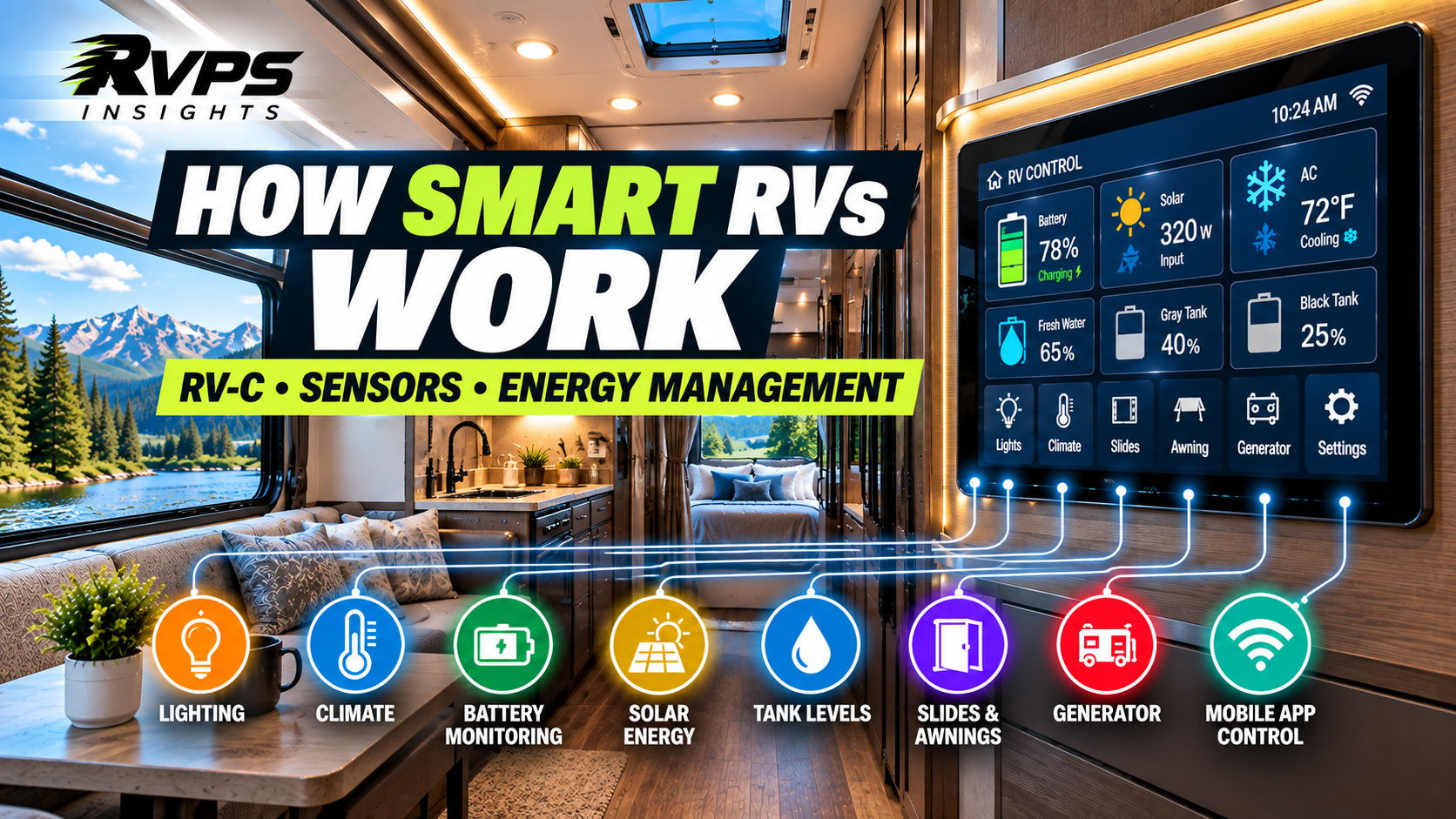
One of the technologies helping make this possible is RV-C, a communication protocol developed for the RV industry. RV-C allows different components to communicate and exchange information instead of operating as completely isolated systems.
For RV buyers, understanding this technology can help you look beyond a manufacturer’s feature list and ask better questions before buying.
What Makes an RV “Smart”?
A smart RV is essentially an RV in which multiple systems can communicate, monitor conditions and respond to commands.
That can include:
- Lighting
- Air conditioning
- Heating
- Battery systems
- Inverters
- Generators
- Water systems
- Tank monitoring
- Slides and awnings
- Security systems
- Appliances
- Climate sensors
- Energy-management systems
- Mobile control applications
The important difference is integration.
A traditional RV may have several independent switches and gauges.
A more connected RV can bring information from several systems into one interface.
For example, instead of checking multiple gauges to understand your electrical situation, a connected system may show battery status, power consumption and charging information through a centralized display.
The RV Industry Association describes smart technology in RVs as including connected devices, intelligent energy management and enhanced security.
What Is RV-C?
RV-C stands for Recreational Vehicle-CAN, and it is a standardized communication protocol used to allow RV components to communicate.
Think of it as a common language.
Imagine that your:
battery → inverter → air conditioner → control panel → energy-management system
all need to exchange information.
Without a common communication system, each component may operate independently.
With RV-C, compatible components can exchange information over the vehicle’s network.
The RV Industry Association says RV-C was created as an open communication protocol based on the CAN bus framework. It can allow devices to share information about areas such as AC and DC power, climate control and chassis systems.
Why does that matter?
Because the real benefit of smart technology isn’t simply being able to control something from your phone.
The bigger benefit is systems working together.
How RV Energy Management Can Become Smarter
Energy is one of the areas where connected technology can make a noticeable difference.
An RV may have several sources and consumers of electricity:
Power sources
- Campground shore power
- Solar panels
- House batteries
- Generator
- Alternator/DC charging
Power consumers
- Air conditioner
- Refrigerator
- Microwave
- Television
- Lights
- Water heater
- Inverter
- Chargers
- Appliances
The challenge is balancing all of them.
Modern energy-management systems can monitor electrical conditions and help manage how power is distributed.
The RV Technical Institute’s electrical training covers systems including inverters, transfer switches, energy-management systems, surge protection, generators, batteries and solar.
Why this matters to an owner
Suppose you’re camping without hookups.
Your battery level is falling.
At the same time, your refrigerator, lights, electronics and other equipment are using power.
A well-designed energy-management system can give you a much clearer picture of what’s happening than a simple battery gauge.
That’s particularly useful for people who spend time:
- Boondocking
- Dry camping
- Working remotely
- Traveling for several days without hookups
- Using solar power
Sensors: The Small Technology That Makes a Big Difference
Smart RVs aren’t just about screens and apps.
Sensors are extremely important.
Depending on the RV, sensors can monitor things such as:
- Temperature
- Battery status
- Water levels
- Tank levels
- Voltage
- Current
- Door status
- Tire pressure
- Interior conditions
- Equipment status
These sensors provide information that can be used by control systems.
For example, a temperature sensor could provide information to a climate-control system.
A battery-monitoring system can provide information about the electrical system.
A tank sensor can tell the owner when a tank needs attention.
This is why a smart RV should be viewed as a network of systems, rather than simply an RV with a touchscreen.
Smart RV Controls: What Can You Actually Control?
The exact features vary considerably between RVs.
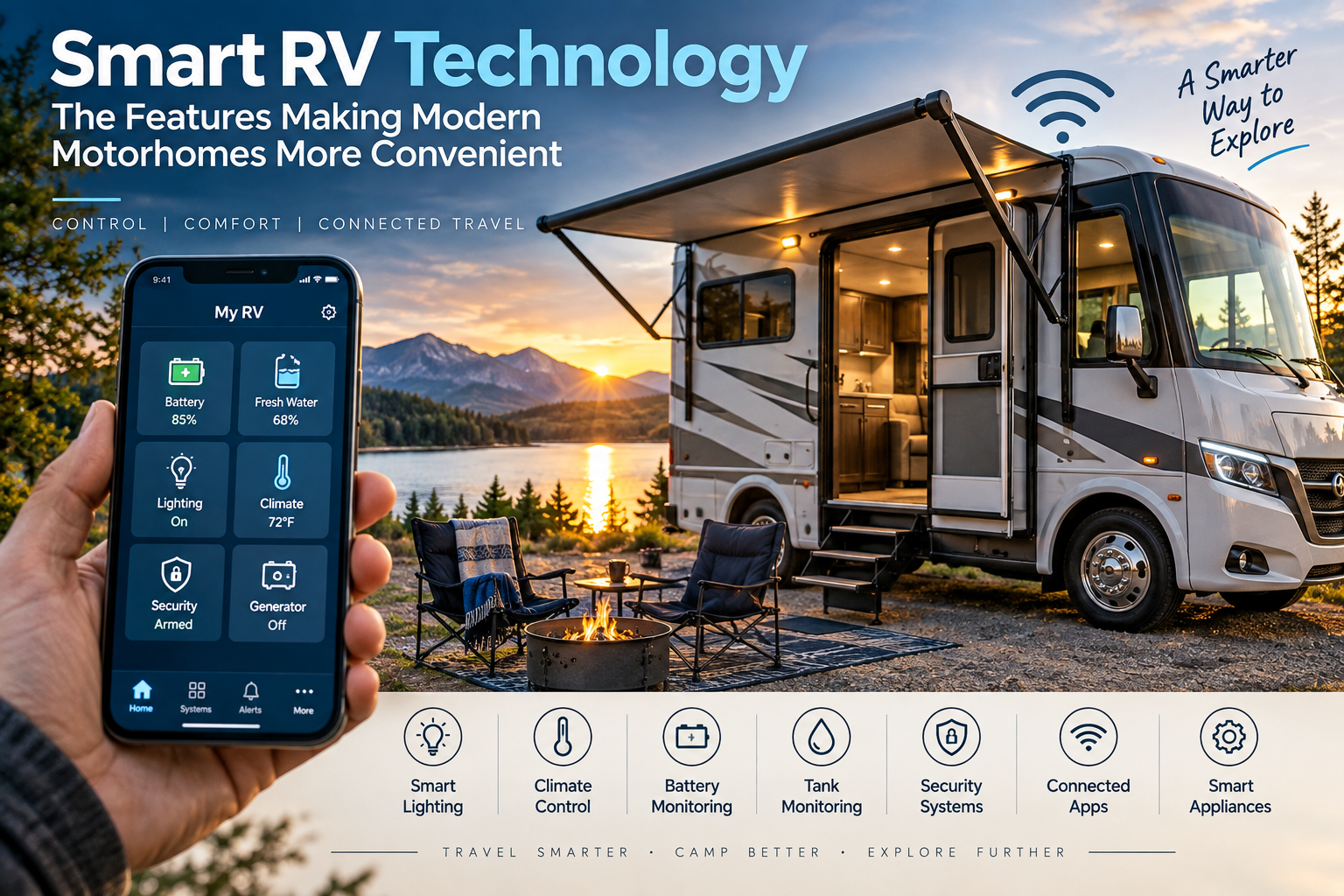
Some connected systems can provide control over areas such as:
Lighting
You may be able to control interior lighting from a central display or mobile application.
Climate
Some systems can monitor and control heating or air conditioning.
Slides and Awnings
Certain connected systems can provide centralized control of selected RV functions.
Electrical Systems
Owners may be able to monitor batteries, shore power, inverter operation and other electrical information.
Appliances
Some newer RV systems can integrate selected appliances into a centralized control environment.
The RV Industry Association has highlighted examples such as Winnebago Connect, Airstream Smart Control and connected products from suppliers such as Lippert.
Does Every Smart RV Need a Smartphone App?
No.
This is an important distinction.
A smartphone app can be convenient, but it shouldn’t be the only way you can operate critical RV functions.
When evaluating an RV, ask:
Can I still operate important systems if my phone isn’t connected?
For essential functions, physical controls or accessible backup controls can be valuable.
Your RV shouldn’t become difficult to operate simply because your phone battery is dead or the internet connection isn’t available.
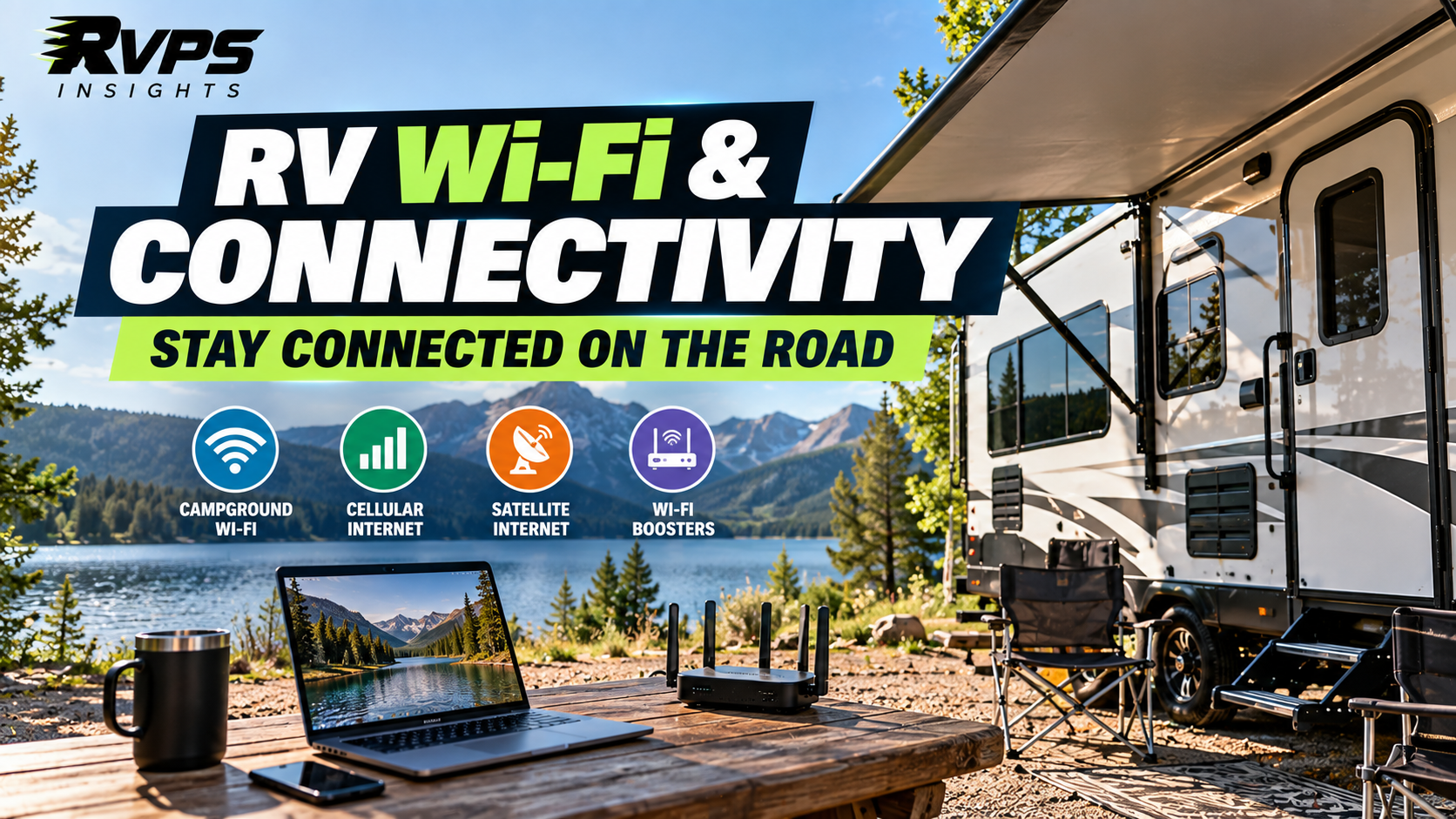
What About RV Wi-Fi?
This is where your previous RV Innovation article on RV Wi-Fi and Connectivity connects nicely.
Wi-Fi and smart-RV technology are related, but they aren’t necessarily the same thing.
A connected RV can have local communication between its components even when there is no internet connection.
That’s an important distinction.
RV network
Allows components inside the RV to communicate.
Wi-Fi
Connects devices locally or to a network.
Cellular internet
Provides internet access through a cellular network.
Satellite internet
Can provide internet connectivity in areas where cellular service may be limited.
So an RV can have sophisticated internal technology without having an internet connection.
That’s an important concept for buyers to understand.
The Biggest Benefit: Knowing What Your RV Is Doing
One of the most useful aspects of smart technology isn’t automation.
It’s visibility.
Instead of wondering:
Why is my battery getting low?
You may be able to see the information directly.
Instead of wondering:
Why isn’t my air conditioner working?
A connected system may provide useful information about the electrical conditions.
Instead of checking multiple locations, a centralized display can potentially put important information in one place.
That can make troubleshooting easier.
But Smart RV Technology Has a Downside
More technology also means more components.
A traditional switch is relatively simple.
A connected system may involve:
sensor → network → controller → software → display/app → device
There are more points where communication can fail.
That’s why buyers shouldn’t automatically assume that more technology equals a better RV.
The real question is:
Does the technology solve a problem that matters to you?
7 Questions to Ask Before Buying a Smart RV
If you’re shopping for a new RV with connected technology, don’t stop at the manufacturer’s feature list.
Ask these questions.
1. What systems are actually connected?
Don’t accept “smart RV” as a complete answer.
Ask which systems communicate with each other.
2. What can I control from the main display?
Find out exactly what the central control panel operates.
3. Does it require internet?
Determine whether the system works locally or requires cellular/Wi-Fi connectivity.
4. What happens if the app stops working?
Ask whether essential functions have manual controls.
5. Can the system be serviced easily?
Find out who supports the system and whether replacement components are readily available.
6. Can the system be upgraded?
Technology changes quickly.
Ask whether the system can receive software updates or accommodate future components.
7. Can I see the energy information?
If you’re interested in boondocking, solar or lithium batteries, ask specifically about battery monitoring and energy management.
Smart RV Technology and Lithium Batteries
Smart technology becomes particularly interesting when combined with modern RV electrical systems.
Lithium batteries are increasingly used in RV applications because of their energy density and other characteristics, and the RV industry has developed standards and safety provisions around their use.
A sophisticated electrical system can combine:
Solar → charge controller → lithium batteries → inverter → appliances
with monitoring and control technology.
That creates something much more useful than simply installing a larger battery.
The owner can potentially understand:
- How much energy is being generated
- How much energy is being consumed
- How much battery capacity remains
- Whether shore power is available
- What major loads are operating
This is where RV Innovation becomes practical technology rather than just a collection of gadgets.
What Should RV Buyers Look For?
If you’re comparing two RVs, don’t simply count the number of smart features.
Instead, look at the quality of integration.
A useful checklist is:
| Feature | What to Look For |
|---|---|
| Central control | Clear and easy-to-use interface |
| Energy monitoring | Battery, voltage and power information |
| RV-C/connected systems | Compatible components communicating together |
| Manual controls | Backup operation for important functions |
| Mobile app | Useful but not essential for basic operation |
| Sensors | Accurate and useful monitoring |
| Serviceability | Easy access to replacement/support |
| Software | Updates and long-term support |
| Electrical system | Compatibility with solar/battery upgrades |
| Documentation | Clear owner’s manuals and system information |
The Future of Smart RVs
The direction of RV technology is increasingly toward connected systems rather than isolated components.
The RV Industry Association’s RV-C program is continuing to evolve, with the current specification and related technical resources available through its RV-C program.
That could eventually mean RV systems becoming better at making decisions based on what’s happening throughout the vehicle.
For example:
Battery level drops → energy management responds → selected loads are adjusted → owner receives an alert.
Or:
Interior temperature changes → climate system responds automatically.
The technology doesn’t have to be flashy to be useful.
The most valuable innovations may be the ones that quietly make an RV easier to operate, more efficient and easier to understand.
Final Takeaway
A smart RV isn’t simply an RV with a touchscreen or smartphone application.
It’s an RV where different systems can communicate, share information and work together.
Technologies such as RV-C, sensors, energy management, battery monitoring and connected controls are helping move RVs in that direction.
For buyers, the important question isn’t:
“How many smart features does this RV have?”
Instead, ask:
“How well do these systems work together, and will they actually make my RV easier to use?”
That’s the difference between buying an RV loaded with technology and buying one with technology that genuinely improves the experience.