

The marina is full of boats that don’t run. Not because the owners were careless people — but because boat engines live in an unforgiving environment that punishes neglect faster than almost any other mechanical system, and the consequences of skipping maintenance show up at the worst possible moments.
- Understanding What Boat Engines Deal With
- The Outboard Engine Maintenance Schedule
- The Sterndrive (I/O) Engine Maintenance Schedule
- Fuel System: The Source of Most Starting Problems
- The Electrical System: The Source of Most Mysteries
- Winterization: The Most Important Service of the Year
- The Honest Bottom Line
Three miles from the dock, on a hot Saturday afternoon, with a boat full of family. That’s when deferred maintenance announces itself. Not during the offseason when it would be convenient. On the water, in the sun, when the day was supposed to be perfect.
An ounce of prevention is worth a pound of cure.
Benjamin Franklin
The good news: boat engine maintenance isn’t complicated. It follows predictable schedules, involves skills any mechanically curious owner can learn, and costs a fraction of what failures cost to repair. This guide covers the complete maintenance picture for outboard and sterndrive engines — the two most common types in recreational boating — so your engine earns its keep rather than becoming the most expensive thing on your maintenance budget.
Understanding What Boat Engines Deal With
Before getting into specific maintenance tasks, it helps to understand why boat engines need more attention than most mechanical systems.
Saltwater and moisture are constant threats. Even freshwater boating exposes engines to humidity, splash, and condensation that accelerates corrosion of electrical connections, fuel components, and metal surfaces. Saltwater boating multiplies every one of those effects significantly.
Engines often run at higher loads than most people realize. Pushing a boat hull through water at 25–35 mph requires sustained high-load engine operation. Unlike a car that spends much of its time at light throttle on highways, a boat engine works hard for extended periods — which accelerates wear on thermostats, impellers, and cooling system components.
Infrequent use creates its own problems. A boat that sits unused for weeks or months develops fuel varnish, stale fuel, corroded electrical contacts, and dried impeller blades that crack when they finally run again. Regular use is actually easier on boat engines than long periods of inactivity.
Winterization is not optional in cold climates. Water trapped in cooling passages freezes, expands, and cracks cast iron or aluminum components with no warning and no repair other than replacement.
The Outboard Engine Maintenance Schedule
Most recreational boats run 4-stroke outboard engines from Mercury, Yamaha, Honda, or Suzuki. These are reliable, well-designed systems that reward consistent maintenance with excellent longevity.
Every Use (Pre-Run Checklist)
Before starting:
- Check oil level on 4-stroke engines (same as a car — dipstick check)
- Check for fuel leaks — smell around the engine and bilge before starting
- Visually inspect prop for dings, bends, or fishing line wrapped around the shaft
- Confirm cooling water flow — within 30 seconds of starting, water should flow from the telltale (the small water stream that exits above the waterline, indicating the water pump is working). No telltale flow = shut down immediately
Every 100 Hours or Annually (Whichever Comes First)
This is the foundation of outboard maintenance — the service interval that keeps most problems from developing.
Oil and filter change (4-stroke engines). Use the manufacturer-specified oil weight and replace the filter. Interval: 100 hours or annually. Cost: $40–$80 in materials; $100–$150 at a shop.
Fuel filter replacement. The inline fuel filter traps debris and water before it reaches the carburetor or fuel injectors. Replace annually regardless of hours. Cost: $10–$25.
Spark plug inspection and replacement. Fouled or worn spark plugs cause misfires, hard starting, and reduced fuel efficiency. Inspect at 100 hours, replace at 200–300 hours or when showing wear. Cost: $20–$60 for a set.
Water pump impeller replacement. This is the most important single maintenance item on any outboard. The impeller is a rubber vane wheel that circulates cooling water through the engine. It wears over time and can fail suddenly — when it does, the engine overheats within minutes. Replace every 2–3 years or 200–300 hours regardless of condition. Cost: $30–$80 in parts; $100–$200 at a shop. Skipping this task is how engines get destroyed.
Gear lube replacement. The lower unit (gearcase) contains gear oil that lubricates the shifting gears and drive components. Replace annually with manufacturer-specified gear oil. Check for milky color (water contamination indicating a seal failure) when draining — milky gear oil requires seal replacement before refilling. Cost: $15–$25 in materials.
Throttle and shift cable inspection and lubrication. Stiff or corroded cables cause shifting problems and can affect throttle response. Inspect for fraying, kinks, and smooth operation. Lubricate with marine-grade cable conditioner.
Every 2–3 Years
Thermostats: Replace even if they appear functional. A thermostat that sticks closed causes rapid overheating; one that sticks open causes running-too-cool conditions that promote carbon buildup.
Anodes: Zinc or aluminum anodes are sacrificial metal blocks that corrode preferentially to protect engine and hull components from galvanic corrosion (particularly in saltwater). Check annually and replace when consumed 50%.
The Sterndrive (I/O) Engine Maintenance Schedule
Sterndrive boats (inboard/outboard) have both an internal engine and an external drive unit — the Alpha or Bravo drive — which requires its own maintenance attention in addition to the engine.
Engine Maintenance
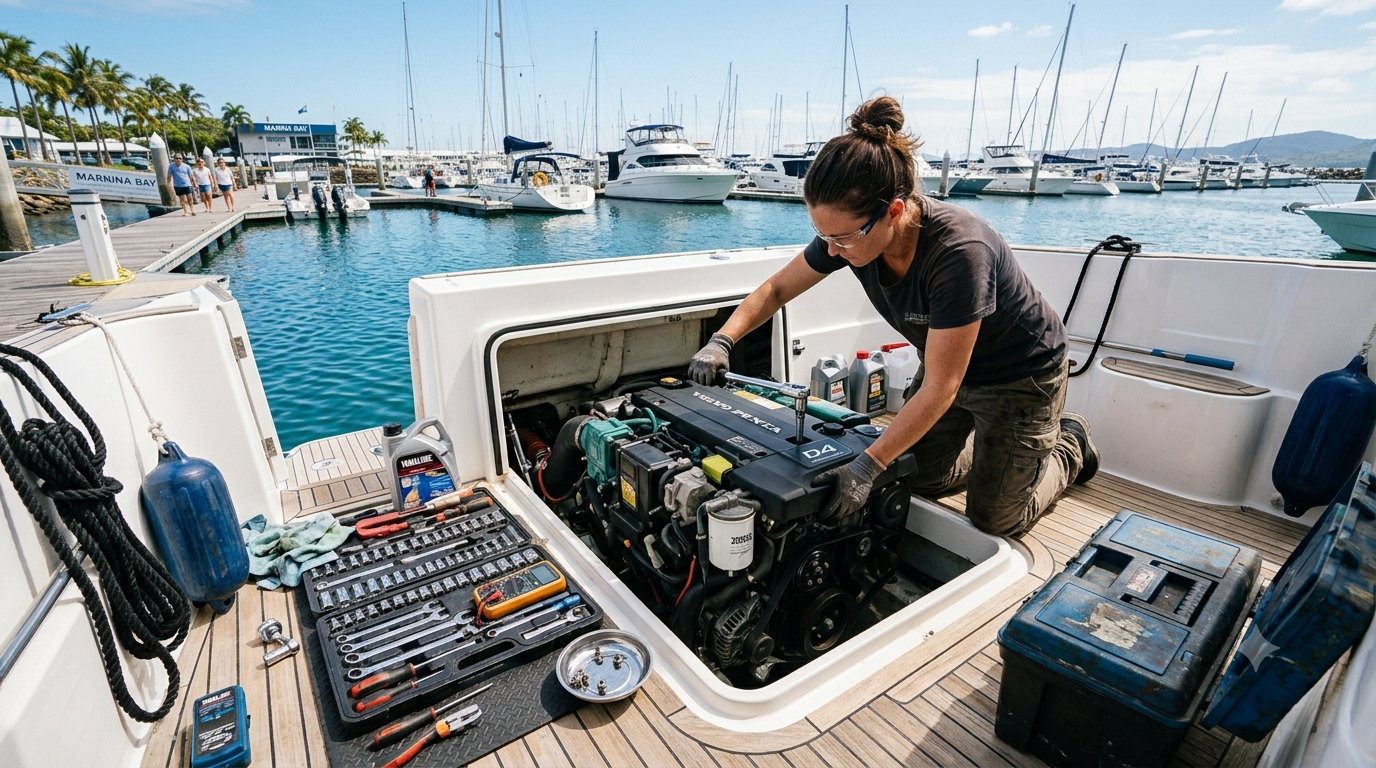
The inboard engine on a sterndrive is essentially a marine-adapted automotive engine. Maintenance follows similar principles with marine-specific considerations:
Engine oil and filter: Change every 100 hours or annually. Use marine-specific oil in the correct viscosity for your engine.
Impeller: Same critical importance as outboards. Replace every 2–3 years. The raw water pump on a sterndrive is accessible from the drive unit — location varies by manufacturer.
Engine zincs: The engine has sacrificial anode plugs in the cooling passages that prevent internal galvanic corrosion. Inspect and replace annually.
Belts and hoses: Inspect annually for cracking, glazing, and proper tension. Marine hose failures can sink a boat — reinforced marine hose is not optional in bilge and cooling applications.
Sterndrive/Outdrive Maintenance
The outdrive is unique to I/O boats and requires specific attention:
Bellows inspection and replacement. The bellows are rubber boots that seal the connections between the hull and the drive unit — protecting the interior from water intrusion. They crack with age, UV exposure, and temperature cycling. Inspect every spring; replace every 3–5 years or when showing cracks regardless of visible leaking. Failed bellows sink boats. This is not an exaggeration.
Gear lube: Change annually in the lower unit, just as with an outboard.
U-joints and gimbal bearing: These components allow the drive to steer and trim. Inspect for play and roughness. Replace when showing wear — typically every 3–5 years depending on use.
Trim pump and fluid: Check power trim fluid level and condition annually. Low or dark fluid indicates a leak or contamination.
Fuel System: The Source of Most Starting Problems
Fuel-related problems cause the majority of recreational boat no-start and poor-running issues. Modern ethanol-blended fuel (E10 is standard at most fuel stations) is harder on marine fuel systems than older formulations — it degrades faster, absorbs water, and can damage rubber fuel components not designed for ethanol contact.
Use marine-grade fuel stabilizer whenever the boat will sit more than two weeks between uses. Add to the tank and run the engine for 10 minutes to circulate it through the system. This single habit prevents the most common fuel-related failures.
Keep the tank full when storing. A full tank leaves less air space for condensation to form. Less condensation = less water in the fuel.
Replace fuel lines every 7–10 years. Marine fuel line is ethanol-resistant reinforced rubber. It degrades over time — cracks and leaks are not just performance problems, they’re fire hazards. If your boat has fuel lines that haven’t been replaced in a decade, add it to the maintenance list.
The Electrical System: The Source of Most Mysteries
Electrical gremlins are the diagnostic bane of every boat mechanic. Corrosion on connections, failed bilge pump switches, and drained batteries cause more “my boat won’t work” moments than mechanical failures.
Inspect every electrical connection annually. Look for green or white corrosion on terminals. Clean with a wire brush and apply dielectric grease. Replace any terminal that shows significant corrosion or damage.
Check the bilge pump. The bilge pump is your last line of defense against a sinking boat. Test it manually every time you go out. Replace the float switch every 3–5 years — they fail in the closed position, leaving the pump running continuously, or in the open position, leaving the bilge unprotected.
Battery maintenance. Marine batteries discharge more deeply and are charged more irregularly than automotive batteries. Use a battery maintainer during storage periods. Replace every 3–5 years, or sooner if you’re seeing slow starts or significant drop in capacity.
Winterization: The Most Important Service of the Year
For any boat stored in climates that freeze, proper winterization is not optional.
Flush and drain the cooling system completely. Use a manufacturer-approved fogging oil sprayed into the intake to coat internal surfaces. Run the engine to circulate it.
Stabilize the fuel. Add stabilizer, fill the tank, and run the engine to circulate stabilized fuel through the entire system.
Change the gear lube and engine oil. Fresh oil going into storage is cleaner and less acidic than oil that has accumulated combustion byproducts all season.
Fog the cylinders. Spray fogging oil into each cylinder through the spark plug holes to coat the internal metal surfaces against corrosion during storage.
Inspect and replace bellows (sterndrive) before winterization if they’re showing any wear.
The Honest Bottom Line
“The world is a book, and those who do not travel read only one page.” — Saint Augustine
Boat engine maintenance isn’t glamorous. It’s an afternoon every spring and fall, an hour or two at each 100-hour milestone, and a modest parts budget that costs a fraction of what failures cost.
The owners who do it — consistently, completely, on schedule — have boats that run reliably for 15–20 years and hold their value well into their second decade. The owners who skip it discover the true cost of the shortcut, usually on the water, usually at the worst possible time.
Your engine will run as long as you take care of it. That’s the deal. It’s a good deal.