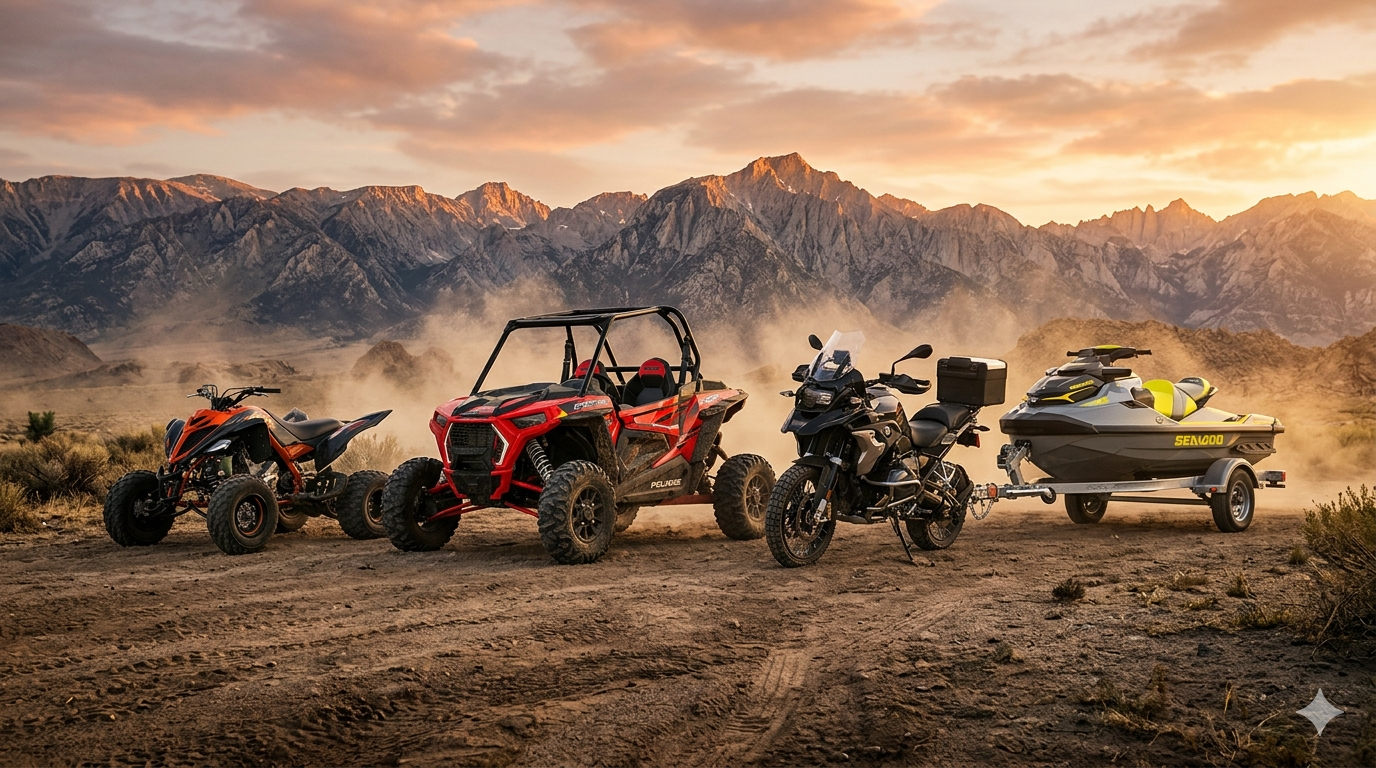

Buying a powersports machine — whether it’s an ATV, UTV, motorcycle, personal watercraft, or snowmobile — is a significant investment. The machine you choose will be pushed hard, maintained inconsistently in the field, exposed to mud, water, dust, and extreme temperatures, and expected to perform without drama every single time you need it.
- What Does “Reliability” Actually Mean in Powersports?
- The Reliability Tiers: How Powersports Brands Stack Up
- Tier 1: The Reliability Benchmarks
- Tier 2: Strong Performers with Category-Specific Strengths
- Tier 3: Value Challengers Worth Knowing
- Reliability by Category: Quick Reference
- What Real Owners Say: The Honest Summary
- Before You Buy — Reliability Questions to Ask
- The Bottom Line on Powersports Reliability
Quality is not an act, it is a habit.”
Aristotle
In that context, reliability isn’t just a nice-to-have. It’s the difference between a machine that becomes your most-used possession and one that sits in the garage generating repair bills.
The powersports industry in 2026 is more competitive than at any point in its history. More brands, more models, more features, and more options than ever before — which makes the reliability question more important, not less. Flashy specs and aggressive pricing can mask engineering and quality control that shows up three years into ownership when you’re far from a dealer and something breaks.
This guide cuts through the marketing and gives you the honest picture on which powersports brands have earned their reliability reputations — and why — across every major category.
What Does “Reliability” Actually Mean in Powersports?
Before ranking brands, it’s worth defining what reliability actually means in a powersports context — because it covers more ground than just “does it break down.”
Mechanical dependability. The most obvious dimension — how often does the machine require unplanned repairs, and how serious are those repairs when they happen? This is where Japanese brands have historically dominated and continue to lead in most categories.
Parts availability. A machine that breaks down near a dealer with parts in stock is a minor inconvenience. The same machine breaking down in a remote location where parts take three weeks to arrive is a serious problem. Parts availability and dealer network density are reliability factors that buyers in rural areas weigh heavily.
Resale value. A reliable brand holds its value better because the used market trusts it. Honda, Yamaha, Polaris, and Can-Am consistently top resale value rankings across most used powersport marketplaces. That resale premium is the market’s vote on which brands deliver on their promises over the long term.
Cost of ownership. How expensive are routine maintenance items? How often does the drivetrain need attention? How complex is the machine to service? These questions determine whether reliability translates into affordable ownership — or just infrequent but expensive repair events.
Dealer and service network. The best brand is the one you can service without drama. A machine is only as reliable as the support network behind it — which is why dealer density matters as much as engineering in a real-world reliability assessment.
The Reliability Tiers: How Powersports Brands Stack Up
The powersports reliability landscape in 2026 breaks naturally into three tiers. Understanding where each brand sits — and why — is more useful than a simple ranking.
Tier 1 — Proven, Trusted, Benchmark Reliability: Honda, Yamaha
Tier 2 — Strong Performers with Category-Specific Strengths: Kawasaki, Polaris, Can-Am (BRP)
Tier 3 — Value Challengers with Growing Credibility: CFMOTO, Suzuki, Arctic Cat
Tier 1: The Reliability Benchmarks
Honda — The Gold Standard
Categories: ATVs, UTVs, Motorcycles, Personal Watercraft
If there is one name that appears at the top of nearly every reliability discussion across every powersports category, it is Honda. Honda’s reputation for long-term reliability is almost unmatched in the industry. Known for rock-solid engineering and ease of maintenance, models like the Honda Rancher, Foreman, and CRF dirt bikes regularly outperform competitors when it comes to long-term value.
According to consumer votes on ATV.com, Honda is the most reliable ATV brand — a position it has held consistently across multiple survey cycles. The Pioneer UTV lineup carries the same reputation: rock solid if basic, with a geared DCT transmission that eliminates the belt replacement costs that plague competitors.
What drives Honda’s reliability advantage isn’t a single engineering decision — it’s a culture of conservative engineering, rigorous quality control, and a global parts and dealer network that is unmatched in the industry. For pure reliability: Honda FourTrax Rancher and Yamaha Grizzly/Kodiak are two of the most dependable machines you can buy.
Honda’s reliability advantage is most pronounced in applications where machines work hard in remote conditions — farming, ranching, hunting in backcountry, and international travel on motorcycles where dealer access is unpredictable. In these scenarios, Honda’s combination of mechanical simplicity, proven drivetrains, and global parts availability makes it the professional’s choice.
Honda’s most reliable models:
- ATVs: FourTrax Rancher, FourTrax Foreman
- UTVs: Pioneer 520, Pioneer 1000
- Motorcycles: Africa Twin, CB500X, Gold Wing
- PWC: Aquatrax (discontinued but legendary for durability)
Best for: Buyers who prioritize long-term dependability above all else, remote riders, utility-focused users, and anyone who needs a machine that runs without drama year after year.
Yamaha — The Engineering Excellence Standard
Categories: ATVs, UTVs, Motorcycles, Personal Watercraft (WaveRunner)
Yamaha earns its place alongside Honda at the top of the reliability tier through a different but equally compelling approach. Where Honda wins on mechanical simplicity, Yamaha wins on engineering depth and performance longevity — building machines that perform at a high level for years without degrading.
From the Yamaha Grizzly to the Wolverine UTV and YZ series dirt bikes, Yamaha powersport vehicles offer a great mix of performance and longevity. Their engines are among the most durable in the industry, and loyalists swear by the smooth ride quality and precision handling.
The Yamaha Ténéré 700 motorcycle is widely regarded as one of the most bulletproof adventure bikes in the world — an engine so proven that it is used in multiple platforms across different markets. The WaveRunner lineup has held the reliability crown in personal watercraft for decades — preferred by rental operators precisely because these machines survive the highest-abuse usage patterns with the lowest repair rates.
Yamaha’s one consistent trade-off is cost: Yamaha machines can be expensive to repair when they do need attention, and some replacement parts are priced at a premium over comparable Japanese competitors. That said, the frequency of those repair events is low enough that total ownership cost remains competitive.
Yamaha’s most reliable models:
- ATVs: Grizzly 700, Kodiak 450
- UTVs: Wolverine RMAX 1000, Viking EPS
- Motorcycles: Ténéré 700, MT-07, FZ series
- PWC: WaveRunner VX Cruiser HO, FX HO
Best for: Riders who want high-performance machines that maintain their capability and character over many years of hard use.
Tier 2: Strong Performers with Category-Specific Strengths
Kawasaki — The Underrated Workhorse
Categories: ATVs, UTVs, Motorcycles
Kawasaki occupies a curious position in the powersports reliability conversation — consistently praised by owners and mechanics who know the brand, and frequently overlooked by buyers who haven’t considered it. Among experienced powersports technicians, the Japanese brands — Honda, Kawasaki, Yamaha, Suzuki — are rarely a bad experience.
The Kawasaki Mule lineup is the archetypal example of Kawasaki’s reliability approach: an air-cooled engine that eliminates the radiator and coolant system entirely, a belt-driven CVT that is well-supported, and a chassis that has been refined over decades of real-world working conditions. It is a no-drama machine — the descriptor that appears most consistently in owner discussions.
The 2026 Kawasaki Ridge UTV has attracted significant attention as a new entrant — a 1000cc four-cylinder engine with a belt-drive transmission and high/low range, backed by a 3-year warranty that is among the most generous in the segment. Early owner and tester feedback points to a machine that handles like it has been refined over years, not months.
Kawasaki motorcycles — the Z series, Ninja, and Versys lines in particular — have one of the strongest reliability records in the mid-range segment. For buyers who want Japanese engineering quality with slightly less brand premium than Honda or Yamaha, Kawasaki delivers genuine value.
Kawasaki’s most reliable models:
- UTVs: Mule SX, Mule PRO-FXT, Ridge 1000
- ATVs: Brute Force 750, KFX 50/90 (youth)
- Motorcycles: Versys 650, Z650, Ninja 400
Best for: Utility buyers who want the simplest, lowest-maintenance machines available; motorcycle riders who want Japanese reliability without the brand premium of Honda or Yamaha.
Polaris — America’s Innovation Leader
Categories: ATVs, UTVs, Snowmobiles, Electric
Polaris occupies a unique position in the American powersports market — the most innovative domestic brand, the top-selling UTV manufacturer in North America, and a company that consistently pushes performance and technology boundaries in ways the Japanese manufacturers don’t. Polaris vehicles consistently dominate resale value rankings across most used powersport marketplaces.
The Polaris Ranger and RZR lineups are benchmarks for their respective segments — the Ranger for utility and the RZR for sport performance. The Sportsman ATV lineup has been the best-selling ATV in America for years. That commercial success reflects genuine product strength.
The honest trade-off: Polaris machines are more mechanically complex than Japanese equivalents, which means more can go wrong — and some owners report that complexity translates into higher repair frequency and cost compared to Honda or Yamaha. For pure power and speed in ATVs — Can-Am. For comfort of ride — Polaris. For dependability and longevity — Honda. This captures the nuance well.
For riders who want the best-handling, most feature-rich machines on the market and are comfortable with the ownership complexity that comes with leading-edge engineering, Polaris delivers consistently. For buyers whose primary concern is lowest-drama ownership, Honda or Yamaha is the safer choice.
Polaris’s strongest models:
- UTVs: Ranger SP 570, Ranger XP 1000, RZR Pro R
- ATVs: Sportsman 570, Sportsman XP 1000
- Snowmobiles: Indy XC, RMK Khaos
Best for: Performance-focused riders who want best-in-class capability and don’t mind a more complex ownership experience; buyers who prioritize resale value.
Can-Am (BRP) — The Performance and Utility Powerhouse
Categories: ATVs, UTVs
Can-Am, manufactured by BRP (Bombardier Recreational Products), competes at the top of the performance segment across ATVs and UTVs — often leading on raw capability while trading some of the mechanical simplicity that defines the Japanese brands.
The Can-Am Defender lineup is the go-to choice for buyers who need the strongest towing and utility performance available. The Can-Am Maverick R is regarded as the top sport UTV of 2026, delivering performance metrics that set new standards for the category. Can-Am ATVs — particularly the Outlander lineup — lead the high-performance utility segment with the most aggressive power outputs available.
The reliability picture for Can-Am is nuanced: owners who ride hard and maintain regularly report excellent long-term experiences. Owners who push machines beyond their limits or defer maintenance more commonly report issues. Parts availability has been a recurring concern for some owners, particularly in rural areas distant from Can-Am dealers — a factor worth researching in your specific region before buying.
Can-Am’s ongoing innovation pace — including the new Maverick R platform and continued Defender updates — keeps the brand at the forefront of capability. For buyers who want the most capable machine available and are prepared to maintain it properly, Can-Am delivers.
Can-Am’s strongest models:
- UTVs: Defender HD7/HD10, Maverick R, Commander
- ATVs: Outlander 700/1000, Renegade 1000
Best for: Performance riders who want maximum capability; property owners who need best-in-class towing and utility; riders who maintain their machines consistently.
Tier 3: Value Challengers Worth Knowing
CFMOTO — The Rising Challenger
CFMOTO marked the one-millionth off-road vehicle from its Hangzhou plant, which supports credibility with distributors and fleet buyers. Quality has improved dramatically since 2020, and the UForce and CForce lineups now represent genuine competitive value at price points well below the major brands.
The honest assessment: CFMOTO’s machines are significantly better than the price suggests — but warranty handling and parts lead times shape repeat purchase rates, and these remain less consistent than the established Japanese and American brands. Confirm local service availability before purchasing. In regions with strong CFMOTO dealer support, the value proposition is compelling.
Best for: Budget-conscious buyers with confirmed local service access who want the most factory-equipped machine for the money.
Suzuki — The Quiet Reliable
Suzuki has pulled back from aggressive new model development in the powersports space but maintains a loyal following for good reason. Suzuki machines are typically a great buy — not a standout in many areas but hardly ever requiring anything but general service. Good bang for the buck, proven drivetrains, and low drama ownership characterize the Suzuki ownership experience.
Best for: Buyers who find a clean used Suzuki at a good price — excellent long-term ownership without the premium of Honda or Yamaha.
Reliability by Category: Quick Reference
| Category | Most Reliable | Best Performance | Best Value |
| ATVs | Honda, Yamaha | Can-Am, Polaris | CFMOTO |
| UTVs | Honda Pioneer, Kawasaki Mule | Polaris RZR, Can-Am Maverick | CFMOTO UForce |
| Motorcycles | Honda, Kawasaki | Yamaha, KTM | Suzuki |
| PWC | Yamaha WaveRunner | Sea-Doo GTX | Sea-Doo Spark |
| Snowmobiles | Yamaha, Ski-Doo | Polaris, Arctic Cat | Arctic Cat |
What Real Owners Say: The Honest Summary
Across owner forums, mechanic surveys, and long-term usage reports, a consistent picture emerges:
For pure reliability and lowest drama ownership: Honda first, Yamaha second — particularly for buyers who work their machines hard in remote conditions or need confidence in long-term mechanical dependability.
For best performance with strong reliability: Yamaha for motorcycles and PWC; Polaris for UTVs; Can-Am for ATVs — machines that perform at the highest level with maintenance discipline.
For the best value per dollar: CFMOTO for buyers with local service access; Kawasaki for buyers who want Japanese quality with slightly less brand premium.
The universal truth: Every major brand makes machines that last when maintained properly. The reliability gap between the top brands narrows significantly with consistent maintenance. What separates the tiers is how forgiving each brand is when maintenance is delayed, conditions are extreme, and dealer support is limited.
Before You Buy — Reliability Questions to Ask
“Not all those who wander are lost.” — J.R.R. Tolkien
Before choosing a brand based on reliability alone, answer these:
- How far am I from an authorized dealer? The best brand is the one you can service without drama. Distance from your dealer matters as much as brand reputation.
- How will I primarily use it? Heavy utility work in remote areas strongly favors Honda or Yamaha. Performance trail riding opens up Polaris and Can-Am.
- How disciplined am I about maintenance? If maintenance schedules slip, Japanese simplicity provides more forgiveness than complex American performance machines.
- What does the used market look like in my area? Strong used market demand for a brand reflects long-term ownership confidence — check local listings before buying new.
- Am I buying new or used? On used machines, the previous owner’s maintenance history matters more than brand reputation. A well-maintained Can-Am outlasts a neglected Honda every time.
The Bottom Line on Powersports Reliability
“The road is there, it will always be there. You just have to decide when to take it.” — Jackson Browne
Here’s the honest answer for 2026: the reliability gap between the major powersports brands has narrowed significantly over the past decade. Every brand on this list makes machines that competent owners run for years without serious issues.
What still separates the tiers is the margin for error — how much the machine tolerates before problems appear, how easy it is to fix when they do, and how well the brand supports you when you’re far from the dealer.
For buyers who want the highest margin for error — the machine that asks the least and delivers the most over the longest period — Honda and Yamaha remain the benchmark. They have earned that position over decades of real-world use, not just in showrooms.
For buyers who want the best-performing machines the powersports world can build, and who are prepared to maintain them properly — Polaris and Can-Am deliver capabilities that Honda and Yamaha simply don’t match.
The right brand is the one that fits how you ride, where you ride, and how you maintain. Choose accordingly — and the machine will take care of the rest.