

Most RVs ask you to leave something behind. Your ATV stays at home. The dirt bikes go on a separate trailer. The side-by-side doesn’t make the trip because there’s simply nowhere to put it. You arrive at the trailhead, but the machine that was supposed to make the trail worth riding is sitting in your garage back home.
- What Is a Toy Hauler, Exactly?
- Types of Toy Haulers
- The Garage: More Than Just a Parking Space
- The Case For: Why Toy Haulers Win
- The Case Against: What to Consider First
- Who Should Buy a Toy Hauler?
- Best Toy Haulers of 2026: The Standouts
- Key Specs to Evaluate Before Buying
- Before You Buy — Questions to Ask
- The Bottom Line
The toy hauler was invented to solve exactly that problem.
Adventure is worthwhile in itself.
Amelia Earhart
Part RV, part garage, part adventure base camp — the toy hauler is the most versatile category in the entire RV market. It gives you full camping accommodations for the family plus a dedicated, lockable, weather-protected cargo bay that loads motorcycles, ATVs, side-by-sides, dirt bikes, kayaks, or virtually any outdoor equipment you own. One vehicle. One trip. Everything comes along.
But toy haulers aren’t for everyone — and understanding who they’re built for, and who they’re not, is the most important step in deciding whether one belongs in your driveway.
What Is a Toy Hauler, Exactly?
A toy hauler is a type of RV — available as a travel trailer, fifth wheel, or motorhome — that combines traditional living accommodations with a dedicated rear cargo area known as the garage. This garage section is purpose-built for transporting large, heavy recreational equipment — the “toys” that give the category its name.
Key distinguishing features that every toy hauler shares:
The garage. A dedicated rear cargo bay with a heavy-duty floor, built-in tie-down anchor points, and reinforced framing capable of supporting the weight of powersports vehicles. Garage sizes range from 8 feet in compact models to 16+ feet in full-size fifth wheels — large enough to accommodate two full-size ATVs or a side-by-side side by side.
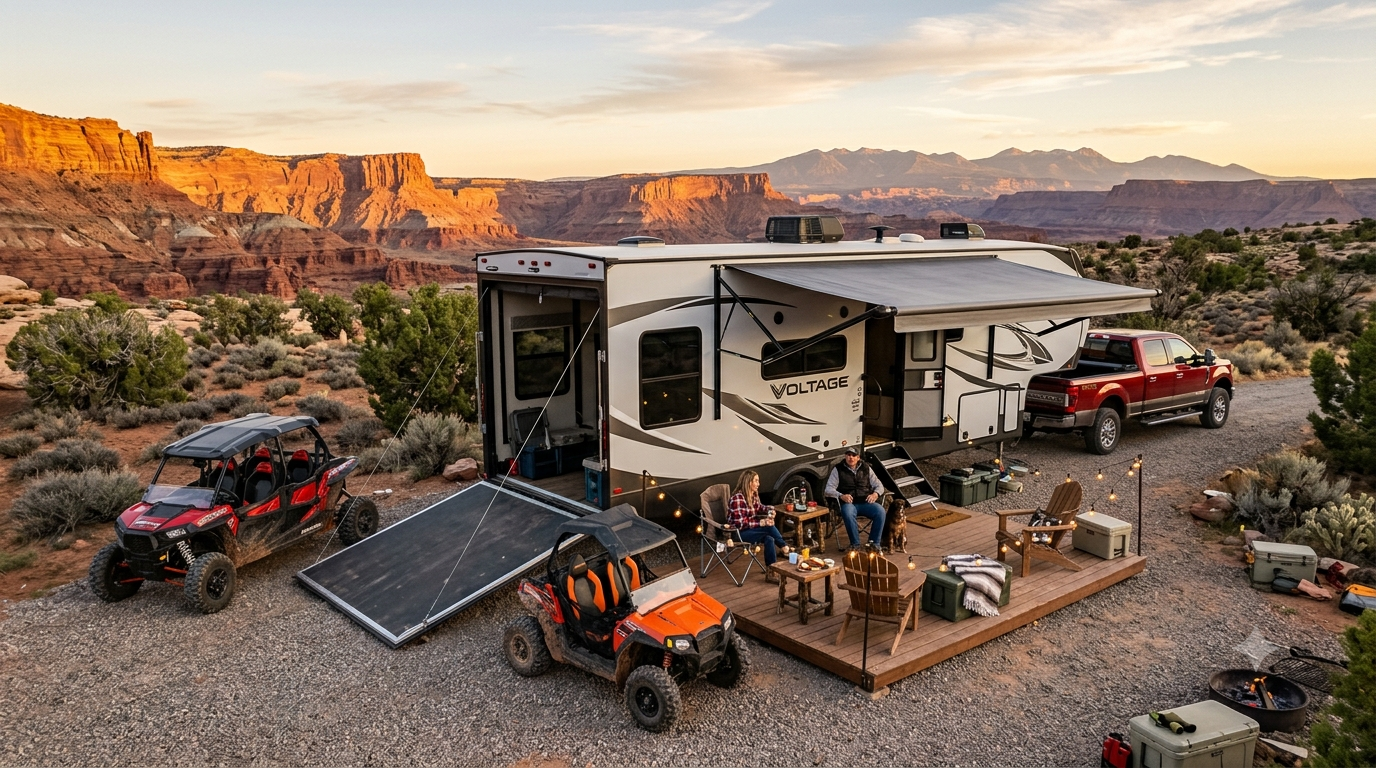
The ramp door. A hinged rear door that lowers to become a loading ramp, allowing you to drive or push vehicles directly into the garage. Many 2026 models feature motorized ramp doors that operate at the push of a button — and convert into a patio deck when parked, creating covered outdoor living space at camp.
Fuel stations. Many toy haulers include onboard fuel storage tanks that allow you to refuel your powersports vehicles at the campsite — eliminating the need to carry gas cans or find a fuel station miles away on a riding day.
Convertible garage space. In 2026, the garage section is rarely just a garage. Fold-down Murphy beds, flip-down furniture, modular seating systems, and even private bedroom conversions allow the garage to serve multiple purposes — extra sleeping capacity at night, living space during the day, and a cargo bay on travel days.
Reinforced construction. Built to handle heavy loads, toy haulers use robust materials, heavier axles, and reinforced floor systems that standard travel trailers don’t have. This durability ensures the structure can withstand repeated loading and unloading of heavy equipment without stress on the frame.
Types of Toy Haulers
Toy haulers are available in three formats, each suited to a different buyer and lifestyle.
Travel Trailer Toy Haulers
The most accessible entry point into toy hauler ownership. Travel trailer toy haulers connect to a standard bumper hitch — towable by a wide range of vehicles including many half-ton trucks and, for smaller models, some SUVs. They are typically more affordable than fifth wheel equivalents and easier to maneuver in tight campsite situations.
The trade-off is garage size and living space. Travel trailer toy haulers offer smaller garages and more compact living areas than fifth wheel models. For buyers whose “toys” are motorcycles, dirt bikes, small ATVs, or kayaks rather than full-size side-by-sides, the travel trailer format is often the right balance.
Starting price range: ~$30,000–$70,000
Best for: First-time toy hauler buyers, half-ton truck owners, buyers with smaller powersports equipment
Fifth Wheel Toy Haulers
The premium format — and the most popular among serious toy hauler owners. Fifth wheel toy haulers connect through a kingpin hitch in the truck bed, providing superior towing stability and enabling larger, heavier configurations that would be impractical in a bumper pull format.
Fifth wheel toy haulers deliver significantly larger garages — up to 16 feet in premium models — more residential living spaces with multiple slide-outs, and the bi-level floor plan that gives fifth wheels their characteristic spacious feel. The Momentum series from Grand Design is perhaps the most recognized name in this segment, with models ranging from entry fifth wheel configurations to flagship luxury builds with 13+ foot garages.
Starting price range: ~$60,000–$150,000+
Best for: Serious powersports enthusiasts with full-size equipment, frequent campers, buyers ready for a premium toy hauler experience
Motorhome Toy Haulers (Class A and Class C)
The least common format but a compelling option for buyers who prefer a drivable rig over a towable one. Motorhome toy haulers — available in Class A and Class C formats — integrate the garage into the rear section of the motorhome itself, eliminating the need for a tow vehicle entirely.
The trade-off is that the motorhome and the toys travel together as a single unit — if you park the motorhome at camp, exploring by vehicle requires unloading a powersports machine. Many motorhome toy hauler owners bring a tow vehicle (a car or truck hitched behind the motorhome) specifically for local exploration.
Starting price range: ~$100,000–$200,000+
Best for: Buyers who prefer drivable RVs, full-timers who want the toy hauler lifestyle without a separate tow vehicle
The Garage: More Than Just a Parking Space
The garage is what defines a toy hauler — and in 2026, it’s far more versatile than the name suggests.
As a cargo bay: The obvious use. Load your ATVs, side-by-side, motorcycles, dirt bikes, e-bikes, kayaks, or whatever outdoor equipment defines your adventures. Everything arrives locked, weather-protected, and secure — a significant advantage over an open trailer, where equipment is exposed to weather and potential theft.
As extra sleeping quarters: Fold-down bunks or Murphy beds in the garage section are standard on most mid-range and premium toy haulers. This converts the garage into a private bunk room for kids or guests when vehicles aren’t loaded — a flexibility that makes the toy hauler double as an effective family camping solution.
As a party patio: Lower the ramp door and you have an instant covered patio deck — furniture out, drinks cold, direct access to the outdoors without stepping off your site. This is one of the most-loved features among toy hauler owners and one that no standard travel trailer or fifth wheel can replicate.
As a mobile office: The hybrid pull-out desk configuration is increasingly popular in 2026 models — the garage converts to a dedicated workspace that closes off from the living area when work is done. For remote workers who camp frequently, this is a genuinely compelling feature.
As a hunting camp: Toy haulers are popular among hunters for a reason that goes beyond powersports. The garage provides a clean, secure, weatherproof space for processing game — easy to clean, protected from elements, and separated from the living quarters. A combination that purpose-built hunting camps charge significantly more to replicate.
The Case For: Why Toy Haulers Win
One Rig, Everything Comes Along
The fundamental advantage — you stop choosing between comfort and adventure. Your camping accommodations travel with your gear. No separate trailer, no left-behind equipment, no arriving at a riding destination only to realize something critical didn’t make the trip.
Superior Storage Versatility
The cargo bay can be used as a secure place to keep tools, materials, and bulky items — not just powersports vehicles. Contractors, photographers, musicians, and outdoor professionals all use toy hauler garages for equipment that doesn’t fit in a standard RV’s storage compartments.
Convertible Garage Flexibility
In 2026, the garage is a multi-purpose space that justifies its footprint whether or not you load a vehicle into it. Murphy beds, fold-down furniture, and modular seating systems mean the garage is never wasted space — it’s living space, sleeping space, or cargo space depending on what the trip demands.
Secure, Weather-Protected Equipment Transport
Loading your powersports equipment into a locked, enclosed garage protects it from road debris, weather, and theft in ways that an open trailer simply cannot. For riders with premium equipment — a $15,000 side-by-side, custom-built dirt bikes, or expensive kayaks — the protection of an enclosed garage has real financial value.
The Ramp Door Patio
This feature converts skeptics faster than any spec sheet. At camp, lower the ramp door and you have an instant covered outdoor living deck. Happy hour, game night, cooking, relaxing — all on your own private elevated patio. It’s one of those features that sounds minor in theory and becomes a daily highlight in practice.
Higher Resale Value
Because toy haulers are more versatile and can be used for more than just camping, they generally have a higher resale value than regular campers. The dual-purpose appeal — camping accommodation plus equipment transport — maintains buyer interest in the used market that a standard travel trailer of the same age may not sustain.
The Case Against: What to Consider First
More Expensive Upfront
Toy haulers are usually more costly than regular campers, both upfront and in terms of fuel costs. They’re also typically heavier, so you’ll need a bigger, more powerful vehicle to tow them. A comparable floor plan costs 20–40% more in toy hauler format than in a standard travel trailer — the reinforced structure, heavier axles, and garage systems add real cost.
Reduced Living Space Per Dollar
The garage takes up real estate that would otherwise be living space. A 35-foot toy hauler typically has less interior living room than a 35-foot travel trailer at the same price — because the rear section is dedicated to the garage rather than bedrooms, bathrooms, or living areas. Larger groups camping without gear may find the trade-off unfavorable.
Heavier Tow Vehicle Requirements
Toy haulers typically require a larger, more capable truck to tow them safely. Most mid-size to full-size fifth wheel toy haulers require a one-ton pickup with a fifth wheel hitch. If you don’t already own a capable tow vehicle, factor the full acquisition cost — RV plus truck — into your total budget before committing.
Campsite Maneuverability
The garage section adds both length and weight to the rig — and a loaded garage adds significantly more. Navigating tight campground loops, backing into smaller sites, and managing weight distribution on steep grades all become more demanding in a loaded toy hauler. It’s manageable with experience — but first-time buyers should plan on a learning curve.
Fuel Economy
Due to their size and weight, toy haulers often have lower fuel efficiency. A fully loaded toy hauler with a side-by-side in the garage and a one-ton diesel pulling it is burning meaningfully more fuel per mile than a lightweight travel trailer setup. For frequent, long-distance travelers, that difference adds up over a season.
Who Should Buy a Toy Hauler?
Here is the honest answer — toy haulers are the right choice for a specific type of buyer, and the wrong choice for everyone else.
Buy a toy hauler if:
You regularly travel with powersports equipment — ATVs, side-by-sides, motorcycles, dirt bikes, or e-bikes — and currently manage that equipment on a separate trailer, with a tow vehicle limited by the equipment transport, or by leaving gear at home. The toy hauler eliminates all three compromises simultaneously.
You are a hunter who wants a base camp that combines sleeping quarters with a functional processing area, separate from the living space and easy to clean.
You have a group of campers with different sleeping needs — the convertible garage provides flexible sleeping capacity that makes a smaller-than-expected toy hauler work for surprisingly large groups.
You work remotely and camp frequently — the garage-as-office trend in 2026 toy haulers creates a genuinely functional workspace that separates professional hours from personal hours at camp.
You value the ramp door patio experience and want covered outdoor living space that no other RV category provides.
Don’t buy a toy hauler if:
Your camping style is primarily comfort-focused and you rarely travel with large equipment. The garage comes at a real cost in living space and purchase price — and if it’s empty most of the time, the compromise isn’t worth it.
Your tow vehicle is a half-ton truck or SUV and your budget doesn’t include upgrading. Most full-size toy haulers require serious towing capability — undershooting that requirement is dangerous.
You’re a first-time RV buyer who isn’t yet sure what you actually want from the RV lifestyle. Start with a standard travel trailer, learn how you camp, and upgrade to a toy hauler when you know that’s exactly what your lifestyle demands.
Best Toy Haulers of 2026: The Standouts
Grand Design Momentum 344M — Best Premium Fifth Wheel Toy Hauler
The Momentum 344M rides on a MORryde Independent Suspension System paired with heavy-duty axles with anti-lock brakes — delivering exceptional ride quality that sets it apart in the toy hauler market. Inside, a thoughtfully arranged mid-living room, hybrid pull-out desk for remote work, professional-grade cooktop, Rockford Fosgate stereo, and electric fireplace make this a genuinely residential experience. The garage accommodates full-size powersports equipment and converts to a private bedroom setup. A standout choice for buyers who want the very best in premium fifth wheel toy hauler engineering.
Grand Design Momentum G-Class — Best Travel Trailer Toy Hauler
The most accessible entry into Grand Design’s Momentum lineup — a bumper pull toy hauler that delivers the brand’s legendary build quality at a price point accessible to half-ton truck owners. Smarter layouts, better storage, and Grand Design’s customer satisfaction track record make the G-Class the benchmark travel trailer toy hauler for buyers who want quality without the fifth wheel price tag.
Forest River Cherokee Wolf Pack — Best Value Toy Hauler
The Wolf Pack consistently earns its place on value-focused toy hauler lists — solid construction, a practical garage, and family-friendly living accommodations at a price point that makes toy hauler ownership accessible for first-time buyers. Available in both travel trailer and fifth wheel formats, the Wolf Pack gives buyers flexibility to match the format to their tow vehicle.
Keystone Fuzion — Best for Full-Time Toy Hauler Living
For buyers who want to live in their toy hauler full-time without sacrificing garage capability, the Fuzion delivers residential-quality living spaces alongside serious garage capacity. Multiple slide-outs, premium interior finishes, and a well-executed garage-to-living-space conversion make the Fuzion a compelling choice for full-timers with powersports equipment.
Key Specs to Evaluate Before Buying
| Spec | Why It Matters |
| Garage length | Must accommodate your specific equipment with room for the ramp and tie-downs |
| Garage payload capacity | The maximum weight the garage floor can safely support — check against your heaviest vehicle |
| Ramp door width | Must be wider than your widest vehicle’s stance |
| GVWR | Total trailer weight when fully loaded — must match your tow vehicle’s rating |
| Tie-down anchor points | More is better; confirm they’re rated for your vehicle’s weight |
| Fuel station capacity | If off-grid refueling is important, confirm capacity and location |
| Garage-to-living conversion | How long does the conversion take? Is it practical for nightly use? |
Before You Buy — Questions to Ask
“Not all those who wander are lost.” — J.R.R. Tolkien
Before committing to a toy hauler purchase, work through these:
- What toys am I actually hauling? Measure your equipment — length, width, and weight — before shopping. These three numbers determine which garage configurations work and which don’t.
- How often will the garage be empty? If you camp without gear more than half the time, a standard travel trailer delivers more living space for less money.
- What does my tow vehicle actually rate for? Confirm both tow rating AND payload capacity against the toy hauler’s GVWR — fully loaded with gear.
- Do I want a travel trailer or fifth wheel format? Fifth wheels offer more space and stability but require a pickup truck. Travel trailer toy haulers are accessible to half-ton truck owners.
- Have I measured the ramp door against my widest vehicle? The ramp door width is frequently the limiting factor for wide side-by-sides. Confirm clearance before purchase.
- Will the garage conversion work for my group’s sleeping needs? Walk through the specific model with your actual group size in mind — don’t assume the conversion works without seeing it in person.
The Bottom Line
“The road is there, it will always be there. You just have to decide when to take it.” — Jackson Browne
A toy hauler is not the right RV for everyone. It costs more, requires more tow vehicle, and trades living space for garage capability. For buyers who don’t regularly travel with large equipment, those trade-offs don’t make sense.
But for the buyer who has been loading dirt bikes on a separate trailer, leaving the side-by-side at home, or compromising their camping experience because the gear doesn’t fit — a toy hauler changes everything. One rig. Everything comes along. The adventure you’ve been planning actually happens the way you planned it.
That’s the toy hauler’s promise. And for the right buyer, it delivers on it completely.