
Buying an RV is one of the most exciting purchases you’ll ever make. It’s also one of the easiest to get wrong.
- Why First-Time Buyers Get It Wrong
- Mistake #1: Buying the Wrong Type of RV for Your Lifestyle
- Mistake #2: Buying Too Big, Too Soon
- Mistake #3: Ignoring the True Cost of Ownership
- Mistake #4: Buying a Towable Without Verifying Tow Capacity
- Mistake #5: Skipping the Pre-Purchase Inspection on a Used RV
- Mistake #6: Choosing the Wrong Floor Plan for Real Life
- Mistake #7: Not Test Driving Before Buying
- Mistake #8: Skipping the Rental Step
- Mistake #9: Ignoring Storage and Campsite Length Restrictions
- Mistake #10: Negotiating the Monthly Payment Instead of the Price
- Mistake #11: Not Researching the Dealership
- The Mistake That Costs the Most: Rushing the Decision
- The Quick Reference Checklist: Before You Sign
- The Bottom Line
Nearly half of all first-time RV buyers report some form of buyer’s remorse. A significant portion resell within the first two years — often at a loss. And in almost every case, the regret traces back to one of a handful of predictable, entirely avoidable mistakes made during the buying process.
The good news: every mistake on this list has been made thousands of times before. That means the patterns are well-documented, the warning signs are identifiable in advance, and with the right information, you can sidestep every one of them. This guide covers the most common — and most costly — RV buying mistakes in 2026, with specific, actionable guidance for avoiding each one.
Learn from the mistakes of others. You can’t live long enough to make them all yourself.
Eleanor Roosevelt
Why First-Time Buyers Get It Wrong
The RV buying process combines the emotional excitement of a lifestyle purchase with the financial complexity of a major investment decision. That combination is where mistakes breed. Buyers walk onto a dealership lot excited about the lifestyle, and excitement is the enemy of good decision-making.
Add to that the sheer complexity of the RV market — dozens of types, hundreds of brands, thousands of floor plans, and a vocabulary of RV-specific terms that takes months to fully absorb — and it becomes clear why so many first-time buyers end up with the wrong rig.
Understanding where others have gone wrong is the most efficient path to getting it right yourself.
Mistake #1: Buying the Wrong Type of RV for Your Lifestyle
The mistake: Choosing an RV category based on how it looks, how impressive it is, or what a friend owns — rather than how you actually camp.
This is the most fundamental mistake in the entire buying process — and the most common source of early resale. A retired couple who buys a 40-foot Class A because it has a beautiful kitchen discovers they can’t access half the campgrounds they want to visit. A young family who buys a sleek Class B van because it’s easy to drive discovers it’s impossibly cramped for four people on a two-week road trip.
The type of RV you buy is the decision that everything else flows from. Get it right and the rest of the process becomes significantly easier. Get it wrong and no floor plan, brand, or price point can compensate.
How to avoid it: Before looking at a single model, answer these questions about your actual camping style:
- How many people need to sleep in it on a typical trip?
- Will you camp at developed campgrounds with full hookups, or explore National Parks and dispersed camping?
- Do you want to drive the RV, or tow it and keep a separate vehicle for exploring?
- How many nights per year will you realistically use it?
- Do you need to carry outdoor equipment — bikes, ATVs, kayaks?
Your answers to these questions should point clearly toward a type of RV. A family of five who camps at KOA three weekends a year needs a very different machine than a couple planning a six-month cross-country journey. Match the type to the reality of your camping life — not the version of it you imagine on the best possible weekend.
Mistake #2: Buying Too Big, Too Soon
The mistake: Assuming that more space is always better — and ending up with an RV that’s difficult to drive, impossible to park, and locked out of the best campgrounds.
It is easy to be tempted by the biggest, most luxurious RV on the lot. But bigger is not always better — especially when you are new to RVing. A large rig can be harder to drive, park, and maintain. Many National Parks, state parks, and older private campgrounds have strict length limits — often 35 feet or less, sometimes as tight as 27 feet. A 40-foot coach locks you out of a meaningful portion of American campgrounds permanently.
First-time buyers consistently overestimate how much space they need and underestimate how much skill it takes to manage a large rig in real camping situations — backing into tight sites, navigating narrow forest roads, parking at a grocery store en route.
How to avoid it: For most first-time buyers, starting in the 22–28 foot range is the right approach. It delivers enough space for comfortable camping without the complexity of managing a full-size coach. As the experienced RV community consistently advises: start smaller than you think you need, learn how you actually camp, and upgrade with confidence when you know exactly what you want. A 24-footer that you’re comfortable driving is worth far more than a 38-footer that stresses you out every time you leave the campsite.
The formula: count the number of people who regularly camp with you, add one, and find the smallest floor plan that comfortably accommodates that number.
Mistake #3: Ignoring the True Cost of Ownership
The mistake: Focusing exclusively on the purchase price while ignoring the ongoing costs that make RV ownership genuinely expensive.
The purchase price of an RV is only one piece of the total ownership cost — and often not the largest one when calculated over time. First-time buyers who budget only for the sticker price routinely experience financial stress in months two through twelve of ownership when the real costs emerge.
Here is what the full cost picture looks like:
Insurance: RV insurance is separate from auto insurance and required. Costs range from $500–$2,000 per year for a travel trailer, and $1,500–$4,000+ for a motorhome. Critically, RV insurance only covers the camper itself — not the contents inside. Many first-time buyers discover this after a theft or loss event.
Storage: Unless you have room on your own property, paid storage costs $50–$400 per month depending on region, type (outdoor vs. covered vs. climate-controlled), and RV size. This cost runs year-round whether you’re camping or not.
Maintenance: Budget 1–2% of purchase price annually for routine maintenance — more for older or heavily used units. Common items include roof resealing, slide-out lubrication, battery replacement, and tire inspections.
Campground fees: Private RV parks with full hookups run $40–$100+ per night. Over a full season, campground fees can easily exceed $2,000–$5,000 depending on frequency of use.
Fuel: For motorhomes, fuel consumption is significant — 8–12 MPG for most Class C and Class A coaches. For towable owners, factor in 20–30% reduced fuel economy for the tow vehicle under load.
How to avoid it: Budget 25–40% of purchase price annually for total ownership costs beyond the mortgage payment. If that number doesn’t fit within your realistic financial picture, reconsider the purchase price — not the cost estimates.
Mistake #4: Buying a Towable Without Verifying Tow Capacity
The mistake: Assuming your existing truck or SUV can tow any travel trailer — and discovering the mismatch on the highway.
One of the most common and most dangerous mistakes first-time RV buyers make is purchasing a trailer that exceeds their vehicle’s towing capacity. This leads to poor handling, excessive wear on the engine and transmission, and in serious cases, loss of vehicle control — particularly in emergency braking situations or on downhill grades.
The tow capacity number on your vehicle’s door placard or owner’s manual is not the only number that matters. Payload capacity — the maximum weight your vehicle can carry including passengers, cargo, and the tongue weight of the trailer — is often the actual limiting factor. A truck rated to tow 9,000 lbs may have a payload capacity of only 1,500 lbs, which means loading the truck with passengers and gear before the trailer is even attached can push the vehicle beyond its safe operating limit.
How to avoid it: Before shopping for any towable RV, pull three numbers from your vehicle’s owner’s manual or door placard:
- Maximum tow rating — the heaviest trailer your vehicle can tow
- Maximum payload capacity — the maximum weight in the truck including passengers, cargo, and tongue weight
- Tongue weight capacity — typically 10–15% of total trailer weight
Match these numbers against the RV’s GVWR (Gross Vehicle Weight Rating) — not just the dry weight, which doesn’t account for water, gear, and supplies. Your tow vehicle should be rated for at least 10–15% more than the trailer’s GVWR to maintain a safety margin.
If your current vehicle can’t safely handle the RV you want, that conversation needs to happen before — not after — the purchase.
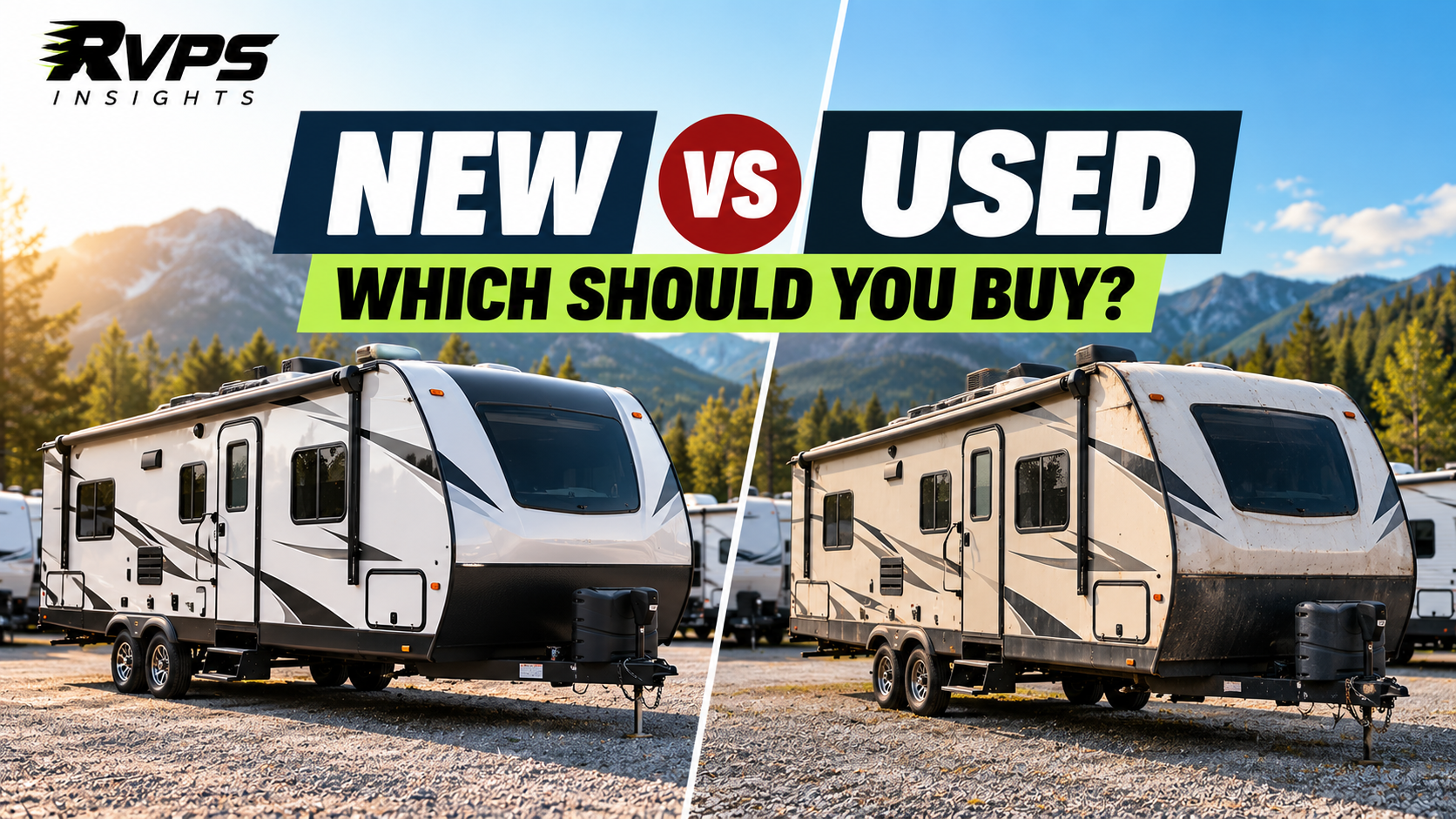
Mistake #5: Skipping the Pre-Purchase Inspection on a Used RV
The mistake: Buying a used RV based on how it looks, how the previous owner describes it, or a walkthrough with the selling dealer — without an independent professional inspection.
Water damage is the single most expensive and most common problem in used RVs. It doesn’t always look like water damage. It can hide behind wall panels, under flooring, and above ceiling liners for months before it becomes visible — by which point the structural damage is significant and the repair cost is substantial.
A professional pre-purchase inspection by an independent RV technician ($200–$400) inspects the roof seals, slide-out seals, window gaskets, underbelly, and structural components specifically for evidence of water intrusion. It also evaluates the mechanical systems, electrical, plumbing, appliances, and tires — giving you a complete picture of the unit’s condition before you’re legally committed to the purchase.
Skipping this inspection is the single most common regret among used RV buyers. A $300 inspection that reveals $8,000 in water damage is not money wasted — it’s money saved.
How to avoid it: Budget for a professional inspection on any used RV above $15,000. Find an independent inspector — not one recommended by the selling dealer. The NRVIA (National RV Inspectors Association) maintains a directory of certified inspectors. Never purchase a used unit that a seller refuses to allow an independent inspection on.
Mistake #6: Choosing the Wrong Floor Plan for Real Life
The mistake: Falling in love with a floor plan in the showroom that doesn’t actually work for how you live day to day.
Surprisingly, the most common regret among first-time RV buyers isn’t about brand or price — it’s about floor plan. Many buyers choose a layout with big bunks or multiple beds expecting family members to join every trip, only to find those beds sitting empty. Others buy compact layouts to save money, only to feel cramped with nowhere to prepare meals or store essentials.
The floor plan shapes everything about your day-to-day RV experience — how comfortable cooking feels, how much privacy exists between sleeping areas, how easy it is to move around when slide-outs are closed, and whether the bathroom layout actually works for your morning routine.
How to avoid it: Spend at least 30 minutes inside any RV you’re seriously considering — not just walking through it, but actually simulating daily routines. Open every cabinet. Lie down on every sleeping surface. Stand at the kitchen counter and visualize preparing a meal. Sit on the toilet and close the door. These may sound trivial in a showroom, but they reveal whether the floor plan actually works for you before you’ve committed to it.
The most important questions to answer in that walkthrough: Does everyone have a real bed — not a sofa conversion? Is there counter space for cooking for your group? Is there enough storage for the gear you actually bring? Can the driver and passenger get in and out without moving furniture?
Mistake #7: Not Test Driving Before Buying
The mistake: Purchasing an RV — particularly a motorhome — without driving it first.
An RV drives significantly differently from a car or SUV. Motorhomes have wider blind spots, longer stopping distances, different mirrors, and require constant awareness of height clearance and width. Even travel trailers handle differently when towed — particularly when backing, braking on downhill grades, and managing sway in crosswinds.
Buyers who skip the test drive often experience their first real RV driving lesson in a fully-loaded motorhome leaving the dealership — not an ideal situation.
How to avoid it: Test drive any motorhome before purchasing. Pay attention to visibility, mirror placement, turning radius, and how the vehicle feels on both highway and surface streets. If you’re buying a towable, ask the dealer if they can demonstrate backing with the trailer attached — or practice backing in an empty parking lot before your first campsite attempt. For buyers who are completely new to motorhome driving, an RV driving course is a worthwhile investment before or immediately after purchase.
Mistake #8: Skipping the Rental Step
The mistake: Committing to a purchase without ever experiencing the RV lifestyle firsthand.
RVing sounds idyllic in theory. The reality involves managing water tanks, troubleshooting electrical hookups, leveling on uneven sites, cooking in a compact kitchen, and sleeping in a bed that may or may not be as comfortable as it looked in the showroom. For some buyers, all of that is part of the charm. For others, it’s a dealbreaker they discover after $40,000 has already left their bank account.
Renting an RV before buying provides invaluable experience that research simply cannot replicate. A single weekend rental in a class of RV similar to what you’re considering will reveal more about your compatibility with the lifestyle than months of online browsing.
How to avoid it: Rent before you buy — ideally a unit similar in type and size to what you’re considering purchasing. Use the rental as a diagnostic experience: What was too cramped? What was too big to maneuver? What features did you use constantly and which ones did you never touch? What was the dealbreaker you didn’t expect? The answers shape a much more informed purchase decision. Platforms like Outdoorsy and RVshare make rental access easy in most US markets.
Mistake #9: Ignoring Storage and Campsite Length Restrictions
The mistake: Buying an RV without planning where it will live when you’re not using it — or whether it will fit in the campgrounds you want to visit.
Large fifth wheels and Class A motorhomes may not fit in neighborhood driveways or smaller campgrounds. Many buyers discover after purchase that their HOA prohibits driveway RV storage, that the only storage facility within 20 miles is full, or that the National Park campground they planned to visit has a 27-foot length limit that their 38-foot coach can’t meet.
Storage logistics and cost vary significantly by region. Indoor climate-controlled storage runs $100–$400 per month. Outdoor covered or uncovered storage is $50–$150 per month. This is a year-round cost that most first-time buyers don’t factor into their initial budget.
How to avoid it: Before finalizing any RV purchase, confirm two things: where it will be stored when not in use and what the length restrictions are at the campgrounds you plan to visit most frequently. Both questions are answerable in advance and both can meaningfully influence which RV makes sense.
Mistake #10: Negotiating the Monthly Payment Instead of the Price
The mistake: Letting the dealer anchor the financing conversation on monthly payments rather than purchase price — and ending up paying significantly more than you realize.
This is the dealer’s favorite approach for a simple reason: when the conversation focuses on monthly payments, buyers lose track of the total cost. A dealer who adjusts the loan term from 10 to 15 years can make a $5,000 higher purchase price look like a $30 lower monthly payment. The buyer feels like they got a deal; the dealer secured a higher margin.
How to avoid it: Always negotiate the purchase price first. Agree on the out-the-door price — the total amount you will actually pay including freight, dealer prep, and documentation fees — before any financing conversation begins. Then, and only then, evaluate financing terms separately. Get pre-approved from at least one independent lender before visiting the dealership, so you have a comparison point for any dealer financing offer.
Mistake #11: Not Researching the Dealership
The mistake: Buying from a dealer based on convenience or inventory alone — without researching their post-sale service reputation.
The dealership relationship doesn’t end at the sale. Warranty claims, service appointments, parts availability, and technical support are all part of the ownership experience — and they’re all delivered through the selling dealer or an authorized service center. A dealer with poor post-sale service makes warranty claims frustrating, repairs slow, and the overall ownership experience worse than it needs to be.
How to avoid it: Research any dealership before purchasing. Check Google reviews specifically for service experiences — not just sales. Look for mentions of how warranty claims were handled, how long repairs took, and whether the service department was responsive after the sale. A slightly higher purchase price at a dealership with an excellent service reputation is almost always worth it over a lower price at a dealer with mediocre post-sale support.
The Mistake That Costs the Most: Rushing the Decision
All of the mistakes above share a common root cause: buying before you’re ready.
There is no urgency to buy a specific RV today. Inventory changes constantly. Walking away from a dealership to think is not a mistake — it is good judgment. The high-pressure tactics some dealers use to create artificial urgency — “this unit won’t last the weekend,” “we can only hold this price until Friday” — are sales techniques, not market realities. An RV that sells before you decide was not the right RV for you. The right one will come along, or a better one will have arrived.
The buyers who have the best RV ownership experiences are overwhelmingly those who took their time, did their homework, asked uncomfortable questions, and walked away when something didn’t feel right. Patience in the buying process directly correlates with satisfaction in ownership.
The Quick Reference Checklist: Before You Sign
“The road is there, it will always be there. You just have to decide when to take it.” — Jackson Browne
Run through this before committing to any RV purchase:
- Have I matched the RV type to how I actually camp — not how I imagine camping?
- Am I starting at a manageable size rather than the most impressive option?
- Have I budgeted for insurance, storage, maintenance, and campground fees — not just the purchase price?
- Have I verified my tow vehicle’s tow rating AND payload capacity against this specific RV’s GVWR?
- On a used unit, have I arranged for an independent professional inspection?
- Have I spent 30+ minutes in the specific floor plan simulating daily routines?
- Have I test driven or towed the rig before committing?
- Have I rented a similar RV to confirm the lifestyle is actually right for me?
- Have I confirmed storage and checked length restrictions at my target campgrounds?
- Have I negotiated the out-the-door purchase price before discussing financing?
- Have I researched the dealership’s post-sale service reputation?
- Am I buying because it’s right — not because someone told me it won’t last?
The Bottom Line
“The world is a book, and those who do not travel read only one page.” — Saint Augustine
Every mistake on this list is avoidable. Not through luck or expertise — but through preparation, patience, and the willingness to ask the uncomfortable questions before you’re legally committed to the answers.
The buyers who skip these steps don’t necessarily end up with bad RVs. They end up with the wrong RV — a subtle but important distinction. The right RV, bought the right way, with clear eyes about what it costs and realistic expectations about how you’ll use it, is one of the best investments you can make in the quality of your leisure time.
Take the time to get it right. The road will still be there when you’re ready.