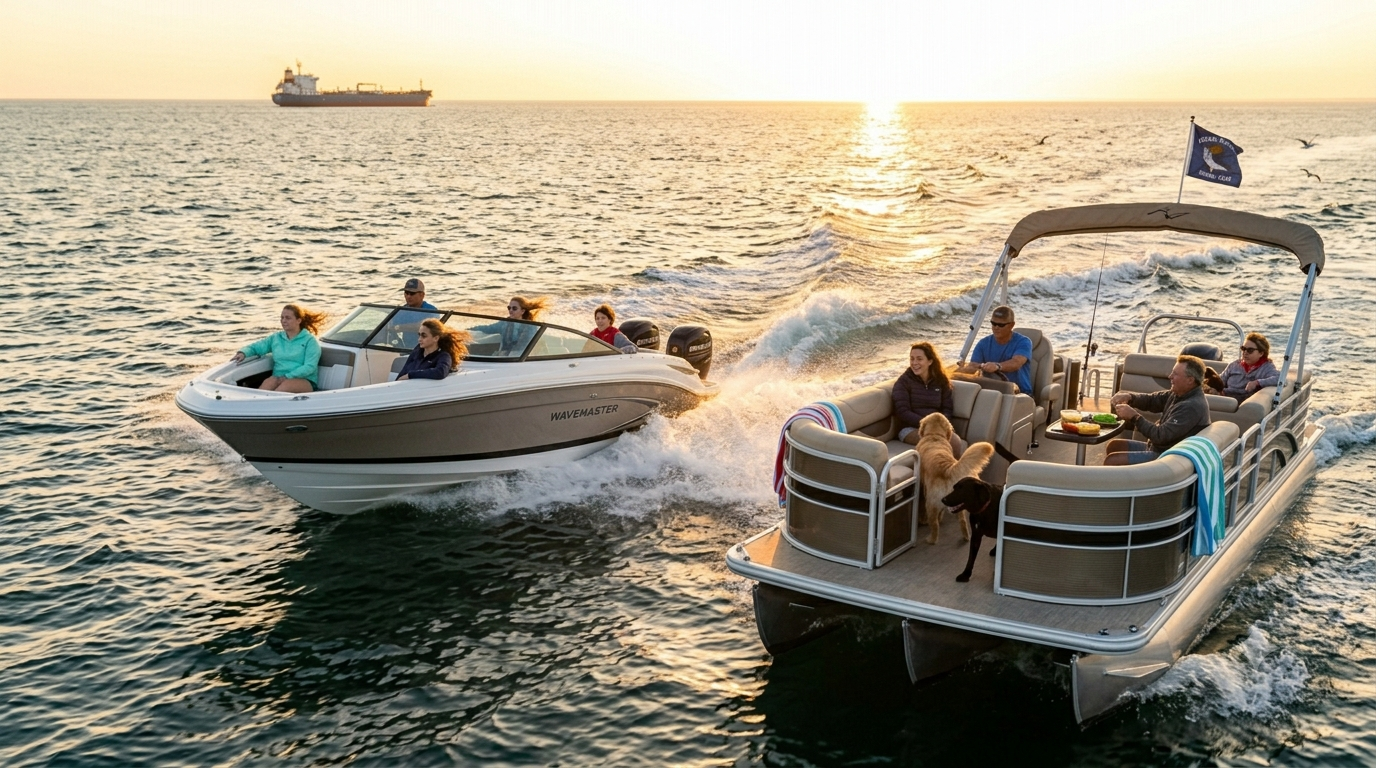

Every summer, thousands of families make the same mistake. They stand at a marina or boat show, fall in love with something that looks like fun, and buy it — without ever really thinking through how they actually plan to use the boat, who will be on it, and whether the machine matches their life on the water.
The pontoon buyer who wanted to tube and wake surf discovers their 90hp pontoon isn’t pulling the rope with enough urgency. The bowrider buyer who wanted lazy afternoons with the whole family discovers the fiberglass seating is genuinely uncomfortable for more than two hours and there’s nowhere to put the cooler.
The sea, once it casts its spell, holds one in its net of wonder forever.Jacques Cousteau
Neither boat is the wrong answer. Wrong for whom is the question.
This guide gives you the honest comparison between America’s two most popular family boat categories — pontoons and bowriders — so you walk away knowing exactly which one matches your family, your water, and your vision for a day on the lake.
What Is a Pontoon Boat?
A pontoon boat is a flat-decked platform supported by two or three aluminum tubes (pontoons) running underneath, providing buoyancy. The broad, flat deck creates a generous living platform — furniture-style seating around the perimeter, a central walkway, and often a rear swim platform and ladder.
Pontoons are primarily about comfort, capacity, and accessibility. They’re designed for groups — typically 8–14 passengers comfortably — on leisurely days of swimming, fishing, entertaining, and soaking up the sun. The stable platform makes boarding easy for all ages and abilities, and the furniture-style layout makes social interaction natural rather than everyone facing forward in fixed seats.
Modern pontoons have evolved significantly. Performance pontoon packages with 300–400hp engines, tritoon configurations (three tubes for more stability and speed), and premium audio and upholstery options have expanded the category well beyond the slow, gentle reputation of earlier generations.
Best for: Families with diverse ages and abilities, social lake days, multi-family outings, fishing trips with casual atmosphere, calm water cruising, and buyers who prioritize passenger comfort and capacity.
What Is a Bowrider?
A bowrider is a V-hull fiberglass boat with open seating extending into the bow (front) section — the distinctive feature that gives the category its name. The driver operates from a center console amidships, passengers sit in rear bench seats and the forward bow seating area, and the classic V-hull design delivers performance, responsiveness, and the ability to handle choppier water far better than a flat pontoon deck.
Bowriders are the quintessential performance family boat — designed for watersports (tubing, waterskiing, wake surfing), spirited cruising, and a more energetic on-water experience than a pontoon delivers. They’re faster, handle wake and chop better, and offer the kind of ride that makes teenagers and young adults genuinely excited to be on the water.
The trade-offs: seating is more limited (typically 6–10 passengers), the bow seating is exposed and can be wet in choppy conditions, there’s less overall deck space for socializing, and the fiberglass hull requires more maintenance care than aluminum pontoon construction.
Best for: Families focused on watersports, buyers who want spirited performance, smaller groups prioritizing on-water experience over passenger capacity, and buyers on lakes or bays with significant chop or boat traffic.
Head-to-Head: The Key Differences
Watersports Capability
Bowrider wins decisively here. The V-hull design, stronger power-to-weight ratio, and clean wake from a properly tuned bowrider make it the natural choice for waterskiing, wakeboarding, tubing, and wake surfing.
Pontoons with 250hp+ triple-tube configurations can pull towables with surprising competence — and are genuinely adequate for tubing and light wakeboarding. But the wake profile of a pontoon isn’t designed for wake surfing, the performance ceiling is lower, and the overall experience for dedicated watersports riders is noticeably behind a purpose-built towboat or bowrider.
If watersports are your primary purpose, bowrider wins.
Passenger Comfort and Social Experience
Pontoon wins here — and it’s not close. The furniture-style perimeter seating, walk-around deck, and flat stable platform create a social environment that a bowrider’s fixed stadium seating simply can’t replicate.
For families with grandparents, young children, or guests who aren’t avid boaters, the pontoon’s wide, stable, easy-to-navigate deck is genuinely friendlier. Getting on and off is easier. Moving around is easier. Sitting for four hours while others swim and grill is more comfortable.
For multigenerational family days and social entertaining on the water, pontoon wins.
Rough Water Performance
Bowrider wins. The V-hull design cuts through chop, handles wake from other boats more confidently, and provides a more controlled ride in wind and wave conditions that would make a flat pontoon deck uncomfortable and potentially dangerous.
On flat, calm inland lakes, this difference matters less. On larger lakes with afternoon wind and boat traffic, it matters considerably.
For buyers on large, exposed bodies of water with regular chop, bowrider wins.
Family with Young Children
Pontoon wins. The wide, flat, fenced deck is inherently safer for young children — less risk of falling overboard, easier to supervise, and a more forgiving environment for kids who move unpredictably. The swim platform and ladder make getting back on board easier for smaller children.
Families with toddlers and young children typically choose pontoon.
Cost
Comparable models across categories price similarly — entry-level pontoons and entry-level bowriders can both be found from $20,000–$35,000 new. At the upper end, premium tritoon pontoons with high-performance packages can reach $100,000+, as can premium sterndrive bowriders.
The maintenance cost distinction is real over time: aluminum pontoon construction is generally more durable and less maintenance-intensive than fiberglass, which requires regular gelcoat maintenance and is more susceptible to cosmetic damage.
The Pontoon vs. Bowrider Quick Reference
| | Pontoon | Bowrider |
| Passenger capacity | 8–14+ | 6–10 |
| Deck space | Large, walk-around | Moderate, fixed seating |
| Stability | Excellent (flat water) | Good |
| Rough water handling | Moderate | Good–Excellent |
| Watersports | Adequate–Good | Good–Excellent |
| Young child safety | Excellent | Good |
| Construction | Aluminum | Fiberglass |
| Maintenance | Lower | Moderate–Higher |
| Speed potential | 25–50+ mph (performance tri) | 35–55+ mph |
| Social atmosphere | Excellent | Good |
Who Should Buy a Pontoon?
Buy a pontoon if:
- You want the most accessible, maintenance-friendly option
- Your priority is a relaxed, social day on the water with a large group
- Your family includes grandparents, young children, or guests who aren’t avid boaters
- You fish casually and want a comfortable platform for it
- Your primary water is a calm inland lake with limited chop
- You want the most accessible, maintenance-friendly option
Who Should Buy a Bowrider?
Buy a bowrider if:
- Watersports are a significant part of why you’re buying a boat
- Your family is primarily teenagers and adults who want an energetic on-water experience
- You’re on larger water with regular wind and boat traffic
- Speed and handling are important to the enjoyment you’re seeking
- You have a smaller core group of regular passengers
Before You Buy — Questions Worth Asking
“Not all those who wander are lost.” — J.R.R. Tolkien
- What will a typical day on the boat look like? Walk through it specifically — who’s coming, what are they doing, what time of day, what kind of water. The boat that fits that vision wins.
- Have you rented both types? One afternoon on a rented pontoon and one on a rented bowrider tells you more than any comparison article.
- What does your primary body of water look like? Small, flat lake → pontoon leans. Large, busy lake with afternoon chop → bowrider leans.
- Is there a dock and how difficult is access? Pontoons are easier to dock and maneuver for less experienced skippers.
The Honest Bottom Line
Both boats are excellent. The question is matching the boat to your actual life on the water rather than an idealized version of it.
Most American families end up happier on a pontoon than they expected — because a relaxed, social, comfortable day on the water turns out to be exactly what they wanted. Some families are genuinely happiest behind a bowrider because the watersports and the performance are the whole point.
Be honest about which family you are. The water will be there either way.