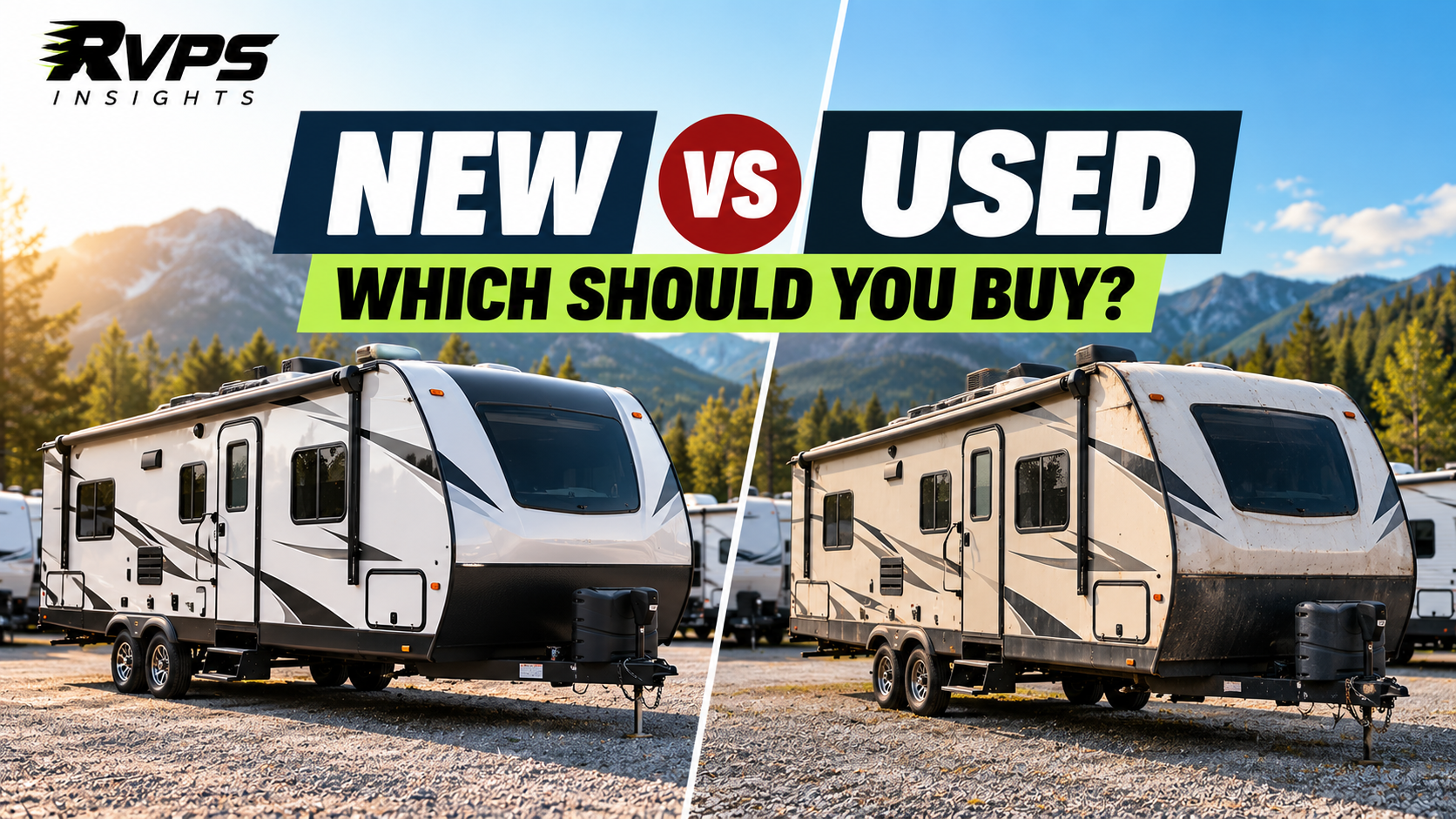

Buying an RV is a significant financial decision, and one of the first questions most shoppers face is whether to purchase new or used.
- 1. Latest technology and floorplans
- 2. Manufacturer warranty
- 3. You know the RV’s history
- 4. More choice in specifications
- Higher upfront cost
- Depreciation
- New doesn’t necessarily mean problem-free
- 1. Lower purchase price
- 2. Access to higher-end RVs
- 3. Some depreciation has already occurred
- 4. Previous-owner upgrades
- Condition can vary dramatically
- Water damage deserves special attention
- Maintenance records matter
- Consider a new RV if:
- Consider a used RV if:
- Short ownership period
- Long ownership period
- Quick New vs. Used Checklist
A new RV gives you access to the latest floorplans, technology, appliances, safety features and manufacturer warranty coverage. A used RV can provide a lower purchase price and allow you to get into a higher-end model without paying the original new-RV price.
But the purchase price is only part of the equation.
Depreciation, financing, insurance, maintenance, repairs, condition, warranty coverage and how long you plan to own the RV can all affect the real cost of your decision.
So, should you buy a new or used RV?
There isn’t one answer that works for every buyer. The better choice depends on your budget, experience, intended use and willingness to deal with maintenance and potential repairs.
New vs. Used RV at a Glance
| Factor | New RV | Used RV |
|---|---|---|
| Purchase price | Generally higher | Generally lower |
| Latest features | Usually available | Depends on model year |
| Warranty | Manufacturer warranty may apply | May have limited or no factory warranty |
| Depreciation | Typically higher early in ownership | Some initial depreciation has already occurred |
| Maintenance history | New history | Should be reviewed carefully |
| Repair risk | New doesn’t mean repair-free | Condition varies significantly |
| Customization | More options on some models | Previous owner’s upgrades may help |
| Financing | Financing commonly available | Financing availability varies by age/model/lender |
| Inspection | Still important | Especially important |
| Resale considerations | More depreciation to absorb | May have less depreciation remaining |
The important point is that neither option eliminates ownership costs. You’re simply taking on different combinations of upfront cost, depreciation, warranty coverage and repair risk.
Why Buy a New RV?
The biggest advantage of buying new is that you’re purchasing the RV in its original condition, with the latest available model-year features.
1. Latest technology and floorplans
New RVs often introduce updated layouts, appliances, entertainment systems, connectivity features, energy-management systems and other technology.
For buyers who specifically want the latest features, shopping new can make it easier to find exactly what they’re looking for.
2. Manufacturer warranty
Depending on the manufacturer and the specific RV, a new vehicle may come with factory warranty coverage.
That can provide some protection against qualifying defects during the warranty period.
However, buyers should read the actual warranty terms rather than assuming every component or repair is covered.
3. You know the RV’s history
With a new RV, you don’t have to investigate how the previous owner used or maintained it.
A used RV could have experienced heavy travel, poor storage, water intrusion, modifications or inadequate maintenance. A well-maintained used RV can still be an excellent purchase, but determining its condition requires more research.
4. More choice in specifications
Depending on inventory and manufacturer availability, buying new can give you more control over the floorplan, equipment and options you want.
That can be particularly useful if you already know exactly how you intend to use the RV.
The Downsides of Buying New
A new RV also comes with some important considerations.
Higher upfront cost
New models generally cost more than comparable used RVs.
That higher purchase price can affect your down payment, monthly payment, insurance costs and total financing cost.
RVIA’s latest lender survey reported that the average amount financed in 2025 was $61,261 for new RV purchases and $59,266 for used RV purchases among reporting institutions. These figures are industry averages, not quotes for an individual buyer.
Depreciation
Depreciation is one of the biggest financial considerations when buying new.
RV values can decline significantly after purchase, although the amount and speed of depreciation vary by RV type, model, condition, demand and market conditions. J.D. Power notes that depreciation varies considerably among RV types and that travel trailers generally depreciate differently from motorized RVs.
This is particularly important if you think you may sell or trade the RV after only a few years.
New doesn’t necessarily mean problem-free
A new RV has never been owned, but that doesn’t mean every component will work perfectly from day one.
An RV combines numerous systems—plumbing, electrical, HVAC, appliances, slide-outs, tanks and other components—into one vehicle.
Some owners may encounter warranty repairs or adjustments during the early ownership period.
Why Buy a Used RV?
The biggest attraction of a used RV is usually value.
Instead of paying for a brand-new RV, you may be able to purchase an older model with many of the features you want for substantially less.
1. Lower purchase price
A used RV can reduce the amount of money you need to spend upfront.
That can potentially leave more room in your budget for:
- Repairs
- Upgrades
- Camping equipment
- Solar and battery systems
- Insurance
- Travel
- Emergency savings
J.D. Power also maintains current RV pricing and used-value information that buyers can use to research individual models.
2. Access to higher-end RVs
A used RV can sometimes allow buyers to consider models that were outside their new-RV budget.
For example, someone who cannot comfortably afford a particular luxury fifth wheel when new might find an older version within their budget.
The important thing is to compare condition and total ownership cost, not simply model year.
3. Some depreciation has already occurred
A used RV has already experienced some portion of its depreciation.
That doesn’t mean a used RV cannot lose additional value. It simply means the original owner has already absorbed some of the early depreciation.
4. Previous-owner upgrades
A used RV may already have useful additions such as:
- Solar panels
- Lithium batteries
- Inverter systems
- Awning upgrades
- Suspension improvements
- Upgraded mattresses
- Backup cameras
- Entertainment systems
- Storage solutions
These additions don’t necessarily increase the RV’s value dollar-for-dollar, but they can make a used RV more attractive if the upgrades are properly installed and in good condition.
The Downsides of Buying Used
The biggest challenge with a used RV is knowing exactly what you’re buying.
Condition can vary dramatically
Two five-year-old RVs can be in completely different condition.
One might have been carefully stored, maintained and lightly used. Another could have experienced water intrusion, neglected maintenance or extensive wear.
That’s why a used RV should be evaluated based on its actual condition, not simply its age or mileage.
Water damage deserves special attention
Water intrusion is one of the issues buyers should take particularly seriously.
Check:
- Roof and roof seals
- Windows
- Slide-outs
- Exterior seams
- Ceiling
- Walls
- Floors
- Storage compartments
- Areas around plumbing
Look for staining, soft spots, unusual odors, bubbling, damaged sealants or other evidence of moisture.
Maintenance records matter
Ask for documentation showing how the RV was maintained.
Depending on the RV type, this could include:
- Engine service records
- Generator maintenance
- Oil changes
- Tire replacement
- Appliance repairs
- Roof maintenance
- Warranty repairs
- Major modifications
J.D. Power’s used-RV inspection guidance also recommends checking maintenance history, tires, brakes, electrical systems, exterior condition, seals and evidence of leaks or mold. JD Power
The Real Cost: Don’t Compare Only the Sticker Price
One of the biggest mistakes RV shoppers can make is comparing only the purchase prices.
Instead, consider the total cost of ownership.
A simple framework is:
Purchase price + financing cost + insurance + registration + maintenance + repairs + storage + expected depreciation − resale value
You don’t need to predict every expense perfectly. The objective is to understand which costs could materially change your decision.
For example, a $45,000 used RV isn’t automatically cheaper to own than a $55,000 newer RV if the older unit needs substantial repairs soon after purchase.
Likewise, a more expensive new RV isn’t necessarily the better financial choice if you plan to sell it after a short ownership period and absorb significant depreciation.
A Simple Decision Test
Ask yourself these questions before shopping.
Consider a new RV if:
- You want the latest floorplan or technology.
- You want potential factory warranty coverage.
- You prefer knowing the complete ownership history.
- You have a specific configuration in mind.
- You’re comfortable with the higher purchase price.
- You expect to keep the RV for several years.
- You want to minimize the uncertainty associated with an older RV.
Consider a used RV if:
- Keeping the initial purchase price lower is important.
- You are comfortable researching and inspecting used RVs.
- You don’t need the latest technology.
- You’re willing to consider older floorplans.
- You want access to a higher-end model at a lower purchase price.
- You’re prepared to budget for repairs and maintenance.
- You find a well-maintained RV with good documentation.
These aren’t rules. They’re simply factors that can help organize the decision.
Don’t Skip the Inspection
Whether you’re buying new or used, an inspection is worth considering.
For a used RV, it becomes especially important.
A professional RV inspection can examine areas that aren’t always obvious during a quick dealership or private-party walkthrough.
For a motorhome, the inspection should also consider the vehicle’s mechanical components.
For a towable RV, pay close attention to:
- Frame and hitch
- Tires
- Brakes
- Suspension
- Roof
- Seals
- Slide-outs
- Appliances
- Plumbing
- Electrical systems
- Water tanks
A test drive or tow evaluation should also be considered where appropriate.
What About Financing?
Financing can change the economics of both choices.
Don’t compare loans based solely on the monthly payment.
Look at:
- Interest rate
- APR
- Loan term
- Down payment
- Total interest
- Amount financed
- Prepayment conditions
- Fees
A longer loan can make the monthly payment look more manageable while increasing the total amount paid over the life of the loan.
This is particularly important for RVs because the loan balance and the RV’s market value can change at different rates.
For more information, see our related guide: [How RV Financing Works].
Think About How Long You’ll Own It
Your expected ownership period should be part of the calculation.
Short ownership period
If you think you’ll sell or trade the RV after only a few years, depreciation deserves significant attention.
Long ownership period
If you expect to keep the RV for many years, the initial depreciation may matter less than the RV’s reliability, maintenance requirements and suitability for your lifestyle.
This is one reason there isn’t a universal answer to the new-versus-used question.
The same RV can make financial sense for one buyer and poor financial sense for another.
A Better Way to Compare Two RVs
Instead of asking:
“Is new better than used?”
compare two actual RVs.
For example:
RV A — New
- Purchase price
- Down payment
- Financing cost
- Warranty
- Insurance
- Expected maintenance
- Expected resale value
RV B — Used
- Purchase price
- Down payment
- Financing cost
- Remaining warranty
- Insurance
- Expected maintenance
- Immediate repairs/upgrades
- Expected resale value
Then compare the estimated total cost over the period you expect to own the RV.
That approach is much more useful than simply comparing model years.
The Bottom Line
A new RV offers the appeal of the latest features, a known history and potential factory warranty coverage. A used RV can offer a lower entry price, access to higher-end models and the benefit of having already absorbed some depreciation.
But neither option is automatically the better financial decision.
The right choice depends on how you plan to use the RV, how much you can comfortably spend, how long you intend to own it, your tolerance for repairs and how carefully you evaluate the specific RV you’re considering.
For a first-time buyer, the best starting point isn’t deciding between new and used.
It’s deciding what type of RV you actually need, what you can comfortably afford, and what ownership costs you can handle after the purchase.
Once you have those answers, comparing new and used examples becomes much easier.
Quick New vs. Used Checklist
Before making an offer, ask:
Budget
- What’s my maximum purchase price?
- What monthly payment can I comfortably afford?
- Have I budgeted for insurance, storage and maintenance?
RV
- Does the floorplan fit my needs?
- Can my vehicle safely tow it?
- Is the RV appropriate for how I plan to travel?
Condition
- Has the RV been professionally inspected?
- Is there evidence of water intrusion?
- Are the tires, roof and seals in good condition?
- Are maintenance records available?
Financial
- What’s the APR and total financing cost?
- How much depreciation should I expect?
- What could the RV realistically be worth when I sell it?
Ownership
- How long do I expect to keep it?
- Can I afford unexpected repairs?
- Where will I store it?
If you can answer those questions, you’ll be in a much stronger position to compare the two options.