

The generator is running. It’s 10:30 at night, and the couple in the site next to yours has been listening to it for the last four hours. They’re not thrilled. You’re not thrilled. The generator itself sounds entirely indifferent.
- How RV Solar Actually Works
- Understanding Your Power Needs
- Batteries: The Heart of the System
- Solar Panels: How Many Do You Need?
- Starlink and Solar: The Off-Grid Connectivity Combination
- What Does a Good RV Solar System Cost?
- Factory Solar vs. Retrofit: What to Know
- Before You Build Your System
- The Honest Bottom Line
Keep close to Nature’s heart… and break clear away, once in a while, and climb a mountain or spend a week in the woods. Wash your spirit clean.
John Muir
There’s a better way.
RV solar power has crossed a genuine threshold in 2026. It’s no longer an enthusiast project requiring deep electrical knowledge and a spreadsheet. It’s increasingly a factory-standard feature on new RVs, straightforward to retrofit on existing rigs, and the single most transformative upgrade most RV owners can make to their camping experience.
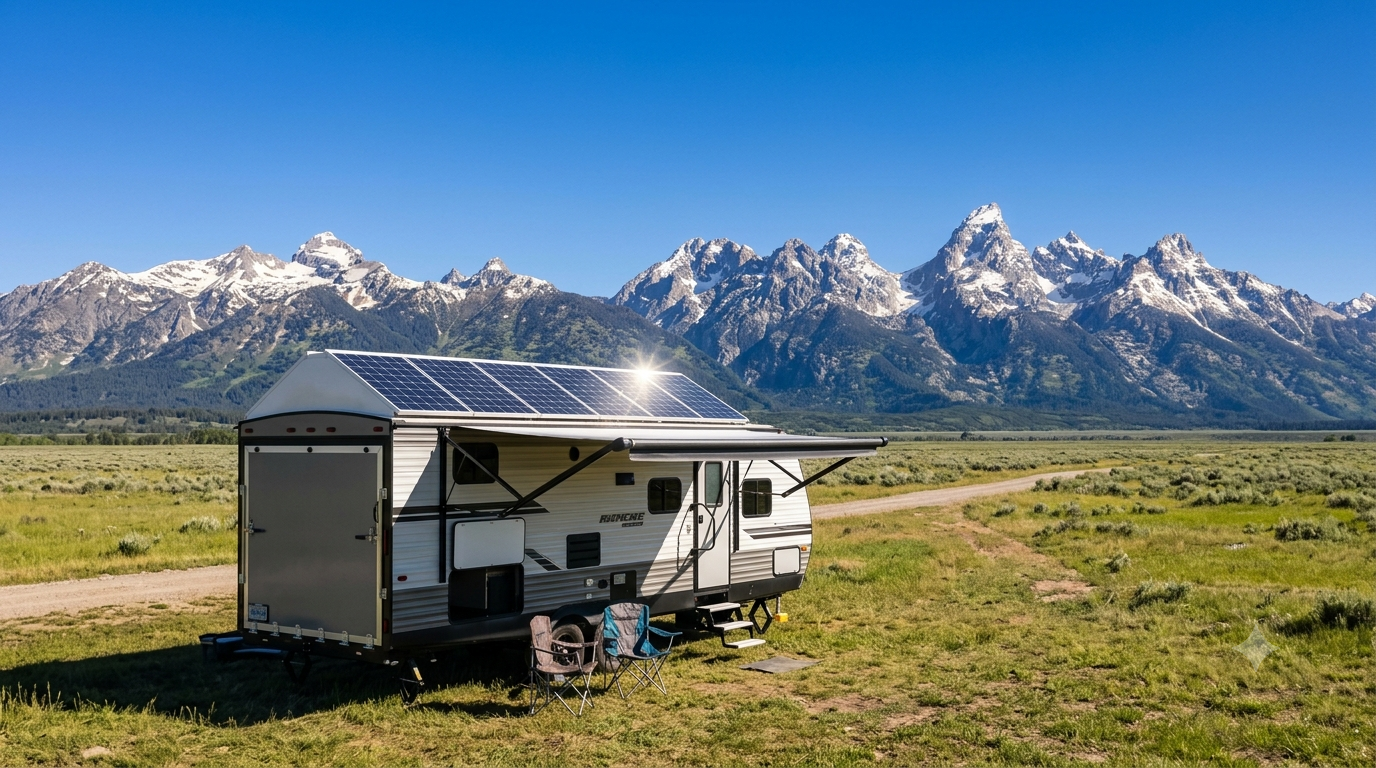
Silent power. Free fuel. The ability to camp in places that don’t have electrical hookups and still run your refrigerator, charge your devices, power your lights, and — with the right setup — even run your air conditioner.
This guide explains exactly how it works, what you actually need, what it costs, and how to build a system that matches the way you camp.
How RV Solar Actually Works
The concept is simple. Solar panels on your roof convert sunlight into direct current (DC) electricity. That electricity passes through a charge controller, which regulates the flow to protect your batteries. The batteries store the energy. An inverter converts the stored DC power to alternating current (AC) for standard household appliances. You run your RV.
In practice, four components make up the heart of any RV solar system:
Solar Panels capture sunlight and convert it to electricity. The measurement that matters is wattage — a 200W panel produces 200 watts of power under ideal conditions. Most RV solar setups run 200–800W for basic to moderate off-grid use; serious full-timers or air conditioning users may run 1,000W or more.
Charge Controller sits between the panels and the batteries and manages the charging process. There are two types — PWM (older, cheaper, less efficient) and MPPT (modern, more efficient, the right choice for any system above 100W). An MPPT controller extracts 20–30% more energy from your panels than a PWM in most conditions.
Batteries store the energy produced by your panels. This is where the most significant technology shift in RV solar has happened over the past five years. Lithium batteries have largely replaced AGM and lead-acid in serious solar setups for good reason — they’re lighter, charge faster, can be discharged more deeply without damage, and last significantly longer. More on this in the battery section below.
Inverter converts DC battery power to AC household current for running standard appliances — microwaves, TVs, laptops, phone chargers. A pure sine wave inverter is the right choice for sensitive electronics; modified sine wave is cheaper but can damage some devices.
Understanding Your Power Needs
Before sizing a solar system, you need to know how much power you actually use. This is the step most beginners skip — and it’s the reason many solar setups are either inadequate or unnecessarily expensive.
Start by listing every device you run and how long you run it daily:
| Appliance | Watts | Hours/Day | Daily Watt-Hours |
| Refrigerator (12V RV fridge) | 40–60W | 24 | 600–900 Wh |
| Laptop | 45–65W | 4 | 180–260 Wh |
| LED Lighting | 20–40W total | 4 | 80–160 Wh |
| Phone charging (2 phones) | 20W | 2 | 40 Wh |
| Fan | 20–50W | 8 | 160–400 Wh |
| Water pump | 60W | 0.5 | 30 Wh |
| Basic daily total | 1,000–1,800 Wh |
Air conditioning is in a different category — a standard 13,500 BTU RV A/C draws 1,300–1,500W. Running it for 4 hours consumes 5,200–6,000 watt-hours per day — roughly three to five times the rest of your daily usage combined. Running air conditioning on solar alone is possible in 2026 with the right (large, expensive) setup but should be planned for specifically rather than assumed.
Batteries: The Heart of the System
The battery bank is where your solar energy lives — and the battery choice determines how your system performs under real conditions more than any other component.
Lithium (LiFePO4) — The Right Choice for Most Buyers in 2026
Lithium iron phosphate batteries (LiFePO4) have become the dominant choice for RV solar in 2026 for a compelling set of reasons:
Usable capacity. A 100Ah lithium battery delivers approximately 100Ah of usable power — you can safely draw it down to near zero. An equivalent lead-acid battery delivers only 50Ah of usable capacity before damage begins at 50% discharge. For equal usable storage, you need twice the lead-acid capacity.
Weight. A 100Ah lithium battery weighs approximately 24–31 lbs. An equivalent 100Ah AGM battery weighs 60–70 lbs. In an RV where every pound counts for towing capacity and fuel economy, this matters.
Charge speed. Lithium batteries accept charge at a much higher rate than lead-acid — they can absorb full solar output without the charge tapering that affects lead-acid chemistry. This means faster charging from panels or shore power.
Lifespan. Quality lithium batteries are rated for 2,000–5,000 charge cycles vs. 300–500 for AGM. A lithium battery that lasts a decade versus a lead-acid battery that needs replacement every 3–5 years changes the total cost calculation significantly.
The cost reality. Lithium costs more upfront — roughly 2–3x the purchase price of an equivalent AGM setup. Over a 10-year ownership period, the total cost of ownership often favors lithium when replacement cycles are factored in.
How Much Battery Capacity Do You Need?
A practical rule of thumb: size your battery bank to hold 2 days of your daily usage without recharging. If you use 1,500Wh per day, you want 3,000Wh of usable storage — which is 250Ah of lithium capacity (at 12V) or 500Ah of lead-acid.
For most campers doing basic off-grid use (no air conditioning), a 100–200Ah lithium bank is the starting point. Serious boondockers and full-timers typically run 200–400Ah.
Solar Panels: How Many Do You Need?
The general rule: your solar array should be able to replenish your daily usage in 4–5 hours of good sun — accounting for the fact that you’ll rarely get more than 5 peak sun hours per day in most of the US, and often fewer in winter or cloudy conditions.
For 1,500Wh of daily usage, you need to generate 1,500Wh during your solar day. At 5 peak sun hours, that requires 300W of panels. Build in a 20–30% buffer for losses and inefficiencies, and you’re looking at 400W as a practical minimum.
Panel types:
Monocrystalline panels are the standard for RV use — higher efficiency (18–22%), better performance in low light and high heat, and a proven track record. These are what you see on most serious RV solar setups.
Flexible panels are thinner and can conform to curved roofs, but they’re less efficient, run hotter, and have a shorter lifespan than rigid monocrystalline panels. They’re a compromise solution for rigs where mounting rigid panels isn’t practical.
Portable folding panels aren’t mounted on the roof — they deploy at camp and can be angled toward the sun for maximum output. Good as a supplement to a roof-mounted system or as a starting point for buyers not ready to commit to a permanent installation.
Starlink and Solar: The Off-Grid Connectivity Combination
One of the most significant developments in 2026 for the off-grid RV community is the pairing of lithium solar systems with Starlink for connectivity. The Starlink Mini — drawing approximately 20–40W — can be powered by a properly sized solar system without materially affecting your power budget. Full-size Starlink draws 65–100W but is similarly manageable in a well-sized system.
The combination of solar power and Starlink connectivity has genuinely changed what full-time boondocking looks like. Remote workers who would previously have been limited to cellular dead zones can now operate from dispersed BLM camping, national forests, and truly remote locations with both power and internet — a combination that wasn’t practically accessible five years ago.
What Does a Good RV Solar System Cost?
Costs vary significantly based on system size and component quality. Here are realistic ranges for complete, properly installed systems:
| System Size | Best For | Estimated Cost |
| 200W + 100Ah lithium | Basic camping, minimal appliances | $800–$1,500 |
| 400W + 200Ah lithium | Most full-timers, basic off-grid | $1,800–$3,000 |
| 600W + 300Ah lithium | Serious boondocking, multiple devices | $3,000–$5,000 |
| 1,000W+ + 400Ah+ lithium | Air conditioning capable, full off-grid | $6,000–$12,000+ |
DIY installation reduces costs significantly — an experienced DIYer can build a 400W/200Ah lithium system for $1,200–$1,800 in components. Professional installation at an RV service center adds $500–$1,500 in labor depending on complexity.
Factory Solar vs. Retrofit: What to Know
Many 2026 new RVs come with solar prep — wiring and a charge controller pre-installed — and some include entry-level panel systems. The value of factory solar varies:
Factory solar prep (just wiring, no panels) is valuable because the installation labor of running wires through the RV is already done. Adding panels later is significantly easier and cheaper.
Factory solar systems on entry-level RVs often include 100W panels and AGM batteries — functional but limited. If serious off-grid use is your plan, treat the factory system as a starting point and plan to upgrade the batteries to lithium and add panels within the first year.
Retrofit solar on an existing RV is entirely practical if the roof has space and the wiring runs are manageable. Most experienced RV solar installers can complete a basic retrofit in a day.
Before You Build Your System
“The world is a book, and those who do not travel read only one page.” — Saint Augustine
Before buying a single component, answer these:
- How many days per week are you off-grid vs. on hookups? If you’re mostly on hookups, an elaborate solar system may not be worth the investment.
- Do you plan to run air conditioning on solar? If yes, budget for a significantly larger system from the start.
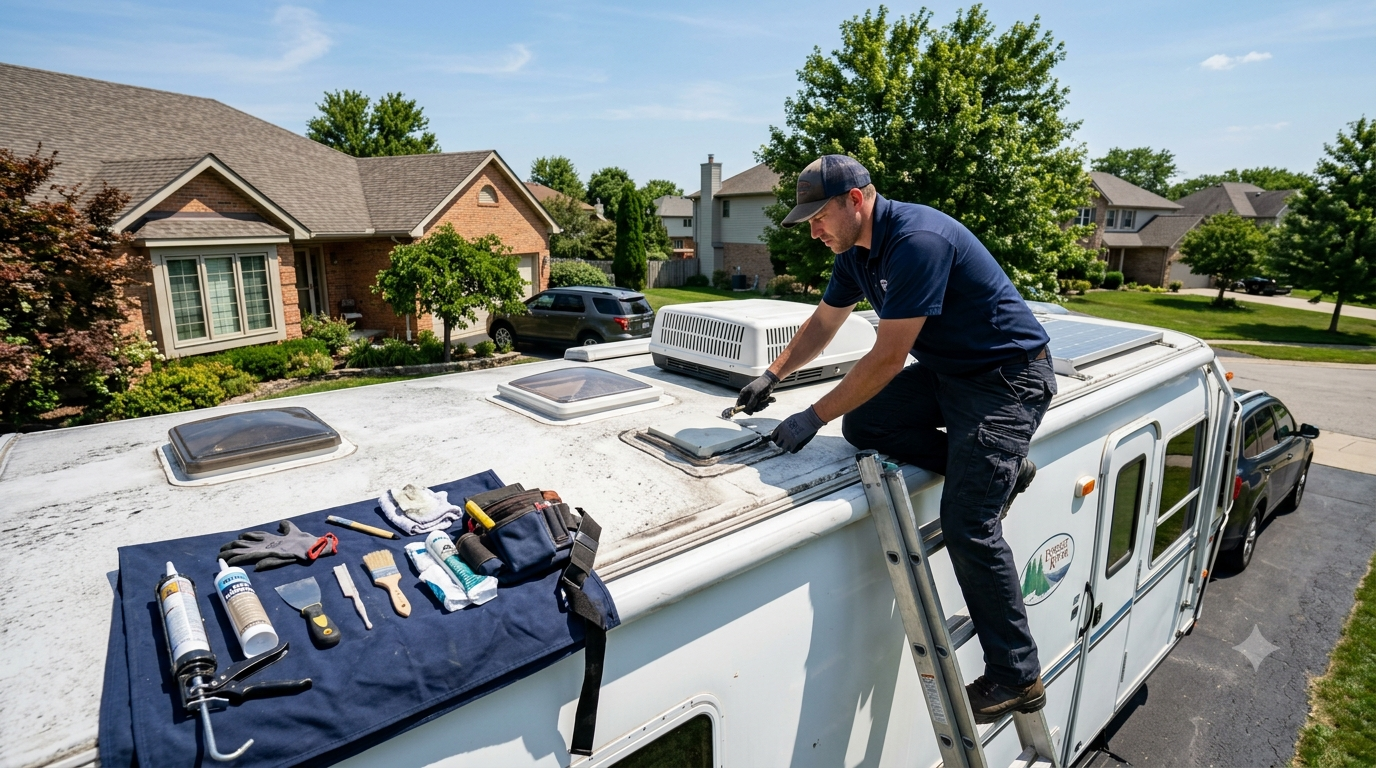
- Is your RV roof in good condition? Installing solar on a roof that needs resealing creates double work.
- Are you comfortable with basic DC electrical work, or do you need professional installation? Both are valid — know which one you are.
The Honest Bottom Line
RV solar power in 2026 is not a luxury upgrade or an enthusiast niche. It’s a practical, financially sensible way to expand where you can camp, eliminate generator noise from your life, and reduce your ongoing operating costs.
Done right, a properly sized solar system pays for itself over 3–5 years in campsite fees avoided at full-hookup parks. Done wrong — undersized panels, wrong battery type, mismatched components — it frustrates and disappoints.
Do the math for your specific usage. Buy quality components. Install it properly. Then go camp somewhere you couldn’t have gone before — because now you have the power to stay.