

So you’ve decided to go towable. Smart move. Towable RVs give you the best of both worlds — a comfortable home base at the campsite and a separate vehicle to explore with once you’re parked. But now comes the real fork in the road: travel trailer or fifth wheel? It’s one of the most debated decisions in the RV world, and for good reason. Both are excellent options. Both have passionate fan bases. And both have trade-offs that matter enormously depending on how you camp.
- What’s the Difference? Understanding the Basics
- Head-to-Head: The Key Differences
- At a Glance: Travel Trailer vs Fifth Wheel
- What They Have in Common
- Gas vs. Diesel: Does Your Truck Choice Matter?
- Top Brands to Know in Each Category
- Before You Buy — Questions to Ask Yourself
- So, Which One Is Right for You?
Here’s everything you need to know to make the right call.
To travel is to live.
Hans Christian Anderson
What’s the Difference? Understanding the Basics
At first glance, a travel trailer and a fifth wheel might seem like variations of the same thing — a towable RV pulled behind a truck. But the connection point changes everything about how they tow, how they feel inside, and what kind of lifestyle they support.
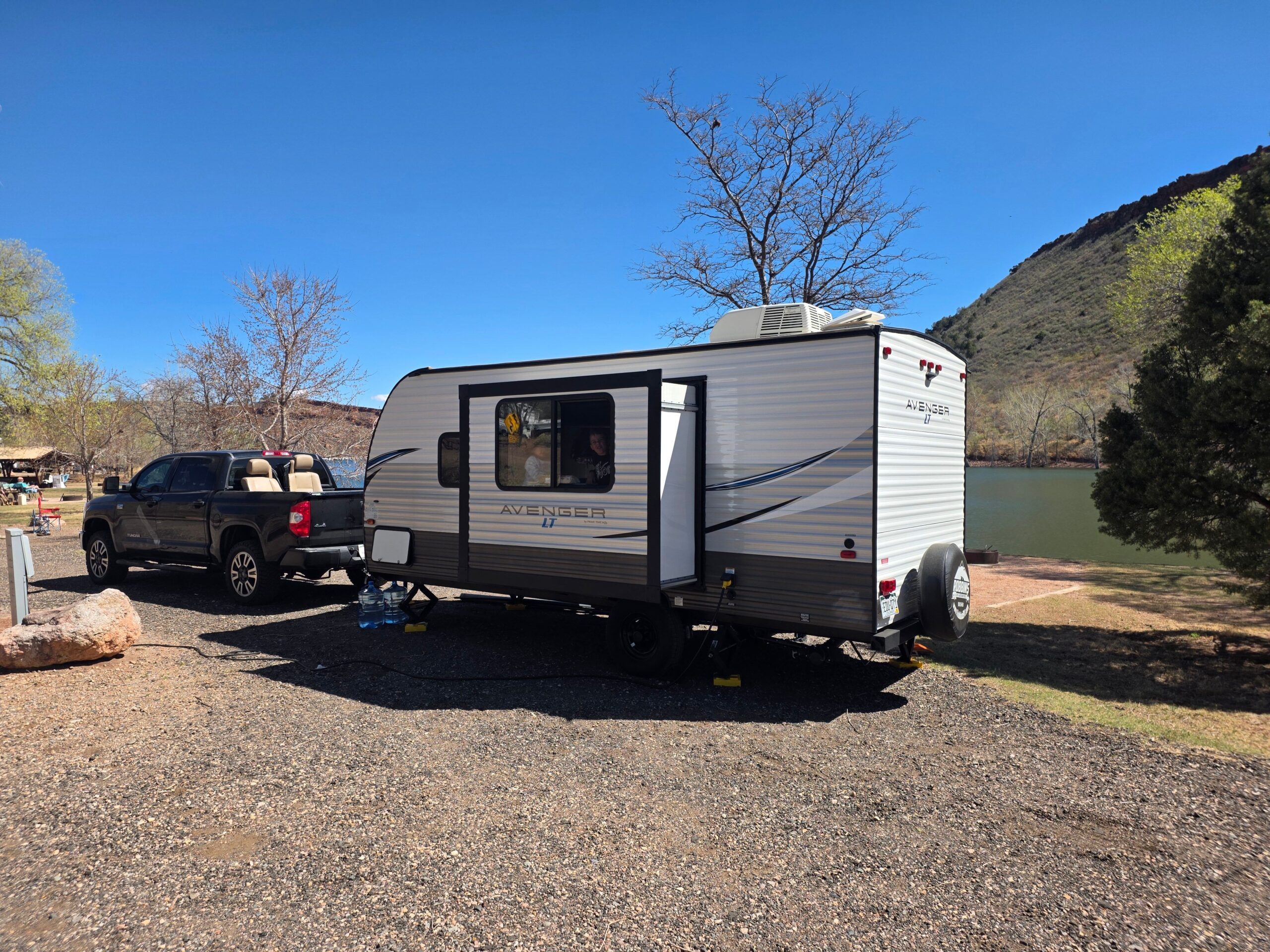
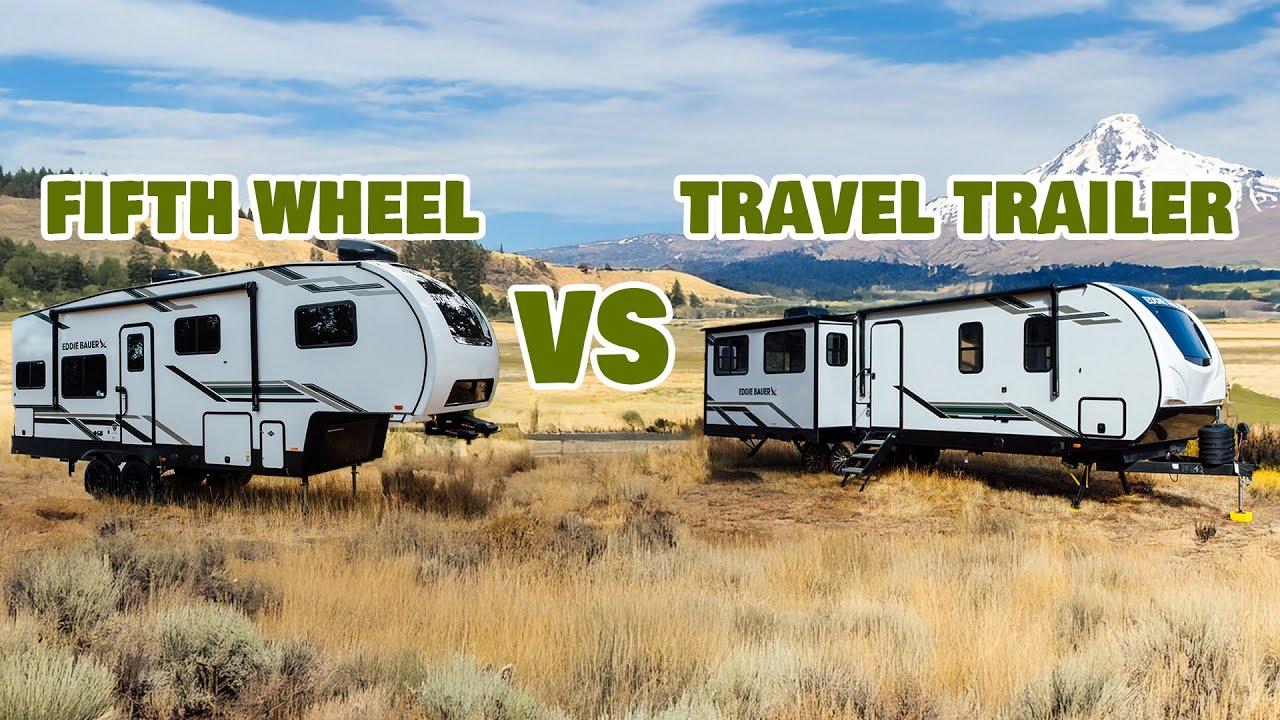
Travel trailers connect to a standard hitch receiver mounted under the rear bumper of the tow vehicle. This means they’re compatible with a wide range of vehicles — from half-ton trucks to large SUVs and even some minivans for lighter models. They come in an enormous variety of sizes, from compact teardrops under 15 feet to large bunkhouse models pushing 35 feet with multiple slide-outs. The layout is almost always single-level, and setup is straightforward once you know the routine.
Fifth wheels connect through a specialized kingpin hitch mounted in the bed of a pickup truck — the same coupling mechanism used by commercial semi-trucks. This over-the-axle connection is what gives fifth wheels their signature two-story profile, with the front section elevated above the truck bed. Fifth wheels are almost always larger than travel trailers, typically ranging from 30 to 40+ feet, and their bi-level layout creates a genuinely different living experience — more space, higher ceilings, and real basement storage.
The hitch location is the starting point. Everything else follows from there.
Head-to-Head: The Key Differences
Tow Vehicle Requirements
This is the single most important practical distinction between the two — and for many buyers, it’s the decision-maker.
Travel trailers offer far more flexibility on tow vehicle choice. Lightweight models can be pulled by mid-size SUVs, half-ton trucks, and even some crossovers. You may already own a vehicle capable of towing a travel trailer, which eliminates a major upfront cost. Even the larger travel trailers typically require only a half-ton or three-quarter-ton truck.
Fifth wheels are non-negotiable: you need a pickup truck, full stop. Not just any pickup either — most fifth wheels require a three-quarter-ton (2500 series) or one-ton (3500 series) heavy-duty truck with a dedicated fifth wheel hitch installed in the bed. If you don’t already own one, budget $50,000–$90,000+ for a capable tow vehicle on top of the RV purchase price.
Winner: Travel Trailer — dramatically more tow vehicle flexibility and lower total cost of entry.
Living Space & Interior Comfort
Fifth wheels win on space — and it’s not close. The bi-level design created by the over-cab section gives fifth wheels higher ceilings, a dedicated raised bedroom area with genuine privacy separation, and a living room that feels like a real room rather than a converted corridor. Many fifth wheels feature residential-quality kitchens, full-size appliances, theater seating, and king-size beds as standard features — not upgrades.
Travel trailers stay mostly single-level. Floor plans are clever and increasingly well-designed, but the footprint is more compact and the ceiling height more modest. Slide-outs add meaningful living space, and premium travel trailer brands have closed the gap considerably — but if you put a 35-foot fifth wheel and a 35-foot travel trailer side by side, the fifth wheel almost always wins on interior volume and livability.
Winner: Fifth Wheel — more space, better privacy, more residential feel.
Towing Stability & Handling
Fifth wheels have a significant advantage here. The over-the-axle hitch connection distributes weight more evenly between the front and rear axles of the tow vehicle, resulting in a more stable, predictable tow with less sway. Most experienced fifth wheel owners describe towing one as feeling like the trailer is “part of the truck” rather than following behind it.
Travel trailers tow behind the vehicle’s rear bumper, which places more leverage on the hitch and creates more potential for trailer sway — especially in crosswinds, at highway speeds, or when passing large vehicles. Weight distribution hitches and sway control bars help considerably, but they add cost and setup time. Backing a travel trailer also requires more space — fifth wheels can be jackknifed due to their over-the-axle connection, making them easier to maneuver in tight campsite spots.
Winner: Fifth Wheel — more stable on the road and easier to back into tight sites.
Campsite Flexibility
Travel trailers have the clear edge here. Their smaller average footprint opens up campground options that fifth wheels simply can’t access — National Parks, older state park campgrounds, Forest Service sites, and backcountry spots often impose strict length restrictions that rule out most fifth wheels. And because they’re towable by more vehicle types, travel trailer owners tend to be more spontaneous — easier to hook up and go on short notice.
Fifth wheels, given their size, are best suited to private RV parks and upscale campground resorts with larger sites and full hookups. If you plan to spend most of your time in well-equipped parks and don’t need to squeeze into tight spots, the size limitation becomes largely irrelevant. But if campsite variety and flexibility matter to you, the travel trailer wins.
Winner: Travel Trailer — more campsite options, more spontaneity.
Storage
Fifth wheels are the storage champions of the towable world. Their elevated front section creates what’s called “basement storage” — large, accessible pass-through compartments underneath the main floor that rival the cargo space of a full-size SUV. Full-time RVers in particular love the ability to store tools, outdoor gear, seasonal items, and supplies without crowding the living space.
Travel trailers offer more limited exterior storage, though premium models have improved significantly. The real trade-off is the truck bed: a fifth wheel hitch occupies much of the bed, limiting its use for hauling gear. Travel trailer owners keep the truck bed fully usable — a meaningful advantage if you carry bikes, kayaks, ATVs, or other outdoor equipment.
Winner: Fifth Wheel for interior/exterior storage. Travel Trailer for preserving truck bed utility.
Cost & Value
Travel trailers are more affordable across the board. Lower purchase price, lower tow vehicle requirements (or no new vehicle needed at all), lower insurance, and lower fuel costs all add up. The resale market is also broader — more buyers can tow a travel trailer, which tends to support better resale values relative to the purchase price.
Fifth wheels carry a higher price tag at every level of the market, and when you factor in the heavy-duty truck requirement, the total investment can be substantially higher. That said, fifth wheels also tend to hold their value well among serious full-time RVers who prioritize the space and comfort they provide.
Winner: Travel Trailer — lower cost at every stage of ownership.
At a Glance: Travel Trailer vs Fifth Wheel
| Travel Trailer | Fifth Wheel | |
| Hitch type | Rear bumper receiver | Truck bed kingpin |
| Tow vehicle | SUV, half-ton, or 3/4-ton truck | 3/4-ton or 1-ton pickup required |
| Size range | 12–35 feet | 30–45+ feet |
| Interior feel | Single-level, compact | Bi-level, spacious, residential |
| Towing stability | Good (with sway control) | Excellent |
| Campsite flexibility | High | Moderate |
| Storage | Moderate | Excellent (basement) |
| Starting price | $15,000+ | $35,000+ |
| Best for | First-timers, flexibility seekers | Full-timers, families, luxury buyers |
What They Have in Common
Despite their differences, travel trailers and fifth wheels share the most important advantage of any towable RV: the ability to park your home at the campsite and drive away freely. No taking the RV to the grocery store. No parking a 40-foot vehicle at the trailhead. Your tow vehicle unhitches and goes wherever you need it, while your living space stays comfortable and waiting.
Both also offer 100% livable interior square footage — no driver’s cab eating into your living area like a motorhome. Both support slide-outs, solar panels, off-grid packages, and the full range of modern RV amenities. And both are available from the same trusted brands — Grand Design, Jayco, Forest River, Keystone, and others — across a wide range of price points and floor plan styles.
Gas vs. Diesel: Does Your Truck Choice Matter?
If a fifth wheel is in your future — or if you’re eyeing a larger travel trailer — your tow vehicle’s engine choice deserves serious thought.
Gas-powered trucks cost less upfront and are cheaper to service at most shops. For travel trailers under 8,000 lbs, a gas half-ton is often perfectly adequate. But for heavy fifth wheels, gas trucks can strain at altitude or in mountain terrain and burn considerably more fuel.
Diesel trucks deliver the torque that heavy towing demands — critical for fifth wheels in the 12,000–18,000 lb range. Better fuel efficiency at highway speeds, longer engine life, and dramatically better pulling power in challenging conditions make diesel the preferred choice for serious fifth wheel owners. The trade-off is higher purchase price and diesel repair costs that vary by location.
For travel trailer buyers, a gas half-ton truck or large SUV handles most models comfortably. For fifth wheel buyers, a diesel three-quarter-ton or one-ton is worth the investment if you plan to travel frequently or tackle hilly terrain.
Top Brands to Know in Each Category
Travel Trailer — Top Brands
- Grand Design Reflection — Premium build quality and exceptional customer satisfaction; a consistent top pick for value-conscious buyers
- Jayco Jay Flight — Best-selling travel trailer line for years; family-friendly layouts and solid construction
- Forest River Salem — Broad range of floor plans at accessible price points; reliable value across the lineup
- Keystone Cougar — Well-equipped models with strong feature sets for the price
Fifth Wheel — Top Brands
- Grand Design Solitude — Widely regarded as one of the best fifth wheels in the luxury segment; outstanding quality and owner satisfaction
- Keystone Montana — The best-selling fifth wheel in North America for over two decades; legendary for space and value
- Jayco Eagle — A premium fifth wheel with excellent construction and family-focused floor plans
- Forest River Cardinal — Strong build quality with generous standard features at a competitive price point
Before You Buy — Questions to Ask Yourself
“The world is a book, and those who do not travel read only one page.” — Saint Augustine
Before you head to the lot, work through these honestly:
- What do I already own for towing? If you drive an SUV or half-ton truck, a fifth wheel likely means buying a new vehicle before you ever buy the RV.
- How often and how far will I travel? Weekend warriors benefit from travel trailer simplicity. Long-haul full-timers often appreciate fifth wheel comfort.
- How many people need sleeping space? Larger families typically find fifth wheels more comfortable for extended trips.
- Where will I camp most often? National Parks and backcountry spots favor travel trailers. Private RV resorts suit fifth wheels well.
- Do I need my truck bed? If you haul gear, bikes, or equipment regularly, a fifth wheel hitch in the bed changes your daily utility.
- What’s my realistic total budget? Don’t forget to factor in the tow vehicle, hitch installation, insurance, and storage — not just the RV sticker price.
So, Which One Is Right for You?
Here’s the honest bottom line: the right choice comes down to how you camp, what you drive, and how much space you actually need.
If you value flexibility, lower costs, and the ability to camp almost anywhere — or if you’re a first-time buyer who wants a lower-stakes entry into towable RVing — the travel trailer is your rig. It’s more versatile, more affordable, and far more forgiving as you figure out your RV rhythm.
If you’re ready to invest in a true home on wheels — one with residential space, basement storage, rock-solid towing stability, and the kind of comfort that makes full-time or extended living genuinely enjoyable — the fifth wheel is worth every dollar and every diesel fill-up.
Both will get you somewhere worth going. The difference is how you want to live when you get there.
Ready to explore both options in person? Visit us to walk through our full lineup of travel trailers and fifth wheels — our team will help you find the perfect match for your tow vehicle, your budget, and your next adventure.