

Nobody gets on an ATV for the first time and thinks something bad will happen to them. That’s not how people think. You think about the trail ahead, the friends you’re riding with, the October air and the leaves changing and the feeling of the throttle under your right thumb.
And then the trail turns, the terrain shifts, or the throttle response surprises you — and suddenly you’re in a situation that your instincts don’t automatically know how to handle.
ATVs are machines with genuine physics. They tip. They dig. They respond to throttle input in ways that feel backward to instincts trained by driving a car. The riders who stay safe aren’t lucky — they learned specific skills, developed specific habits, and built a knowledge base that gave them options when things got unexpected.
This guide gives you that foundation. Not in the generic “wear a helmet” way — but in the specific, honest, experience-based way that actually prepares you for what’s out there.
Before You Ride: The Non-Negotiables
Gear That Actually Matters
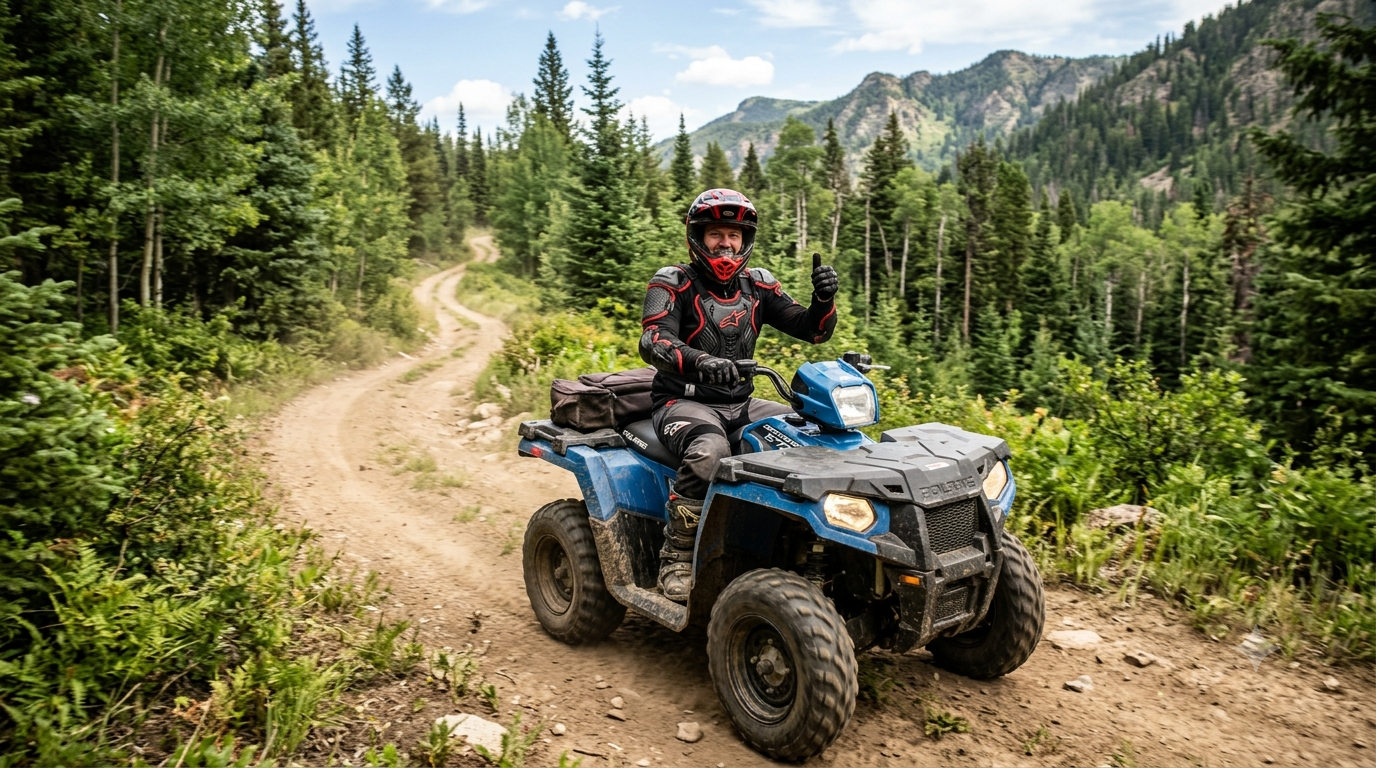
Helmet — DOT or ECE certified, every single ride. Not a bicycle helmet. Not a motorcycle street helmet unless it has an open-face or full-face design rated for off-road use. A DOT-certified ATV or dirt bike helmet. Wear it from the moment you’re on the machine to the moment you get off — including the slow trip from the trailer to the trail.
Head injuries are the leading cause of ATV fatality. A helmet doesn’t make you invincible, but it reduces the severity of head impacts in a way nothing else does. This isn’t negotiable.
Goggles or face shield. Flying debris, mud, branches, dust, and insects are constant hazards at any speed. Goggles designed for off-road use seal around the eyes and protect against impacts. If your helmet has an integrated face shield, that works too — just make sure it’s rated for impact protection, not just UV.
Gloves. When you go down — and at some point, most riders go down — your hands go out first. ATV-specific gloves protect against abrasion, impact, and vibration fatigue on long riding days.
Over-the-ankle boots. Not sneakers. Not work boots. Boots that provide ankle support, toe protection, and a thick sole that resists catching on foot pegs. Motocross boots are ideal; at minimum, heavy leather work boots that cover the ankle.
Long pants and a long-sleeved shirt or jacket. Skin doesn’t handle gravel and brush contact well. Riding pants with knee and hip padding are ideal for beginners. At minimum, heavy denim and a thick jacket reduce abrasion severity.
The Five Most Important Riding Skills for Beginners
1. Body Position Is Everything
The single most impactful thing a new ATV rider can learn is how to use their body to control the machine rather than fighting it.
For flat terrain: Sit upright with a slight forward lean. Weight through the footpegs rather than the seat. This keeps your center of gravity low and lets you respond to terrain changes.
Climbing hills: Lean forward aggressively — chest toward the handlebars if the grade is steep. Your weight needs to be over the front end to prevent the ATV from tipping backward on a climb. If you feel the front wheels getting light, you’re already leaning back too far — this is when tip-overs happen.
Descending hills: Lean back slightly. Engage engine braking. Never allow the machine to pick up uncontrolled speed going downhill — use the brakes in smooth, progressive applications rather than grabbing them abruptly.
Cornering: Shift your weight to the outside footpeg in corners and lean slightly into the turn. Counterintuitive compared to car driving — but critical for ATV handling.
2. Throttle Control — The Skill That Prevents Most Accidents
The leading cause of new rider incidents on ATVs is abrupt, uncontrolled throttle application. ATVs respond to throttle faster than most beginners expect — and the consequence of a sudden burst of power in the wrong situation (a steep climb, a loose corner, a crossing) is not recoverable with instinct alone.
Practice throttle control deliberately. In a safe open area, practice smooth roll-on and roll-off inputs. Learn to modulate rather than snap. Build a feel for how your specific machine responds before taking it into terrain that demands precise control.
3. Reading Terrain Before You’re On It
Train yourself to look ahead — not at the ground directly in front of your wheels. Experienced riders are always reading the terrain 20–30 feet ahead, anticipating what’s coming and adjusting speed and position before they arrive at it.
Specific hazards to identify early:
- Ruts that cross the trail at an angle (can catch a wheel and throw direction)
- Loose gravel over hardpack on corners (low traction when you need it most)
- Water crossings (depth and bottom composition unknown until you’re in it — approach slowly)
- Camber — trail that slopes to one side (raises tip-over risk, particularly on the uphill side)
4. Knowing When to Stop
The most dangerous words in off-road riding are “I wonder if I can make it.”
If a trail section is beyond your current skill level — too steep, too technical, unknown depth crossing — stopping, assessing, and either finding a different line or dismounting to walk the section is always the right call. No trail is worth an injury. No group has the right to pressure you into terrain you’re not ready for.
The riders who never have serious accidents are the ones who’ve developed a finely calibrated sense of their own limit and enforce it consistently — even when someone else would push through.
5. The ATV Doesn’t Stop Like a Car
ATV braking requires technique that’s different from automotive instinct. Most ATVs have separate front and rear brake controls. Abrupt application of the front brake can cause a forward pitch-over. Locking the rear brake causes a skid that can turn into a lateral slide on loose surfaces.
Practice braking in a safe area before riding trails. Learn to apply brakes progressively and to use front and rear in combination rather than grabbing either one abruptly.
The Hills: Where Most Serious Incidents Happen
Hills deserve their own section because hill-related incidents — rollovers, tip-overs, and runaway descents — are responsible for a disproportionate share of serious ATV injuries.
Rule 1: Never traverse a steep hill sideways. Traversing (crossing a hill at an angle rather than going straight up or down) dramatically raises tip-over risk. Go straight up and straight down whenever terrain allows.
Rule 2: If you can’t make a climb, don’t. Getting stuck halfway up a steep hill with the engine stalling is how backward rollovers happen. If a climb is beyond your ability or your machine’s traction — stop before you commit, not after.
Rule 3: Never roll a ride back downhill. If an engine stall happens on a steep climb, don’t try to turn around while on the slope. Get off the machine. Secure it if possible. Evaluate your options from a stable position.
Rule 4: Engine braking first, physical braking second on descents. Use lower gear and the engine to control descent speed before adding brake input. Progressive, controlled braking prevents wheel lockup that leads to uncontrolled slides on steep descents.
Riding With Others: Group Safety
Group ATV rides are more fun than solo rides — and statistically more likely to involve incidents that could be avoided.
Ride within your own ability — not the group’s pace. The fastest rider in a group setting a pace that stresses everyone else is a social pressure that kills judgment. Ride your own ride. A good group waits at intersections and adjusts pace to the least experienced rider.
Maintain safe following distance. The rider in front of you makes decisions based on what they see from their position. If they brake suddenly or go down, you need time to react. The minimum following distance in trail riding is 10–15 seconds behind the preceding rider.
Establish hand signals before you start. Stop, slow down, obstacle ahead, turn left/right. Agree on them before you leave the staging area, not while you’re moving.
Water Crossings: Treat Every One as Unknowns
Water crossings are where ATV trips most often turn into unexpected adventures — the unplanned kind.
The depth, current, and bottom composition of a water crossing you haven’t made before are unknowns until you’re in it. Approach every unfamiliar crossing slowly, assess from the bank first if possible, and enter at a shallow angle that gives you options if conditions are different than expected.
If water enters the air intake, the engine hydrolock — a potentially catastrophic failure. Know where your air intake is and what depth puts it at risk.
If you’re unsure about a crossing — don’t cross. Find another route or wait until you have more information. An hour of exploring for an alternative crossing is worth more than a drowned engine and a long, expensive extraction.
Before You Go Riding
“Not all those who wander are lost.” — J.R.R. Tolkien
Every ride, before you start:
- Is everyone wearing a helmet and appropriate gear?
- Has the machine been checked — tire pressure, oil level, brake function?
- Does someone know where you’re going and when to expect you back?
- Do you have water, a phone (even in areas with no signal — cameras work), and basic first aid?
- Are you familiar with the terrain level ahead — or are you treating it as unknown?
The Honest Bottom Line
Riding ATVs is genuinely wonderful. The freedom, the terrain, the physical engagement, the access to places you couldn’t reach on foot — all of it is real and worth pursuing.
The riders who enjoy it for decades are the ones who built their skills deliberately, respected terrain that was beyond their current ability, wore their gear consistently, and developed judgment — not just throttle response. None of that is complicated. All of it is learnable.
Start with a safety course. Build your skills on forgiving terrain. Wear the gear. The trails will still be there as your skills develop. And they’ll be more enjoyable every time, because you’ll be able to ride more of them confidently.