
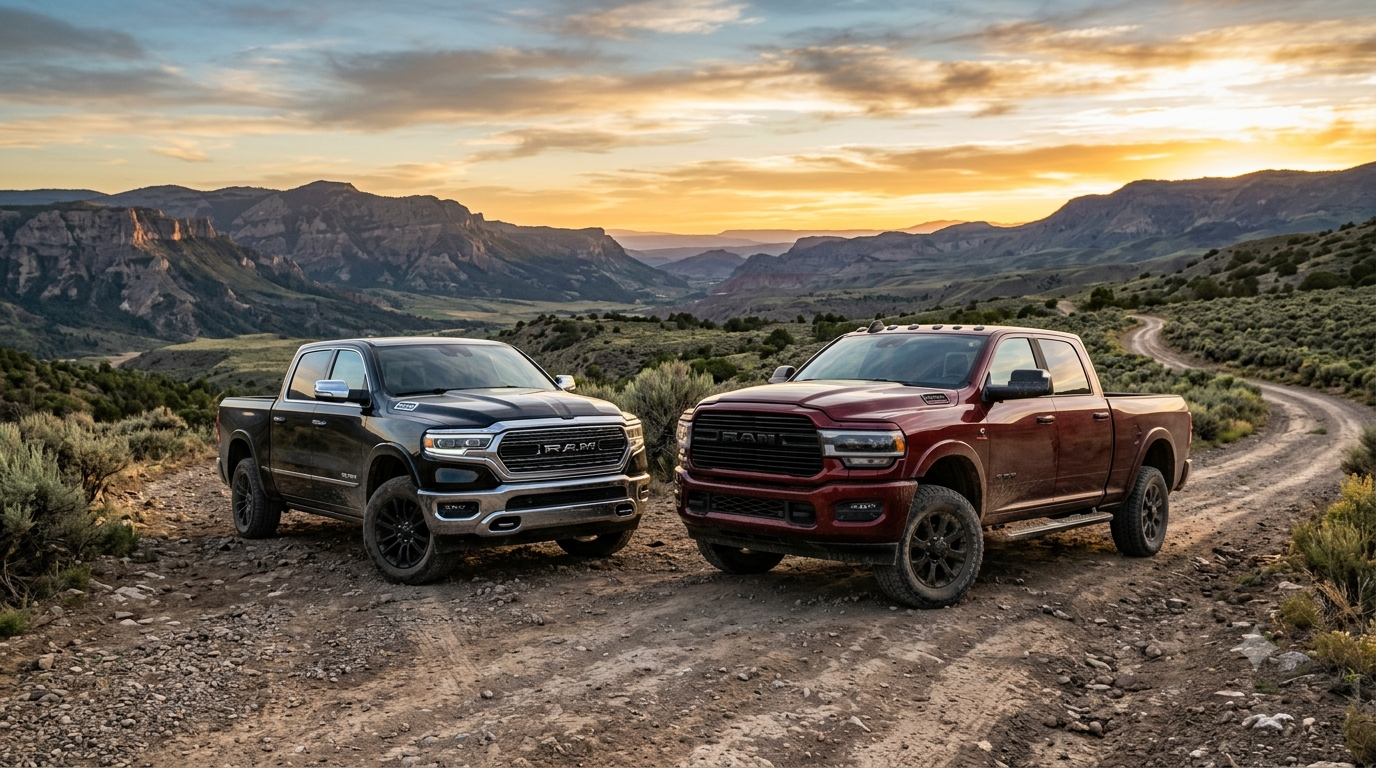

Here’s the conversation that happens thousands of times a year at Ram dealerships across America: a buyer walks in knowing they want a Ram, sits down at the finance desk, and ends up with a 2500 when their life genuinely called for a 1500 or vice versa.
The upsell from 1500 to 2500 is easy to make. More truck sounds like more capability. More capability sounds like more value. And the buyer who wants to be prepared for anything doesn’t want to walk away from a dealership with a truck that might someday feel inadequate.
But more truck isn’t always better truck. A 2500 that’s overkill for 90% of your driving costs more to buy, more to fuel, more to maintain, and handles differently in daily driving in ways that matter. And a 1500 that’s undersized for your actual towing needs creates real safety concerns that no amount of wanting to save money justifies.
This guide gives you the honest comparison so you can make the right decision not the impressive one.
The Fundamental Difference: What the Numbers Mean
Before models and options, understand the core capability difference.
Ram 1500: Half-ton truck. Maximum tow rating up to 12,750 lbs (properly equipped, 5th wheel). Maximum payload up to 2,320 lbs. 3.6L V6, 3.0L EcoDiesel, or 5.7L HEMI engine options.
Ram 2500: Heavy-duty three-quarter-ton truck. Maximum tow rating up to 20,000 lbs (properly equipped diesel). Maximum payload up to 4,010 lbs. 6.4L HEMI gas or 6.7L Cummins High-Output diesel engine options.
The gap between those numbers is not a minor upgrade, it’s a fundamentally different class of vehicle with fundamentally different capabilities. The 2500 isn’t a beefed-up 1500; it’s a different truck built on a heavier frame with a larger axle, heavier suspension, and a powertrain designed for sustained heavy-load operation.
The Ram 1500: More Than Enough for Most People
Starting Price: $38,000 (Tradesman) | Tow: Up to 12,750 lbs | Payload: Up to 2,320 lbs
The Ram 1500 is one of the finest half-ton trucks ever built and in 2026, it continues to earn its reputation for the combination of ride quality, technology, interior refinement, and capability that made it a perennial segment leader.
The coil-spring rear suspension is the 1500’s signature advantage over the competition, it delivers a car-like ride quality on daily driving that traditional leaf-spring suspensions can’t match. If you spend 80% of your time driving empty or lightly loaded, the difference in daily comfort between a 1500 and a 2500 is genuinely significant.
The Ram 1500 is right for you if:
Your towing is consistently under 10,000 lbs, most travel trailers, boats, car haulers, campers, and recreational equipment fall here. The 1500 handles this class of load with confidence and the right hitch setup.
Your payload needs are under 1,500–1,800 lbs in real-world use (accounting for passengers and in-cab cargo alongside bed loads).
You value ride quality and fuel economy in daily driving. The 1500’s air suspension and coil springs deliver a noticeably smoother daily driving experience. The 3.0L EcoDiesel delivers 30+ MPG on the highway unloaded — remarkable efficiency for a full-size truck.
Your truck is also your daily driver commuting, errands, family transportation. The 1500’s refined interior and comfortable ride make this a genuinely pleasant everyday vehicle.
The 1500’s honest limitations: Extended heavy towing (9,000+ lb trailer on long trips, mountain passes) will stress a 1500’s brakes, transmission, and cooling system more than the equivalent 2500. The 1500 can do it but it works harder, runs hotter, and the equipment wears faster under sustained high-load conditions.
The Ram 2500: When the Job Actually Demands It
Starting Price: $45,000 (Tradesman) | Tow: Up to 20,000 lbs (diesel) | Payload: Up to 4,010 lbs
The Ram 2500 is a commercial-grade work truck that happens to also be available in configurations so comfortable and well-appointed that buyers forget what they’re driving until they need it. The 6.7L Cummins turbo-diesel engine is legendary in the heavy-duty truck world a proven industrial powertrain with the kind of low-end torque (over 900 lb-ft in High-Output configuration) that makes 15,000-lb trailers feel like they’re barely there.
The 2500’s leaf-spring rear suspension trades the 1500’s car-like ride for the load-carrying stability that heavy-duty use demands. Under significant load, the 2500 rides and handles far better than the 1500 the suspension is designed for the work. Unloaded, the ride is noticeably firmer a trade-off that experienced HD truck owners accept without complaint.
The Ram 2500 is right for you if:
You regularly tow 12,000+ lbs large fifth wheels, heavy equipment trailers, horse trailers with multiple horses, large boat setups. This is where the 2500’s capability advantage becomes a safety argument, not just a performance one.
You need maximum payload for commercial or agricultural use contractors, farmers, and ranchers who regularly carry significant bed weight and payload need the 2500’s rated capacity.
You do extended heavy towing on challenging terrain mountain passes, desert heat, long grades. The 2500’s powertrain, cooling system, and brakes are sized for sustained heavy-load operation in a way the 1500’s aren’t.
Your work demands the Cummins diesel for fuel economy under load, for the diesel torque advantage in heavy pulling, or for professional use where diesel infrastructure is already in place.
The 2500’s honest trade-offs: Costs more to buy ($7,000–$10,000 premium over comparable 1500). Gets meaningfully worse fuel economy unloaded (13–17 MPG diesel vs. 20–25 MPG for 1500 EcoDiesel). Firmer unloaded ride. Harder to park in urban environments. Higher maintenance costs.
The Cummins Decision
If you’re considering the 2500, the choice between the 6.4L HEMI gas engine and the 6.7L Cummins turbo-diesel deserves its own attention.
6.4L HEMI Gas: Lower purchase price ($9,000–$11,000 less than Cummins option), adequate power for most 2500 use cases, simpler maintenance without diesel-specific systems (DEF fluid, DPF, etc.), better performance in very cold climates. Good choice for buyers who want HD truck capability without the diesel infrastructure commitment.
6.7L Cummins Diesel: The definitive choice for maximum towing and payload. 900+ lb-ft of torque (High-Output). Better fuel economy under load than the HEMI. Outstanding long-term durability. Significantly better resale value (Cummins-equipped trucks command meaningful used premiums). The right choice for buyers whose primary use is commercial work and heavy recreational towing.
Head-to-Head: The Decision Matrix
| Ram 1500 | Ram 2500 | |
| Max tow rating | 12,750 lbs | 20,000 lbs (diesel) |
| Max payload | 2,320 lbs | 4,010 lbs |
| Daily ride quality | Excellent (coil springs) | Firm (leaf springs) |
| Unloaded MPG | 20–30 (diesel), 17–21 (gas) | 14–18 (diesel), 13–16 (gas) |
| Starting price | $38,000 | $45,000 |
| Diesel option | 3.0L EcoDiesel | 6.7L Cummins |
| Best for regular tow | Under 10,000 lbs | Over 12,000 lbs |
| Best daily driver | Yes | If you need the capability |
The Honest Test: What Do You Actually Tow?
Before deciding, look up the real weights of what you tow. Not the marketing weight the actual GVWR.
Common towing scenarios and which truck fits:
- 20–25 ft travel trailer (GVWR 6,000–8,000 lbs): Ram 1500 handles this comfortably with proper hitch equipment.
- Fifth wheel (GVWR 12,000–14,000 lbs): 1500 at the upper edge; 2500 the more confident choice.
- Large fifth wheel (GVWR 16,000–18,000 lbs): Ram 2500 required.
- Horse trailer (4 horses): Ram 2500 required.
- Heavy equipment trailer (loaded): Ram 2500 or 3500 depending on load.
- 20-ft boat (GVWR 6,000–8,000 lbs): Ram 1500 handles this well.
- Large boat or center console (12,000+ lbs): Ram 2500.
Before You Buy
- What is the GVWR of the heaviest thing you currently tow? Look it up not the dry weight, the GVWR.
- What is the maximum load you regularly carry in the bed? Add passengers and cab cargo to this.
- Is this your daily driver or a dedicated work/tow vehicle? If daily driver, the 1500’s ride quality advantage matters considerably.
- How often do you approach your towing or payload limits? Occasional vs. regular heavy use changes the calculus meaningfully.
The Honest Bottom Line
The Ram 1500 is the right truck for most buyers refined, capable, comfortable, and more than adequate for recreational and moderate work towing.
The Ram 2500 is the right truck for buyers who regularly work near or at the limits of what the half-ton class offers commercial operators, serious fifth wheel tourers, horse and livestock haulers, and agricultural professionals who need the Cummins and the heavy-duty platform.
Be honest about which category describes you. The answer is usually clearer than the showroom floor makes it seem.