
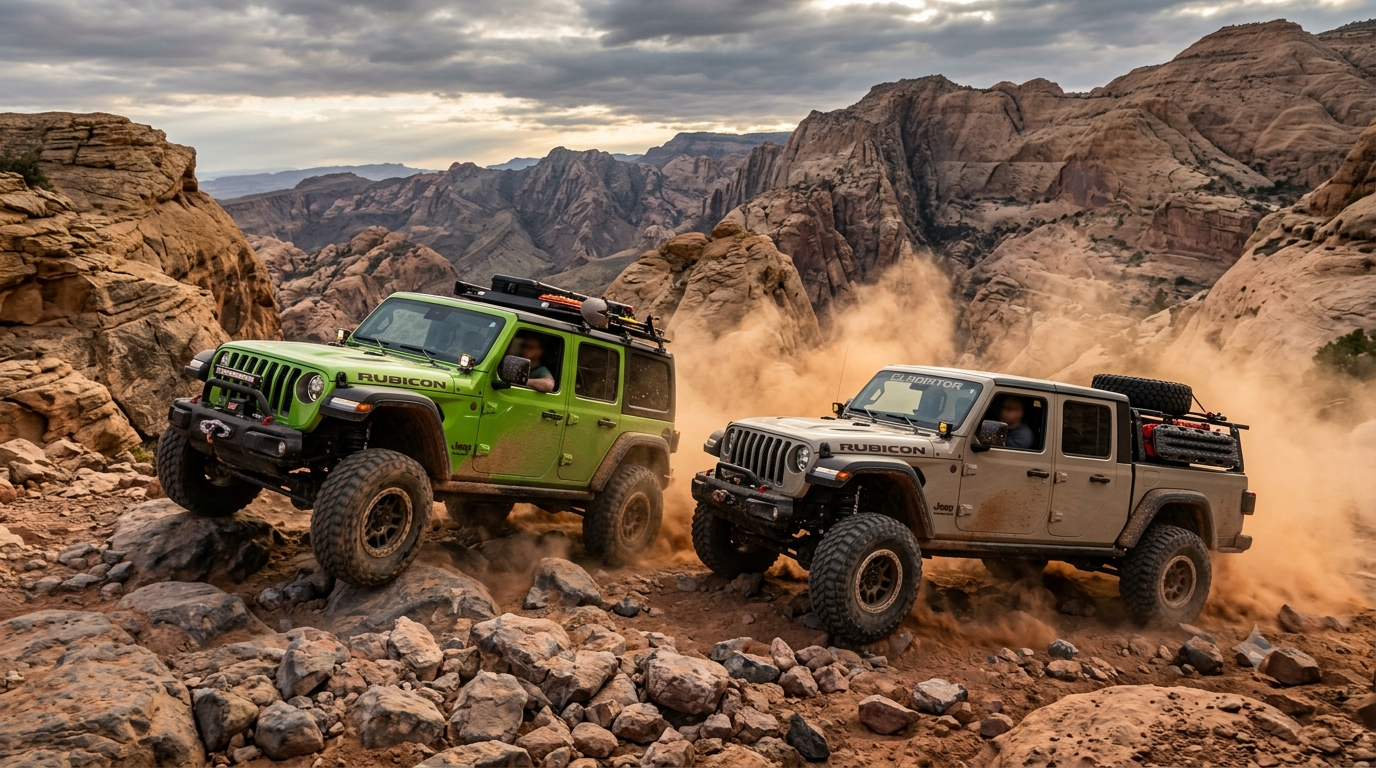

Few automotive debates generate the kind of passionate specificity that the Jeep Wrangler vs. Gladiator question does because both answers are genuinely defensible, both camps are fully committed, and the decision ultimately comes down to a set of lifestyle priorities that are deeply personal.
The Wrangler and Gladiator share a platform, a reputation, and a Trail Rated badge that represents genuine off-road engineering. They both have solid axles, proper 4WD systems, disconnecting sway bars, and the iconic Jeep design vocabulary. And then they diverge in ways that make them clearly the right choice for different buyers.
This is the comparison that settles the debate for your specific situation.
The Wrangler: The Original
Starting Price: $31,595 (Sport) | Wheelbase: 96.8″ (2-door) / 118.4″ (4-door Unlimited)
The Wrangler is the reason the Trail Rated badge means something. It’s been continuously refined for generations of off-road use evolving in technology and comfort while maintaining the fundamental architecture that makes it capable in terrain where other vehicles turn around.
The 4-door Wrangler Unlimited is the family-practical version that most buyers purchase four real doors, room for five passengers, a reasonable amount of cargo space, and all the off-road capability of the 2-door in a more livable daily package.
What the Wrangler delivers that no other vehicle in this price range matches is an off-road experience that’s both accessible and genuinely capable at the limit. The combination of solid axles, selectable 4WD, a 2-speed transfer case with proper low range, disconnecting front sway bar, and approach/departure angles that no unibody crossover can approach makes the Wrangler the honest choice for buyers whose trails actually test a vehicle.
The Wrangler’s on-road trade-offs are real. The solid axle front suspension, the short wheelbase, and the tall upright body create an on-road driving experience that rewards drivers who accept it, it requires more steering correction at highway speed than a unibody SUV, generates more wind noise, and offers ride quality that reflects the hardware under it. None of this is a defect; it’s the price of genuine off-road engineering. Experienced Wrangler owners make peace with it quickly and stop noticing it.
The Wrangler is right for you if:
- Off-road capability is the primary reason you’re in this conversation
- You don’t need to haul significant cargo that requires an open truck bed
- The 4-door Unlimited cabin space is adequate for your needs
- You want the most trail-capable Jeep available in a body-style that’s been proven over generations
The Gladiator: The Wrangler That Grew a Bed
Starting Price: ~$39,090 (Sport) | Wheelbase: 137.3″ | Bed Length: 60″
The Gladiator is essentially a Wrangler Unlimited with a 5-foot truck bed and that description, while accurate, undersells what that architectural change actually means for a specific type of buyer.
The truck bed is not just storage. It’s a fundamentally different relationship between the vehicle and what you carry. Bikes, kayaks, motorcycles, ATV gear, camping equipment, building materials, landscaping supplies, all of these go in the bed, accessible without folding seats and without managing cargo net configurations. It’s the practical difference between an SUV and a pickup truck, applied to a platform with Wrangler-level off-road credentials.
The longer wheelbase that the bed requires (137.3″ vs. 118.4″ for the 4-door Wrangler) creates a more stable highway and high-speed off-road experience, the additional length moderates the Wrangler’s characteristic body motion. The trade-off is reduced breakover angle (the belly of the vehicle has more exposure between the axles) and slightly reduced maneuverability in tight technical terrain.
The Gladiator is Trail Rated and genuinely capable, the same solid axles, the same 4WD hardware, the same Dana axles as the Wrangler. It’s not a compromise in capability; it’s a different capability balance.
The Gladiator is right for you if:
- You regularly haul gear, equipment, or materials that benefit from an open truck bed
- You tow, the Gladiator’s maximum tow rating of 7,650 lbs exceeds the Wrangler’s 3,500 lbs significantly
- You want off-road capability without giving up truck utility
- Your off-road riding is serious but not at the technical extreme where breakover angle becomes critical
Head-to-Head: The Key Differences
| Wrangler (4-door) | Gladiator | |
| Wheelbase | 118.4″ | 137.3″ |
| Cargo | 31.7–72.4 cu ft (interior) | 60″ truck bed (8.1 cu ft @ 1,000 lb payload) |
| Max tow rating | 3,500 lbs | 7,650 lbs |
| Breakover angle | 27.8° | 20.3° |
| Approach angle | 44.0° | 43.6° |
| Departure angle | 37.0° | 26.0° |
| Starting price | $31,595 | $39,090 |
| Highway stability | Good | Better (longer wheelbase) |
| Tight trail maneuverability | Better | Good |
| Best for | Max off-road, trail purists | Truck utility + off-road |
The Towing Argument
The Gladiator’s 7,650 lb maximum tow rating vs. the Wrangler’s 3,500 lbs is worth focusing on because it’s not a minor upgrade.
7,650 lbs opens up most mid-size campers, most ATVs and UTVs on a trailer, most mid-size boats, and many enclosed cargo trailers. The Wrangler’s 3,500 lbs is enough for a small camper or a light boat, but rules out most serious recreational towing.
For buyers who want genuine off-road capability and also tow a trailer with ATVs to the trail, or a camper to a boondocking spot, the Gladiator’s tow rating is not a trivial advantage.
The Overlanding Lens
Both the Wrangler and Gladiator have become central to the overlanding movement, the style of vehicle-based adventure travel that combines off-road capability with long-distance self-sufficiency.
For overlanding specifically, the Gladiator has a compelling case: the truck bed carries rooftop tent systems, camp kitchens, and expedition gear in a way that the Wrangler’s cargo area can’t match. Several overland-specific builds use the Gladiator’s bed as the foundation for comprehensive expedition setups, full sleeping platforms, water storage, fuel cans, and gear organization that would require a trailer on a Wrangler.
The Wrangler overlander typically runs a rack system or trailer. The Gladiator overlander often runs self-contained. Which approach fits depends on your camping style and how much you want in the vehicle vs. behind it.
Before You Decide
- Do you tow anything above 3,500 lbs? If yes, the Gladiator’s rating makes the decision for you.
- Do you carry cargo that benefits from a truck bed? Bikes, gear, materials, equipment if this is a regular reality, the bed changes your life.
- How technical is your trail riding? The Wrangler’s breakover and departure angle advantages matter on extreme technical trails; on most trails, both perform equivalently.
- What’s the budget? The $7,500+ price gap between base models is real and may be the deciding factor.
The Honest Bottom Line
The Wrangler is the right choice for buyers whose identity is the trail, the people for whom the off-road experience is the primary reason for every purchasing decision, who want the most capable Jeep platform in the most proven form, and who don’t regularly need truck bed utility.
The Gladiator is the right choice for buyers who want genuine off-road capability and genuine truck utility in the same vehicle, people who haul, people who tow, and people whose adventure lifestyle involves both. It’s a significant portion of the Jeep-buying market, and for those buyers, the Gladiator is the more complete answer.
Both are exceptional vehicles. Both carry the Trail Rated badge honestly. Choose the one that matches your actual life not the one that sounds more hardcore in a conversation.