
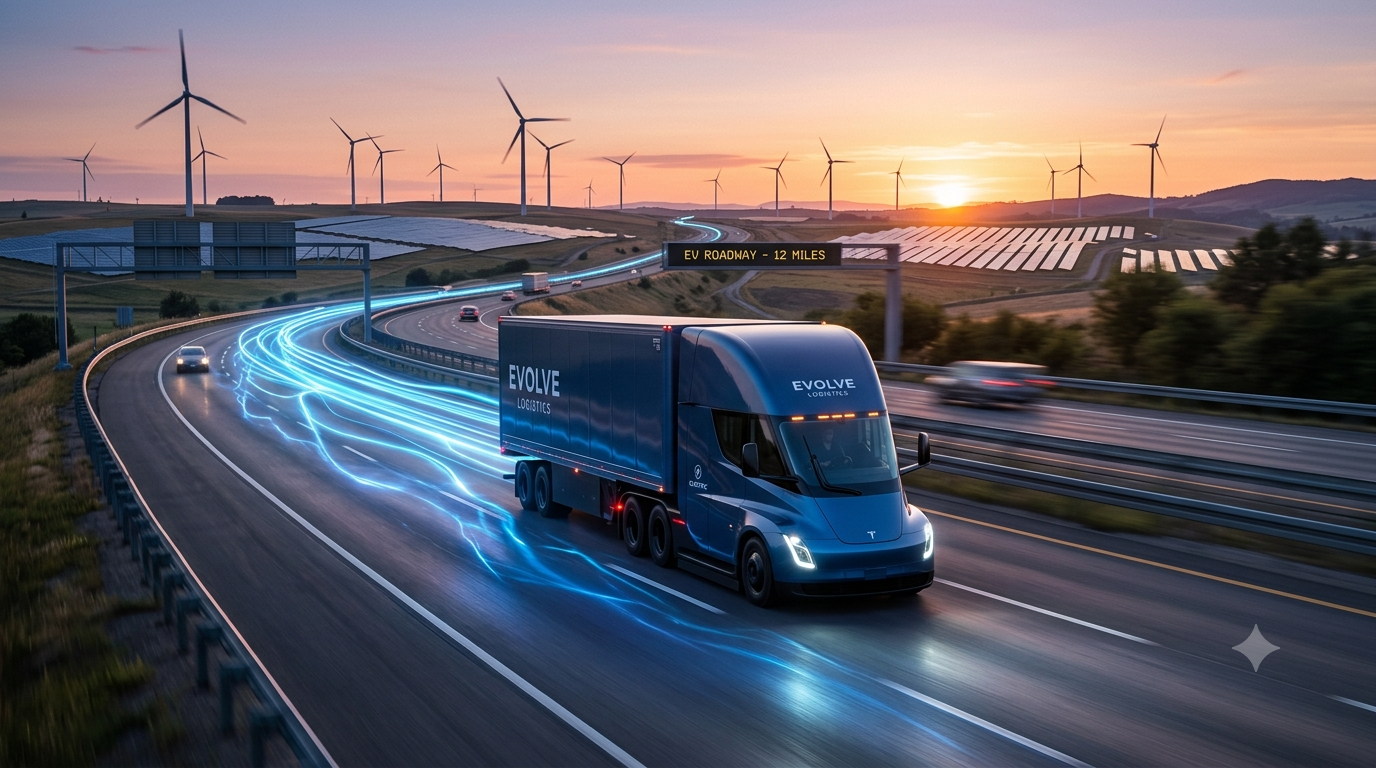

For more than a century, the deep rumble of a diesel engine has been the sound of freight on the move. That sound is starting to fade. Electric trucks, once dismissed as a niche experiment for delivery vans on short urban routes, are now pushing into long-haul lanes, construction sites, and ports at a pace that has caught even industry insiders off guard. The numbers tell the story bluntly: the global electric truck market is on track to grow from roughly $5.88 billion in 2025 to $8.54 billion in 2026, a jump of over 45% in a single year. Zoom out further, and some forecasts put the market at $72 billion by 2031, growing at a compound annual rate above 30%. This isn’t a passing trend anymore. It’s a full-scale transition, and it’s happening faster in some corners of the world than almost anyone predicted five years ago.
- What’s Actually Driving the Shift
- The Global Picture Looks Different Depending on Where You Stand
- Meet the Trucks: How the Leading Electric Models Compare
- Hydrogen Enters the Conversation
- Battery, Hydrogen, or Diesel: The Practical Trade-offs
- The Real Math: Total Cost of Ownership by Route Type
- The Price Tag Is Still a Real Barrier
- Charging Infrastructure Is the Quiet Bottleneck
- What This Means If You Operate or Manage a Fleet
- Conclusion
What’s Actually Driving the Shift
Three forces are converging to make electric trucks unavoidable rather than optional for fleet operators.
The first is regulation. Governments around the world are tightening emissions standards for commercial vehicles, and heavy trucks are a disproportionately large source of transport-related pollution despite being a small share of vehicles on the road. Cities are adding low-emission zones that restrict diesel access, and corporate “Scope 3” carbon commitments are forcing large shippers to demand cleaner fleets from their logistics partners. If a retailer promises net-zero emissions by a certain year, its trucking contractors don’t get to sit that promise out, and that pressure trickles all the way down to owner-operators bidding on contracts.
The second force is economics. Diesel prices remain volatile, and every spike reminds fleet operators how exposed they are to fuel markets they don’t control. Electric trucks sidestep that volatility almost entirely, and the price of the lithium-ion batteries that power them has been falling steadily for years. That decline is the single biggest reason electric trucks are becoming financially viable for more use cases every year, and it’s a trend battery manufacturers show no signs of reversing.
The third is simply proof of concept. Early pilot programs in ports, distribution centers, and urban delivery routes have quietly demonstrated that electric trucks can handle real workloads without falling apart or leaving fleets stranded. Once fleet managers see the trucks working reliably in someone else’s operation, day after day, the internal case for adoption gets a lot easier to make to a skeptical CFO.
The Global Picture Looks Different Depending on Where You Stand
Adoption is not happening evenly, and that unevenness is worth understanding if you’re trying to predict where this goes next.
| Region | 2025–2026 Snapshot | What’s Driving It |
| China | Electric trucks outsold LNG trucks for the first time in 2025; now over 25% of the truck market | Aggressive subsidies, domestic battery supply chain, years of manufacturing head start |
| United Kingdom / Europe | UK electric LCV registrations up 50% in 2025; TCO parity with diesel expected by 2030 | Low-emission zones, EU emissions targets, maturing charging networks |
| United States | Strong pilot activity and growing state-level incentives, but no single national mandate | California Clean Truck & Bus Voucher program, corporate sustainability pledges |
China is the clear frontrunner by a wide margin. That statistic bears repeating: electric trucks now outsell LNG-powered trucks in the country, a shift driven by aggressive government incentives, a dense domestic battery supply chain, and manufacturers who have been building electric commercial vehicles for years rather than months.
Europe is moving more cautiously but steadily. The United Kingdom already leads the continent in electric light commercial vehicle registrations, and total cost of ownership in the broader region is expected to reach parity with diesel trucks by 2030, the tipping point most analysts consider the real threshold for mass adoption rather than just early-adopter enthusiasm.
The United States sits somewhere in the middle: strong pilot activity, growing infrastructure investment, and a patchwork of state-level incentives, but without the singular national push seen in China. California’s Clean Truck & Bus Voucher program has become an unlikely bellwether, with the vast majority of applications going to a single manufacturer, a sign of how concentrated early demand still is.
Meet the Trucks: How the Leading Electric Models Compare
The electric truck conversation can feel abstract until you look at the actual vehicles fleets are buying today. Range, battery size, and price vary widely across manufacturers, and those differences determine which trucks fit which routes.
| Truck | Battery Size | Range | Charging | Approx. Price |
| Tesla Semi (Long Range) | 822 kWh | 500 miles | 1.2 MW Megacharger, 60% in ~30 min | $290,000 |
| Tesla Semi (Standard Range) | 548 kWh | 325 miles | 1.2 MW Megacharger | Lower than Long Range trim |
| Freightliner eCascadia | 550 kWh | 230 miles | Depot / DC fast charging | $300,000+ |
| Volvo VNR Electric | 564 kWh | 275 miles | Depot / DC fast charging | $300,000+ |
| Volvo FH Aero Electric | 540 kWh | 373 miles | Depot / DC fast charging | Not yet widely published |
The Tesla Semi currently leads the pack on both range and price, undercutting Freightliner and Volvo by tens of thousands of dollars while offering nearly double the range of some competitors. That combination has translated into real-world demand: in California’s incentive program, one manufacturer accounted for the overwhelming majority of applications between January 2025 and February 2026, while the rest of the major manufacturers combined for a small fraction of that. Whether that lead holds as Volvo, Freightliner, and other manufacturers ramp up production remains one of the more interesting subplots in the industry to watch over the next few years.
Hydrogen Enters the Conversation
Battery-electric trucks solve a lot of problems, but not every problem. Heavy long-haul routes demand range and fast refueling that battery technology still struggles to deliver economically, especially when the truck is carrying maximum payload and the extra battery weight starts eating into cargo capacity. That gap is where hydrogen fuel cell trucks are carving out a role.
Hydrogen fuel cell technology offers refueling times much closer to traditional diesel fill-ups, measured in minutes rather than tens of minutes, and better range retention under heavy loads, which makes it attractive for the toughest long-haul segments. Rather than one technology winning outright, the more likely outcome is a split: battery-electric trucks dominating regional and urban routes where charging infrastructure is easier to build out, and hydrogen filling the gap on the longest, heaviest routes. Manufacturers are increasingly hedging their bets by developing both, rather than betting the company on a single approach.
Battery, Hydrogen, or Diesel: The Practical Trade-offs
For a fleet manager comparing options today, the decision usually comes down to a handful of practical factors rather than ideology about which technology is “the future.”
| Factor | Battery-Electric | Hydrogen Fuel Cell | Diesel |
| Typical range | 230–500 miles | 400–600+ miles | 800–1,200+ miles |
| Refuel/charge time | 30–90 minutes (fast charging) | 10–15 minutes | 10–15 minutes |
| Upfront cost | High (2–3x diesel) | Very high | Baseline |
| Fuel/energy cost | Low and stable | Currently high | Volatile |
| Maintenance | Low (fewer moving parts) | Moderate | Higher over time |
| Infrastructure availability | Growing, uneven | Very limited | Universal |
| Best fit today | Regional/urban routes with depot charging | Long-haul, heavy payload (emerging) | Routes without electrification infrastructure |
This table is really a snapshot of where each technology sits on its own adoption curve. Diesel still wins on range and infrastructure availability, which is exactly why it remains dominant on the longest, most demanding routes. But its advantage on fuel cost and maintenance has essentially inverted, and that inversion is the whole reason this transition is happening at all.
The Real Math: Total Cost of Ownership by Route Type
Sticker price gets all the attention, but fleet managers who’ve actually run the numbers know that total cost of ownership tells a very different story, and that story changes depending on what kind of route the truck is running.
| Route Type | Fuel Cost per Mile (EV vs Diesel) | 5-Year Operating Savings | Break-Even on Purchase Premium |
| Regional/urban (150,000 mi/year, depot charging) | $0.14 vs $0.65 | $457,500 | Year 2 |
| Long-haul (public DC fast charging) | $0.28–$0.40 vs $0.65 | Narrower, offset by charging downtime | Diesel often wins in 2026 |
Across the industry overall, Class 8 long-haul electric trucks currently run about 13% lower in total cost of ownership than comparable diesel trucks, translating into savings of up to $200,000 over a truck’s lifetime, and that gap is projected to widen to roughly 50% by 2030 as batteries get cheaper and charging infrastructure matures. Maintenance is a big part of that advantage: electric trucks typically cost 40–60% less to maintain, since there are no oil changes, no diesel particulate filter regeneration cycles, and fewer brake replacements thanks to regenerative braking that does much of the stopping work electronically. Over a truck’s life, that adds up to $6,000 to $12,000 in avoided maintenance spend.
The catch is that this math flips depending on the route. On regional and urban routes with reliable depot charging, the numbers are already compelling enough that a purchase premium of roughly $100,000 pays for itself within about two years. On long-haul routes reliant on public fast charging, the picture is murkier: charging costs are higher, and 60 to 90 minutes of daily charging downtime eats into the productivity advantage a diesel truck has simply by not needing to stop as often. For 2026, most analysts agree diesel still wins on the longest routes, which is exactly why so much of the current electric truck deployment is concentrated in regional and drayage operations rather than coast-to-coast hauling.
The Price Tag Is Still a Real Barrier
None of this means the transition is painless. Electric trucks still cost two to three times more to purchase upfront than a comparable diesel model, and even the most competitively priced options on the market today sit well north of $250,000. For a small trucking company running on thin margins, that price gap is not a rounding error, it’s a decision that can determine whether the business survives a bad year.
What’s changing the math is total cost of ownership rather than sticker price. Lower fuel costs, reduced maintenance (electric drivetrains have far fewer moving parts than diesel engines, and no oil changes, filters, or exhaust systems to maintain), and government incentives are narrowing the gap over the vehicle’s operating life. In markets like China, that math already favors electric trucks outright. In Europe and North America, it’s a matter of when, not if, according to most industry forecasts, with parity expected by roughly 2030 in Europe.
Charging Infrastructure Is the Quiet Bottleneck
A truck is only as useful as its ability to refuel, and this is where the electric truck story gets complicated. Depot charging for local and regional fleets is relatively straightforward: trucks return to a home base overnight and charge on a predictable schedule, much like a delivery van plugging in after its shift ends. Long-haul trucking is a different problem entirely. It requires a network of high-power public charging stations along major freight corridors, capable of delivering enough energy in a reasonable window to keep drivers within legal hours-of-service limits.
Building that infrastructure is expensive and slow, and it requires coordination between utilities, governments, and private charging companies that don’t always move at the same speed or share the same incentives. Megacharger-class stations capable of the fastest charging speeds are still relatively rare outside a handful of pilot corridors. Every fleet operator considering long-haul electrification is watching this space closely, because the best truck in the world is useless if there’s nowhere to charge it on the route that actually matters to their business.
What This Means If You Operate or Manage a Fleet
For anyone running trucks for a living, the practical takeaway is this: electrification is worth evaluating now even if a full fleet switch isn’t realistic yet. Short, predictable routes with depot charging access are the easiest and most cost-effective place to start, and they’re where most successful early adopters have focused. Watch total cost of ownership rather than sticker price when comparing options, since the upfront number tells only part of the story. Pay close attention to regional incentive programs, which can shift the economics substantially depending on location, sometimes by tens of thousands of dollars per vehicle. Finally, keep an eye on hydrogen developments if your operation involves long-haul, heavy-payload routes, since that technology may end up being the better fit for those specific lanes rather than battery-electric, at least until battery energy density improves further.
Conclusion
The shift toward electric trucks is no longer a question of if but of how fast, and the answer to “how fast” is increasingly “faster than expected.” China has already crossed a meaningful adoption threshold, Europe is closing in on cost parity by the end of the decade, and hydrogen is emerging as a credible partner technology rather than a competitor. The barriers that remain, high upfront costs and uneven charging infrastructure, are real, but they are the kind of barriers that shrink with scale and investment, not permanent walls. For an industry that has run on diesel for over a hundred years, the pace of change happening right now is nothing short of historic, and the fleets that start evaluating electrification today will have a head start on the competitors still waiting for certainty that may never fully arrive.