
So you’ve decided to buy an RV. Welcome to one of the best decisions you’ll ever make — and one of the easiest to get wrong if you go in unprepared.
- Step One: Understand the RV Landscape
- Step Two: Set a Realistic Budget — All of It
- Step Three: New vs. Used — The Real Decision
- Step Four: Choosing the Right Size
- Step Five: Essential Features vs. Nice-to-Haves
- Step Six: Mistakes Every First-Time Buyer Should Avoid
- Step Seven: Navigating the Dealership
- Top Beginner-Friendly RV Brands in 2026
- Before You Buy — Final Checklist
- So, Where Do You Start?
The RV world is enormous. There are dozens of types, hundreds of brands, thousands of floor plans, and enough jargon to fill a textbook. First-time buyers who walk onto a dealership lot without a clear plan often leave with the wrong rig — too big, too small, too expensive, or simply not suited to how they actually camp. Nearly half of all first-time RV buyers report some form of buyer’s remorse. A significant portion resell within the first two years, often at a considerable loss.
This guide exists to make sure that doesn’t happen to you.
What follows is the complete beginner’s roadmap to buying your first RV in 2026 — from understanding the different types, to setting a realistic budget, to navigating the dealer, to the questions you absolutely must answer before you sign anything. By the end, you’ll know exactly what you’re looking for, what to avoid, and how to walk into any dealership with the confidence of someone who has done this before.
Life is short and the world is wide. The sooner you start exploring it, the better.
Simon Raven
Step One: Understand the RV Landscape
The single most common first-time buyer mistake is walking into a dealership without understanding what type of RV actually fits their lifestyle. There are fundamentally two categories — towable RVs and motorhomes — and getting this foundational choice right changes everything else.
Towable RVs
Towable RVs are pulled behind a separate vehicle and disconnected at the campsite, leaving your tow vehicle free to use independently. They come in four main types:
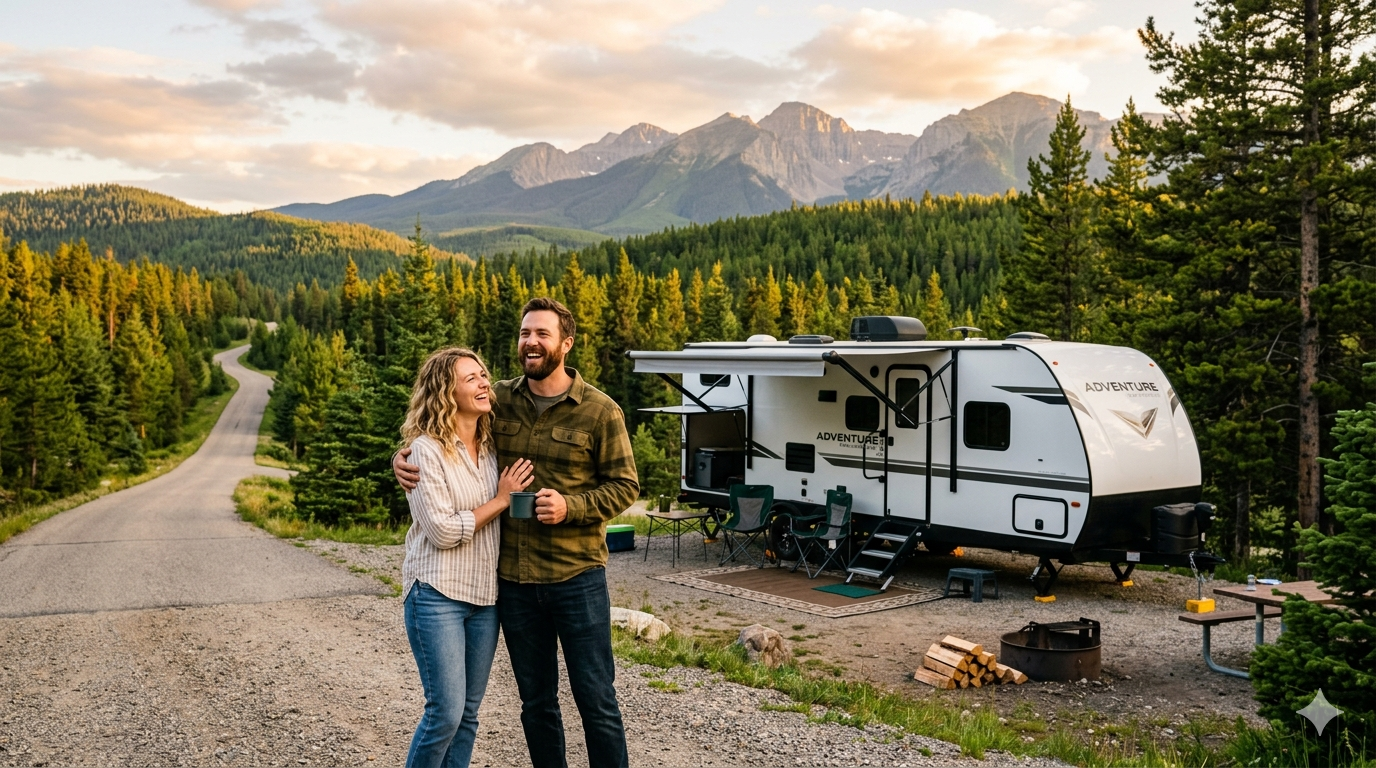
Travel Trailers are the most popular RV category in America — and for good reason. They connect to a standard hitch receiver, come in an enormous range of sizes (from compact teardrops under 15 feet to full bunkhouse models pushing 35 feet), and are towable by everything from mid-size SUVs to heavy-duty trucks depending on the model. For most first-time buyers, a lightweight travel trailer in the 22–28 foot range is the smartest starting point — manageable, affordable, and versatile.
Fifth Wheels connect through a kingpin hitch in the truck bed, creating a more stable tow and a bi-level interior with genuine residential feel. They require a pickup truck — typically a three-quarter-ton or one-ton — and are larger and more expensive than most travel trailers. Best suited for buyers stepping up from a previous RV rather than starting here.
Toy Haulers are travel trailers or fifth wheels with a rear garage section for hauling ATVs, motorcycles, dirt bikes, or other recreational equipment. The garage converts to additional living space at camp. A compelling option if powersports equipment is already part of your outdoor lifestyle.
Pop-Up Campers are the most affordable and easiest-to-tow entry point into RVing — lightweight, compact when folded, but requiring more setup at camp and offering less weather protection than hard-sided models. A reasonable starting point for buyers on a very tight budget.
Motorhomes
Motorhomes are self-contained — the living space and the engine are part of the same vehicle. No tow vehicle required; just climb in and drive.
Class A motorhomes are the largest and most luxurious — flat-front bus-style coaches ranging from 29 to 45 feet. Maximum space and residential amenities, but demanding to drive and expensive to operate. Not recommended as a first RV for most buyers.
Class C motorhomes are built on a van or truck cutaway chassis with a distinctive over-cab sleeping area. More manageable than a Class A, family-friendly, and available in a wide range of sizes and price points. The most practical motorhome choice for first-time buyers.
Class B motorhomes (van conversions) are the most compact drivable option — typically 19–24 feet, built on a full-size van chassis. Easy to drive, park almost anywhere, and surprisingly well-equipped. Best for couples or solo travelers who prioritize mobility over space.
The beginner’s recommendation: For most first-time buyers in 2026, a lightweight travel trailer in the 22–28 foot range is the sweet spot — affordable, manageable, easy to learn on, and upgradeable when you’re ready. If you prefer a drivable rig, a Class C motorhome is the most practical starting point.
Step Two: Set a Realistic Budget — All of It
The sticker price is where most beginners start their budget. It’s also where most beginners go wrong.
The purchase price of an RV is only one piece of the true ownership cost. Smart buyers plan for the complete financial picture, which includes depreciation, insurance, maintenance, storage, and operating expenses that can add 25–40% annually to the total investment. Ignoring these numbers is how buyers end up financially stretched and emotionally burned out within the first year.
Here’s what a realistic first-year RV budget looks like:
Purchase price: The most obvious cost. New travel trailers start around $20,000–$30,000 for quality beginner-friendly models. New Class C motorhomes start around $80,000–$100,000. Used options in the 3–7 year range offer significantly better value per dollar and have already absorbed the steepest depreciation.
Insurance: RV insurance is separate from auto insurance and is required. Costs vary by RV type, value, usage (part-time vs. full-time), and coverage level. Budget $500–$2,000 per year for a travel trailer; $1,500–$4,000+ for a motorhome. RV insurance only covers the camper itself, not the contents inside — speak with an insurance agent to work out the best policy for your specific needs.
Storage: Unless you have room on your own property, you’ll need paid storage. Indoor climate-controlled storage runs $100–$400/month depending on region and RV size. Outdoor covered or uncovered storage is $50–$150/month. Factor this in before buying — it’s a cost that runs year-round whether you’re camping or not.
Campground fees: Private RV parks with full hookups run $40–$100+ per night. State and National Park campgrounds are typically $20–$50/night. KOA and similar private chains fall in the middle. Budget realistically based on your actual camping frequency.
Maintenance and repairs: Budget 1–2% of the RV’s purchase price annually for maintenance — more for older or heavily used units. Common first-year items include roof sealant inspection and resealing, slide-out lubrication, battery replacement, and minor interior repairs.
Fuel: For motorhomes, fuel cost is significant — Class A and C coaches typically get 8–12 MPG. For towable owners, factor in the additional fuel consumption of your tow vehicle under load, which is typically 20–30% lower than unloaded highway mileage.
The honest number: Focusing only on the purchase price while ignoring insurance, maintenance, storage, fuel, and campground fees creates budget shock that can force unwanted early sales. Budget 25–40% of purchase price annually for total ownership costs.
Step Three: New vs. Used — The Real Decision
One of the most consequential choices you’ll make as a first-time buyer is whether to buy new or used. Both have genuine advantages — and genuine pitfalls.
The case for buying new: A new RV comes with full manufacturer warranty coverage, the latest floor plans and technology (solar prep, lithium battery compatibility, smart technology are increasingly standard in 2026), and the peace of mind of knowing the ownership history. Financing terms are typically better on new units. And there’s something genuinely exciting about being the first person to use every system in your RV.
The trade-off is significant: new RVs depreciate 10–20% in the first year, then level out over time. A buyer who finances with a modest down payment can find themselves in a negative equity position within the first 12–18 months — owing more than the RV is worth if life circumstances require an early sale.
The case for buying used: Used RVs in the 3–7 year range have absorbed most of their early depreciation, offering more stable asset value. A pre-purchase inspection by an independent RV technician — typically $200–$400 — is a worthwhile investment for any used purchase above $25,000. Used RVs also carry lower insurance premiums and often represent significantly better value per square foot than new equivalents at the same price point.
The risk with used is condition. Water damage, deferred maintenance, and worn mechanical systems are the most common issues in used RVs — and all of them are expensive to repair. A professional pre-purchase inspection is not optional on any used RV purchase above $15,000. It’s a $200–$400 investment that can identify thousands of dollars in issues before you’re legally committed to the purchase.
The beginner’s recommendation: For most first-time buyers, a used RV in the 3–5 year range from a reputable brand offers the best combination of value, modern features, and manageable depreciation risk. If peace of mind and warranty coverage are priorities, new is worth the premium — just go in clear-eyed about the depreciation reality.
Step Four: Choosing the Right Size
Size is the dimension that first-time buyers most consistently get wrong — and it’s the mistake that causes the most buyer’s remorse.
The most expensive mistake is purchasing a large, complex RV before developing the skills and experience to handle it confidently. This leads to stress, accidents, and often quick resale at a significant loss. For first-time buyers, starting in the 22–28 foot range is strongly recommended.
Here’s why size matters more than most buyers expect:
Campsite access. Many National Parks, state parks, and older private campgrounds have strict length limits — often 35 feet or less, sometimes as tight as 27 feet. A 40-foot coach locks you out of a significant portion of American campgrounds permanently. The smaller your first RV, the more options you have while you’re still learning your preferred camping style.
Drivability and parking. Every additional foot of length adds complexity when backing into a campsite, navigating narrow forest roads, or parking at a grocery store. The difference between a 24-foot travel trailer and a 30-foot travel trailer feels minor in the showroom and significant on the road.
Daily livability. Bigger isn’t always better for livability. A well-designed 24-footer often feels more comfortable than a poorly laid out 32-footer. Focus on floor plan first, size second.
Fuel and operating costs. For motorhomes particularly, size and weight directly drive fuel consumption. A larger Class A burns meaningfully more fuel per mile than a Class C of the same vintage.
The right size formula: Take the number of people who regularly camp with you, add one, and find the smallest floor plan that comfortably accommodates that number. You can always move up. You can’t easily move down once you’ve committed.
Step Five: Essential Features vs. Nice-to-Haves
Modern RVs in 2026 come packed with features — some of which significantly improve your camping experience, and some of which you’ll use twice and forget about. Understanding the difference before you walk into a dealership prevents you from paying for things you don’t need and overlooking things you do.
Features worth prioritizing:
Adequate fresh water and tank capacity. A larger fresh water tank (40+ gallons) and black/gray water tanks give you meaningful off-grid flexibility. If you plan to boondock or dry camp, tank capacity matters as much as any other spec.
Solar prep and lithium battery compatibility. In 2026, solar prep is increasingly standard on new RVs and should be treated as a minimum requirement for any buyer interested in camping away from full hookups. A factory-prepped solar system is significantly cheaper to complete than a retrofit.
Enclosed and heated underbelly. If you plan to camp in shoulder seasons or cold weather, an enclosed, heated underbelly protects your fresh and gray water lines from freezing. Without it, fall and spring camping in most of the country becomes logistically complicated.
Backup camera. Non-negotiable for first-time drivers of any towable or drivable RV. Backing into a campsite without one is stressful and risky. Many 2026 models include it standard — confirm before buying.
Slide-outs. Slides dramatically expand interior living space when parked. One or two slides on a travel trailer transform the floor plan. The trade-off is additional mechanical complexity and maintenance. For first-timers, a single slide on a quality platform is a reasonable balance.
Features you can live without initially:
Outdoor kitchens, theatre seating, multiple TVs, and elaborate entertainment systems are enjoyable but not necessary for a positive first RV experience. These can be upgraded or added in future RVs once you understand exactly how you camp.
Step Six: Mistakes Every First-Time Buyer Should Avoid
Learning from others’ mistakes is far less expensive than making them yourself. These are the most common — and most costly — errors first-time RV buyers make:
Buying more RV than you can tow. One of the most common mistakes first-time RV buyers make is purchasing a trailer that exceeds their vehicle’s towing capacity. Before choosing a towable RV, verify that your truck or SUV can safely handle the weight — and never rely solely on salesperson estimates when evaluating towing power. Check both tow rating AND payload capacity. Payload is often the actual limiting factor once passengers and gear are loaded.
Skipping the pre-purchase inspection on a used unit. Even a visually clean used RV can have hidden water damage, deferred maintenance, and worn systems. A $200–$400 professional inspection has saved countless buyers from five-figure repair surprises.
Buying based on the showroom experience. An RV that looks beautiful in a well-lit dealer showroom can feel completely different after 48 hours of actual use. Spend at least 30 minutes walking through any RV you’re seriously considering. Simulate daily routines — cooking, sleeping preparation, and moving around — to identify potential layout issues before committing.
Ignoring the total cost of ownership. The purchase price is just the beginning. Insurance, storage, campground fees, maintenance, and fuel are all ongoing costs that need to be planned for, not discovered.
Rushing the decision. There is no urgency to buy a specific RV today. Inventory changes constantly. Walking away from a dealership to think is not a mistake — it’s good judgment. The right RV will still be there, or a better one will have arrived.
Not renting first. Trying out an RV through rental services before buying provides invaluable experience. Renting an RV allows you to test different types and sizes to determine what works best for your needs — and can save you from costly mistakes in your eventual purchase.
Step Seven: Navigating the Dealership
Walking into an RV dealership prepared changes the entire dynamic of the buying experience. Here’s what to know before you go:
Do your research before you arrive. Know the type of RV you want, the approximate size range, the features that matter to you, and a realistic budget including all ownership costs. A buyer who has done their homework is far harder to upsell than one who arrives open to anything.
Get pre-approved for financing before you visit. Shopping around for RV financing before setting foot on the lot gives you negotiating leverage and prevents you from being surprised by dealer financing rates. Compare rates from banks, credit unions, and RV lenders — and read the fine print on loan terms to understand the total cost over time.
Ask about all-in pricing upfront. Freight charges, dealer prep fees, and documentation fees can add $2,000–$5,000 to the sticker price. Ask for the out-the-door price — the total amount you’ll actually pay — before evaluating any offer.
Negotiate the price, not the monthly payment. Dealers who anchor negotiations on monthly payments have more flexibility to obscure the total cost of the loan. Always negotiate the purchase price first, then discuss financing terms separately.
Understand the warranty. New RVs come with manufacturer warranties — typically 1–3 years on the structure and appliances. Ask specifically what is covered, what requires factory service vs. any authorized dealer, and how warranty claims are handled if you’re far from your selling dealer.
Don’t feel pressured. A reputable dealer will give you time to think, compare, and ask questions without artificial urgency. High-pressure tactics are a signal — not a reason to rush.
Top Beginner-Friendly RV Brands in 2026
Not all RV brands are equal in build quality, warranty support, or beginner-friendliness. These are the names that consistently earn high marks for first-time buyers:
- Jayco — Most trusted entry-level brand for first-time buyers; solid construction, honest warranty support, wide dealer network; Jay Flight lineup is the go-to starting point for travel trailers
- Grand Design — Best build quality at a mid-range price; exceptional customer satisfaction scores; Imagine series is a top recommendation for buyers ready to invest in quality from day one
- Forest River — Widest variety of floor plans and price points; reliable value across the lineup; Salem and Wildwood series are strong beginner options
- Keystone — Strong mid-range value; Cougar and Montana lines are popular for good reason; solid construction at accessible prices
- Winnebago — Best brand for beginner motorhome buyers; legendary reliability, strong dealer network, and the Minnie Winnie Class C is a standout first motorhome
Before You Buy — Final Checklist
“The world is a book, and those who do not travel read only one page.” — Saint Augustine
Answer every one of these before you commit:
Have I resisted the pressure to decide today if I’m not ready?
What type of RV fits my camping style — towable or drivable?
What does my tow vehicle actually rate for — including payload?
Have I set a complete budget including insurance, storage, fuel, and maintenance?
Have I considered a used RV in the 3–7 year range for better value?
Have I walked through the specific unit and simulated daily use?
Have I arranged for a professional inspection on any used unit over $15,000?
Am I buying a size I can comfortably handle as a first-time driver?
Have I gotten pre-approved for financing and compared rates?
Have I asked for the full out-the-door price — not just the sticker?
So, Where Do You Start?
Here’s the honest answer for 2026: start smaller than you think you need, spend less than you think you should, and upgrade when you know exactly what you want.
The majority of experienced RV owners who have been at it for five or more years will tell you the same thing: their first RV was too big, too complex, or too expensive. The ones who started with a manageable, affordable rig — learned on it, camped on it, figured out exactly what they actually needed — are the ones who upgraded with confidence and kept RVing for decades.
Your first RV doesn’t have to be your dream RV. It has to be the one that gets you on the road, teaches you how you actually camp, and gives you the foundation to buy your dream RV next.
The road is waiting. Start right, and it’ll take you everywhere you want to go.
Ready to begin your RV journey? Visit our showroom and let our team walk you through every type, every floor plan, and every budget option — no pressure, no rush, just honest guidance to help you find the perfect first RV.