
It’s the first real decision every RV buyer faces — and it’s the one that shapes everything that follows. New or used. Clean slate or proven value. Full warranty or better price.
- The State of the RV Market in 2026
- The Case for Buying New
- The Case for Buying Used
- The Real Risks — Honestly Assessed
- Head-to-Head: New vs. Used at a Glance
- The Depreciation Math — Run It Before You Decide
- What the 2026 Market Recommends by Budget
- Before You Decide — The Five Questions That Matter
- The Bottom Line
There is no universally right answer. But there is almost always a right answer for you — and finding it requires an honest look at your budget, your camping habits, your mechanical comfort level, and what you actually value in an RV ownership experience.
Both options have passionate advocates in the RV community, and both produce happy owners. The difference is in understanding the real trade-offs — not the surface-level ones — and matching that understanding to your specific situation. A buyer who goes new when they should have gone used loses money. A buyer who goes used when they should have gone new loses time — and sometimes sanity.
This guide walks through every dimension of the new vs. used decision with the clarity and honesty you need to make the right call in 2026.
An investment in knowledge pays the best interest.
Benjamin Franklin
The State of the RV Market in 2026
Before diving into the new vs. used comparison, it helps to understand the market context — because 2026 is a different buying environment than it was two or three years ago.
RV prices surged dramatically during 2020–2022 as pandemic-driven demand outpaced supply. That surge has moderated significantly. In 2026, the market has stabilized — new RV prices have softened from their pandemic peaks, and used inventory has expanded as buyers who purchased during the boom years begin trading up or exiting the lifestyle.
For buyers, this means both sides of the new vs. used equation look better than they did at the height of the surge. New RVs are priced more competitively. Used RVs are more abundant, and lightly used units from 2021–2023 are available at meaningful discounts from their original purchase prices. The depreciation hit that early-pandemic buyers absorbed has already happened — which is exactly why the 3–5 year old used market represents such strong value in 2026.
In most used travel trailers, prices range from $14,000 to $35,000 depending on age and condition. New entry-level travel trailers start around $20,000–$30,000 for quality beginner-friendly models. The overlap between a loaded used trailer and an entry-level new trailer at similar price points is where the real decision gets interesting.
The Case for Buying New
Full Manufacturer Warranty — Real Peace of Mind
The single most compelling argument for buying new is the warranty. Most new RVs come with manufacturer warranties covering major components for 1–3 years — structure, appliances, plumbing, electrical, and mechanical systems. For a first-time buyer who isn’t yet fluent in RV maintenance, the assurance that unexpected repair costs are covered removes a significant source of financial anxiety.
This matters more than it sounds. RVs are complex machines — far more so than cars. They combine living quarters, plumbing, electrical systems, gas appliances, and mechanical drivetrain components (in the case of motorhomes) into a single unit. When something breaks in the first year, a warranty transforms what could be a $2,000 repair bill into a covered service appointment.
Even brand-new RVs can have issues — loose trim, minor leaks, appliance adjustments — as they settle in with use. Having those addressed under warranty rather than out of pocket is a genuine financial benefit of buying new.
Latest Technology, Features, and Floor Plans
In 2026, new RVs arrive with meaningful technology improvements that older used models simply don’t have. Solar prep and lithium battery systems pre-installed are common even in mid-range new units. App-connected monitoring, improved backup cameras, and smart technology features are standard or near-standard across most new model lines.
Floor plans have also improved significantly. RV manufacturers have responded to real-world owner feedback by redesigning kitchens, optimizing storage, improving slide-out quality, and refining layouts in ways that 2018 or 2019 models simply don’t reflect. If a specific modern floor plan is important to your camping experience, only a new RV can deliver it.
No Mystery History
A new RV has no previous owner, no hidden storage of water damage, no deferred maintenance left by someone else, and no lifestyle clues embedded in its condition. You are the first person to use every system, every appliance, every slide-out. That clean slate matters to buyers who want certainty about what they’re getting — and it’s a psychological comfort that has real value for many owners.
Better Financing Terms
Lenders generally offer more favorable interest rates and longer terms for new RVs. The rate advantage between new and used can be 1–3%, which on a $50,000 loan over 15 years represents thousands of dollars in total interest cost. For buyers who are financing — which is most buyers — this rate difference partially offsets the higher purchase price.
Customization Freedom
When buying new from a dealer, buyers can often choose floor plan, color scheme, décor package, and optional features before the unit arrives. This customization freedom disappears completely with used — you buy whatever the previous owner chose. For buyers with specific layout requirements, accessibility needs, or particular feature priorities, new is the only path to getting exactly what they want.
The Case for Buying Used
Significantly Lower Purchase Price
The most obvious advantage — and the one most buyers consider first — is price. Used RVs typically save buyers 30% or more compared to equivalent new models. A 3-year-old Grand Design Imagine that cost $42,000 new may be available for $28,000–$32,000 used. That $10,000–$14,000 difference funds a lot of camping trips, covers years of maintenance, and reduces the financial risk of discovering that full-time RVing isn’t actually the lifestyle you thought it would be.
For first-time buyers particularly, a lower entry price reduces the cost of getting the decision wrong. If you buy new and discover that you camp three times a year rather than the twenty you planned, you’ve over-invested significantly. A used RV in the same scenario reduces the financial consequence of that discovery.
Slower Depreciation — Stronger Equity Position
New RVs depreciate 10–20% in the first year, then level off. A 3-year-old RV has already absorbed the steepest part of that depreciation curve. When you buy a used unit at a price that reflects its current value, your subsequent depreciation exposure is significantly lower — which means your equity position is stronger if you need to sell or trade in.
RVs depreciate anywhere from 35% to 38% within the first five years of construction. Buying at the 3-year mark means the previous owner absorbed most of that hit, not you.
More RV for Your Budget
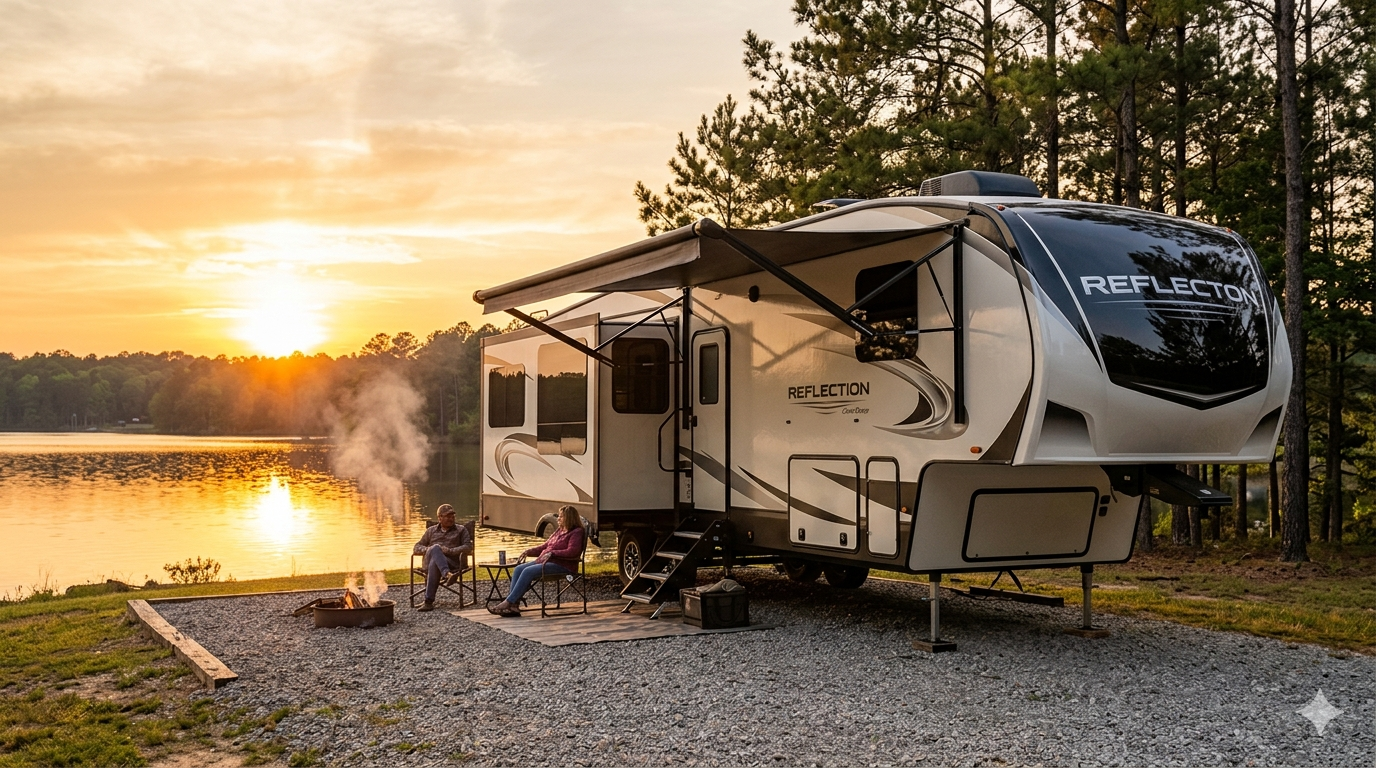
The used market allows buyers to access higher-end models, larger floor plans, and premium brands at price points that would only buy entry-level quality new. A $45,000 budget that buys a basic new travel trailer might buy a 3-year-old Grand Design Reflection fifth wheel used — a dramatically better machine in terms of build quality, features, and livability. For buyers who know exactly what quality level they want, used often delivers it at a more accessible price.
Previous Owner May Have Already Fixed the Issues
New RVs have a well-documented “shake-out” period — the first year of ownership often involves handling minor issues as the unit settles: loose screws, trim adjustments, appliance calibration, and seal checks. On a used unit purchased after 2–3 years, the original owner has typically already worked through that list. The bugs are worked out. The known issues are either fixed or disclosed. Some used RVs also arrive with bonus accessories — hoses, leveling blocks, sway bars, upgraded batteries — that the first owner added and left with the unit.
Lower Insurance Premiums
Used RVs typically carry meaningfully lower insurance premiums than new equivalents. Insurance rates reflect replacement value — a used RV costs less to replace, so it costs less to insure. For annual budget planning, the insurance premium difference between a new and used RV can be $500–$1,500 per year depending on the unit.
The Real Risks — Honestly Assessed
Neither option is risk-free. Understanding what each risk actually looks like in practice is more useful than a generic pros/cons list.
Risks of Buying New
Immediate and significant depreciation. New RVs can lose 20–30% of their value in the first year. A buyer who finances with a modest down payment can find themselves in negative equity — owing more than the RV is worth — within 12–18 months. This only matters if you need to sell or the RV is totaled, but it’s a real financial position to understand before committing.
First-year quality issues are common. Even the best RV brands produce units that need attention in the first year. The RV manufacturing process is less automated than automobile production, and fit-and-finish issues are more common. The warranty covers these — but dealing with warranty claims takes time, requires dealer visits, and can disrupt camping plans.
Potential over-investment for casual users. Buyers who discover they camp less than anticipated have over-invested in a depreciating asset. The premium paid for new evaporates faster when the unit sits in storage more than it sits on a campsite.
Risks of Buying Used
Hidden water damage is the #1 risk. Water intrusion — through failed roof seals, slide-out seals, or window gaskets — is the most common and most expensive problem in used RVs. It’s not always visible on casual inspection. A professional pre-purchase inspection by an independent RV technician ($200–$400) is not optional on any used RV purchase above $15,000. It’s the single most important thing a used RV buyer can do to protect their investment.
Deferred maintenance from the previous owner. Not every RV owner maintains their unit properly. Deferred maintenance on roof seals, slide mechanisms, battery systems, and tires can create repair bills that appear shortly after purchase. Service records from the selling dealer or the previous owner provide meaningful reassurance — their absence is a warning sign.
Financing challenges on older units. Most lenders place age restrictions on used RV financing — typically 10–15 years as a maximum. Older units may only qualify for personal loan financing at higher rates. Confirm financing availability on any used unit you’re seriously considering before becoming emotionally invested in the purchase.
No warranty protection. On a used unit with an expired factory warranty, every repair is out of pocket. Extended warranty policies are available and worth evaluating — one couple who went used reported that an extended warranty they purchased essentially broke even over their first few years of ownership, and they’d buy one again.
Head-to-Head: New vs. Used at a Glance
| New RV | Used RV (3–7 years) | |
| Purchase price | Higher | 20–40% lower |
| Depreciation | 10–20% year one | Mostly absorbed already |
| Warranty | Full manufacturer 1–3 years | Expired or limited |
| Condition | Pristine, known | Variable, requires inspection |
| Latest features | Yes — solar, smart tech, new floor plans | Depends on model year |
| Financing rates | Better rates typically | Slightly higher, age restrictions |
| Customization | Yes — floor plan, colors, options | Buy what’s available |
| Insurance | Higher premiums | Lower premiums |
| Risk level | Lower | Higher without inspection |
| Value for money | Lower per square foot | Higher per square foot |
| Best for | Warranty peace of mind, modern tech, long-term use | Budget-conscious buyers, first-timers, value seekers |
The Depreciation Math — Run It Before You Decide
This is the calculation most buyers skip — and it’s the most important one in the entire new vs. used decision.
Example: $50,000 new travel trailer vs. $35,000 used equivalent (3 years old)
New buyer year one: $50,000 purchase → $40,000–$45,000 value after year one (10–20% depreciation) → immediate equity loss of $5,000–$10,000.
Used buyer year one: $35,000 purchase → $32,000–$33,000 value after year one (slower depreciation curve already absorbed) → much smaller equity loss.
The used buyer starts with $15,000 less debt, loses less value in year one, and has $15,000 available for camping, upgrades, or simply financial stability.
The new buyer has a warranty, modern features, and the clean slate — and those things have genuine value. But they cost $15,000 in purchase price difference plus the accelerated depreciation hit. Whether that’s worth it depends entirely on how much those advantages are worth to you specifically.
What the 2026 Market Recommends by Budget
Based on current pricing and inventory across the US market, here’s the practical guidance for 2026 buyers:
Under $25,000: Used is the only path to a quality RV at this price point. Look for Forest River, Keystone, or Jayco travel trailers in the 3–7 year range from a dealer who inspects units before resale.
$25,000–$45,000: The most competitive new vs. used decision range. A $35,000 budget buys an entry-level new travel trailer or a 3-year-old mid-range model from a premium brand like Grand Design or Jayco. The premium brand used option typically delivers more quality per dollar.
$45,000–$75,000: Strong argument for used in this range — access to premium fifth wheels and well-equipped motorhomes at prices that represent genuine value. New at this level delivers the warranty and modern features but at the cost of immediate depreciation on a significant investment.
$75,000+: Serious full-timers and long-term owners can justify new at this level — the warranty coverage on a complex, high-value machine has real financial value, and modern features in premium Class A and Class C motorhomes represent meaningful improvements over older models.
Before You Decide — The Five Questions That Matter
“The road is there, it will always be there. You just have to decide when to take it.” — Jackson Browne
Answer these honestly before making your decision:
- How long do I plan to keep it? Long-term owners (5+ years) justify new more easily — the warranty value and depreciation hit spread over more years. Short-term buyers (2–3 years) almost always do better used.
- How much will I actually use it? Three camping trips per year means the warranty premium is less justified than twenty trips. Match the investment level to the actual use.
- Am I comfortable with mechanical ownership? Buyers who are handy, or willing to learn basic RV maintenance, navigate used ownership far more confidently. Buyers who want to call a dealer when something beeps unfamiliarly benefit from the warranty relationship that comes with new.
- Have I budgeted for a professional inspection on any used unit? If the answer is no, either add it to the plan or reconsider used. Without an inspection, used RV buying is genuinely risky.
- Have I rented or borrowed before buying? Trying out an RV before buying provides invaluable experience and can prevent a costly mismatch between what you imagined and what you actually want.
The Bottom Line
“The world is a book, and those who do not travel read only one page.” — Saint Augustine
Here’s the honest answer for 2026: for most first-time buyers, a quality used RV in the 3–5 year range from a reputable brand, purchased with a professional inspection, represents the best combination of value, capability, and manageable financial risk.
The used path delivers more RV per dollar, a softer depreciation curve, lower insurance, and the wisdom of buying after someone else has worked out the first-year issues — all at a price that makes the RV lifestyle accessible without over-committing financially.
Buy new if: you’re a long-term owner who values warranty peace of mind, you want a specific modern floor plan or technology package that isn’t available used, you’re considering full-time RVing on a premium unit, or the financial premium genuinely fits within your budget without stretching it.
Buy used if: you’re a first-time buyer learning your camping preferences, your budget is firm, you’re willing to invest $200–$400 in a pre-purchase inspection, or you want the most RV capability per dollar available in 2026.
Your first RV doesn’t have to be your dream RV. It has to be the one that gets you on the road — where the real education begins.